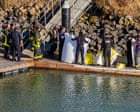
The capsizing of the 50-foot vessel Volare near Alcatraz Island on July 14, 2026, exposes a critical mismatch between vessel geometry, environmental fluid dynamics, and human physical tolerance. When a three-deck pontoon pleasure craft carrying 20 passengers rolled and sank, leaving one dead and three missing, it demonstrated how quickly a maritime excursion can transition from structural stability to a catastrophic failure cascade. Resolving why this disaster occurred requires moving past superficial reports of "rough seas" to examine the hard physics of hydrostatics, microclimates, and human thermoregulation in the San Francisco Bay.
The Triple Threat of San Francisco Bay Hydrology
To understand why the waters 600 yards off Alcatraz Island are uniquely hostile, one must analyze the bay’s hydrological bottleneck. The San Francisco Bay functions as a massive drainage basin for California's interior river systems, constricted at its exit by the narrow gap of the Golden Gate. This geography generates three distinct compounding forces:
- The Funnel Effect (Venturi Acceleration): Marine winds blowing from the Pacific Ocean are compressed as they pass beneath the Golden Gate Bridge. This wind accelerates rapidly as it enters the wider bay, driving sustained, localized gusts directly toward Alcatraz.
- The Current-Wave Interaction: Strong ebb tides—water rushing out of the bay toward the ocean—frequently collide head-on with incoming ocean swells and westerly winds. This counter-directional energy creates steep, short-period waves. Unlike long, predictable ocean swells, these "choppy" bay waves feature high frequency and abrupt faces, which deny vessels time to recover their equilibrium.
- The Tidal Jet: Near Alcatraz, currents can exceed 4 to 5 knots. A vessel that loses propulsion or experiences steering compromise is instantly subject to rapid drift, shifting it from relatively shielded shore zones into raw, unmitigated chop within minutes.
On the afternoon of the incident, Richmond Police Department marine units reported swells of up to five feet, driven by winds blowing directly under the Golden Gate toward Alcatraz. For a vessel navigating these waters, hitting these short-period swells sideways (beam-to) creates a severe, immediate threat of capsizing.
Hydrostatic Instability: The Failure Mechanics of a Multi-Deck Pontoon
The Volare was documented as a 50-foot, three-story pontoon-style pleasure craft with a cabin and an upper deck. While pontoon configurations offer exceptional primary stability in calm, flat inland waters—such as the delta channels of Stockton, California, where the vessel was registered—they behave poorly under dynamic offshore forces.
The structural vulnerability of this design can be mapped through three physical variables:
1. The Lever Arm and Metacentric Height ($GM$)
A vessel's resistance to tilting (heeling) is governed by its metacentric height ($GM$), which is the distance between its center of gravity ($G$) and its metacenter ($M$).
$$\text{Stability} \propto GM = KB + BM - KG$$
Where $KB$ is the center of buoyancy, $BM$ is the transverse metacentric radius, and $KG$ is the height of the center of gravity above the keel.
By adding a cabin and an upper deck to a pontoon hull, the builder drastically increases the height of the center of gravity ($KG$). When a high concentration of passengers moves to the upper decks—such as during a memorial service to scatter ashes—$KG$ rises even further, shrinking the $GM$ value. A small $GM$ means the vessel has a weak righting arm; once it begins to heel under the force of a wave, it lacks the rotational force required to snap back upright.
2. The Sail Area and Wind Heeling Moment
A three-deck superstructure creates a massive lateral surface area, acting as a sail. Strong winds hitting the side of the vessel exert a continuous heeling moment. When combined with five-foot waves hitting the hulls laterally, the lateral wind force can easily exceed the vessel's remaining righting energy.
3. The Buoyancy Boundary and Water Ingress
Pontoons rely on sealed, segmented air chambers to maintain flotation. If a pontoon boat is driven bow-first into a steep wave (pitchpoling) or takes a wave over the side, water can pool on the flat, wide deck. This is known as the "free surface effect." Water moving freely across a flat deck drastically destabilizes the vessel because the liquid shifts toward the direction of the tilt, accelerating the roll rate.
Once the deck edge of a pontoon submerges, the boat loses its water-clearing capability. The motor running and leaking fuel upon rescuers' arrival indicates that the vessel's propulsion was active during the initial phase of the roll, potentially driving the listing vessel deeper into the water column before it inverted.
The Human Cost Function: The Physiology of Cold Water Shock
The immediate cause of death and the ongoing danger to the missing survivors is not merely physical trauma from the capsize, but the rapid onset of cold water shock and subsequent hypothermia.
The water temperature in the San Francisco Bay in mid-July hovers between 55°F and 59°F (12°C to 15°C). Sudden immersion in water below 60°F triggers an involuntary physiological response sequence that follows a highly predictable timeline:
Phase 1: The Cold Shock Response (Minutes 0 to 3)
Immediate immersion triggers a massive gasp reflex, followed by hyperventilation. If a victim’s head is underwater during the initial gasp, they will inhale water, leading to immediate drowning. The sudden constriction of blood vessels also causes a spike in heart rate and blood pressure, which can trigger cardiac arrest in vulnerable individuals.
Phase 2: Functional Disability (Minutes 3 to 30)
As the body attempts to protect its core temperature, it restricts blood flow to the extremities. Skeletal muscles and nerves in the arms and legs cool rapidly. Within 10 to 15 minutes, victims lose manual dexterity, making it impossible to grip floating debris, pull themselves onto a life ring, or put on a life jacket. This explains why several passengers entered the water without life jackets and could not secure them afterward.
Phase 3: Hypothermia (Hour 1 and Beyond)
True hypothermia—the drop of core body temperature below 95°F (35°C)—takes at least 30 to 60 minutes to develop in adults, depending on body mass and protective clothing. Once hypothermia sets in, cognitive function declines, followed by unconsciousness and eventual cardiac failure.
Tactical Search and Rescue Limits in High-Velocity Estuaries
When the San Francisco Fire Department and U.S. Coast Guard initiated the search for the three missing individuals, they faced a highly complex search area determined by active drift vectors. Emergency responders cannot simply search the site of the capsizing; they must project where a body will travel over time.
To map the search area, the Coast Guard uses the Self-Locating Datum Marker Buoy (SLDMB) alongside tidal prediction software:
                  [Capsizing Point: 600 yards off Alcatraz]
                                     |
                                     v
                        +--------------------------+
                        |  Local Tidal Current     | (4+ Knots, Ebbing)
                        |  + Wind Shear Vector     | (Westerly, 15-20 Knots)
                        +--------------------------+
                                     |
                                     v
                        [Resultant Drift Vector]
                                     |
                                     v
                   [Search Target Zone: West of Golden Gate]
Because the incident occurred at 3:30 p.m. during an active tidal phase, the current immediately swept any floating objects westward. By Tuesday evening, search assets—including the 87-foot Coast Guard Cutter Barracuda, local marine units, and fixed-wing aircraft—had shifted their primary search zone to the open ocean west of the Golden Gate Bridge.
Thermal imaging cameras (FLIR) mounted on aircraft are highly effective at night, but their utility is limited by "cluttered" water surfaces, floating debris from the vessel (such as cushions and chairs), and the rapid cooling of a victim’s exposed head to match the ambient water temperature.
Operational Lessons for Recreational Fleet Management
The Volare disaster demonstrates that recreational boat operators frequently underestimate the transition from protected inland waters to volatile marine estuaries. Operators transitioning from flat-water river systems to the San Francisco Bay must implement three rigorous protocols to prevent similar stability failures:
- Dynamic Load Assessment: Calculate passenger weight distribution dynamically. High-passenger vessels must enforce strict limits on upper-deck occupancy, particularly when operating in wind-exposed transit zones.
- Environmental Go/No-Go Gateways: Establish firm limits on wind speed and wave height based on hull design. A three-story pontoon boat should not transit past the harbor line if bay swells exceed three feet or if wind speeds create a heeling risk.
- Pre-emptive Life Jacket Deployment: In water temperatures below 60°F, life jackets must be worn before entering rough waters, not stored in cabins. Once a vessel capsizes, physical shock and rapid muscle cooling prevent passengers from retrieving or donning flotation devices.