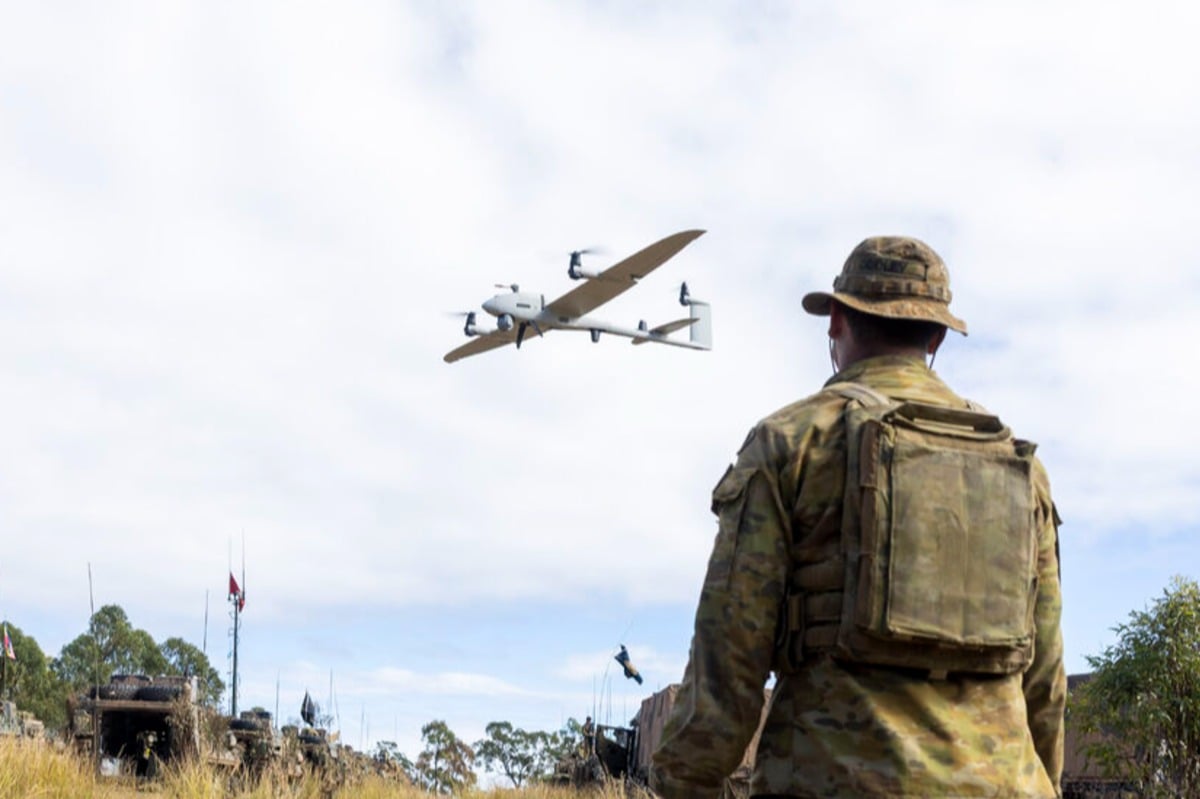
The traditional model of land reconnaissance is structurally flawed in high-intensity, peer-on-peer conflicts. Historically, reconnaissance units relied on mounted or dismounted elements executing direct observation—a vector that inherently places human operators within the enemy’s direct-fire envelope and exposes the force to rapid compromise. Data emerging from European theater operations confirms that a transparent battlefield, saturated with multi-spectral surveillance, invalidates legacy scouting doctrine. Australia's deployment of the Quantum Systems Vector AI fixed-wing uncrewed aerial system (UAS) during Exercise Southern Jackaroo signals a structural shift from risk-heavy, human-centric scouting to automated, stand-off target acquisition.
The integration of this system is not a mere equipment upgrade; it represents an explicit response to the attrition metrics and electronic warfare realities observed in Ukraine. To understand why this shift is mandatory rather than optional, defense planners must analyze the operational math governing modern reconnaissance, weapon systems integration, and signature management.
The Tri-Pillar Architecture of Fixed-Wing Asymmetry
Reconnaissance efficiency is governed by three interdependent operational vectors: depth, endurance, and computational independence. Standard quadcopters and small multi-rotor assets are constrained by battery physics, restricting their utility to line-of-sight tactical scouting. The implementation of a fixed-wing architecture fundamentally modifies the operational cost function via three specific mechanisms:
- Deep Deep-Target Penetration: The Vector AI platform possesses an operational radius exceeding 60 kilometers. This reach transforms the asset from a front-line observer into a deep-theater interdiction tool. By penetrating beyond the tactical forward line of enemy troops, the platform identifies high-value infrastructure, logistical nodes, and command elements.
- The Disruption Loop: Neutralizing forward combat units is an inefficient use of deep reconnaissance asset capacity. The strategic value lies in breaking the enemy's logistical chain. Disruption of rear elements degrades the adversary’s structural capacity to coordinate movements, resupply forward lines, and sustain artillery tempo.
- Operational Survivability: Multi-rotor platforms generate high acoustic and visual signatures due to constant rotational velocity adjustments. Fixed-wing platforms utilize aerodynamic lift, reducing energy consumption and acoustic signatures, allowing the asset to remain undetected while mapping environments in real time.
The Algorithmic Attrition Cycle
The primary bottleneck in legacy drone operations is the cognitive load placed on the human operator. Traditional systems require a pilot to manually steer the aircraft while simultaneously scanning a video feed for anomalies. In a contested environment, this model fails due to human fatigue and the speed of modern engagement cycles.
[Raw Multi-Spectral Feed]
          │
          ▼
[Edge-Computing AI Layer] ──(Autonomous Object Detection & Classification)
          │
          ▼
[Target Coordinates Extracted]
          │
          ▼
[Digital Artillery Integration (Link 16 / Advanced Data Links)]
          │
          ▼
[Kinetic Strike Delivery (Deep Fire / Tube & Rocket Artillery)]
The introduction of onboard machine learning software changes this dynamic entirely. The drone operates as an edge-computing sensor node. The software algorithmically parses raw video data, automatically detecting, tracking, and classifying objects of military significance without requiring continuous operator intervention.
This automation directly shortens the sensor-to-shooter loop. When the onboard system identifies an armored vehicle or an artillery battery, it extracts precise coordinates and streams them directly into digital fire-control networks. The result is a compressed kill web: target identification in depth leads to immediate, automated coordination of tube or rocket artillery strikes, eliminating the manual transcription of coordinates that historically delayed counter-battery fire.
Signature Inversion and the Reality of Constant Observation
A critical doctrinal lesson imported from frontline operations in Ukraine is the total erosion of concealment. Modern military units must operate under the structural assumption of permanent adversarial surveillance. This creates a paradox: while an uncrewed system removes soldiers from immediate physical danger, the deployment of the system itself can compromise the broader unit if electromagnetic signatures are poorly managed.
The primary vulnerability is no longer visual; it is electromagnetic. Every radio-frequency transmission between a ground control station and a UAS serves as a beacon for enemy electronic warfare and direction-finding systems. Line-of-sight data links can be back-tracked to their geographic origin within seconds, inviting immediate counter-battery or loitering munition strikes on the drone operators.
To mitigate this bottleneck, modern deployment requires a strict signature inversion strategy:
- Emission Minimization: Restricting data transmission to intermittent bursts rather than continuous high-bandwidth video streams.
- Autonomous Navigation: Programming the platform to execute pre-planned reconnaissance routes under total radio silence, utilizing onboard edge-processing to log target data without transmitting.
- Physical Dispersal: Decoupling the physical location of the directional antenna arrays from the shelter housing the operators, ensuring that any kinetic counter-strike targets an expendable mast rather than human capital.
Structural Vulnerabilities and Systemic Bottlenecks
While fixed-wing autonomous systems offer unparalleled advantages in deep-target mapping, they are not a singular solution to the problems of modern land warfare. Sophisticated adversaries deploy highly dense, layered electronic warfare umbrellas designed to sever navigation and control telemetry.
If GPS and GLONASS signals are jammed, platforms relying exclusively on satellite navigation experience immediate drift, rendering their target coordinate data useless. True resilience requires the integration of alternative positioning technologies, such as optical terrain-relative navigation, which compares real-time camera feeds against onboard topographic maps to calculate positioning without external signals.
The second core limitation is industrial scalability. Complex, high-tier composite drones like the Vector lineage cannot be treated as expendable consumables if domestic manufacturing cannot match battlefield attrition rates. A peer-on-peer conflict consumes hardware at an unprecedented pace.
Unless a nation possesses the domestic industrial depth to mass-produce these high-end components, software updates, and replacement airframes rapidly, a technologically superior fleet can be entirely depleted within the opening weeks of a sustained campaign.
The Strategic Imperative
The integration of autonomous fixed-wing assets during Exercise Southern Jackaroo confirms that the Australian Army is actively dismantling its outdated, human-exposed scouting doctrine. The path forward requires a definitive shift away from legacy acquisition cycles that prioritize multi-decade platforms.
The defense apparatus must immediately implement modular procurement strategies where the drone airframe is treated as a highly mutable, short-lifecycle chassis, while continuous capital investment is funneled into edge-AI software optimization and electronic warfare counter-countermeasures.
Capital allocations must pivot from heavy, armor-centric reconnaissance toward expanding sovereign manufacturing capacity for scalable, automated uncrewed systems. Failure to institutionalize these automated kill webs ensures that future forces will remain blind, out-ranged, and exposed on a highly transparent battlefield.