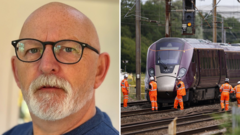
The collision of two East Midlands Railway passenger trains on June 19, 2026, near the Elstow interchange south of Bedford, demands an analytical approach that strips away media sentimentality to isolate the operational breakdowns, infrastructural vulnerabilities, and downstream economic bottlenecks created by the incident. A standard news report focuses on immediate emotional distress. A rigorous structural review must instead evaluate this event through the mechanics of modern rail safety systems, systemic single-point-of-failure vulnerabilities, and the massive logistical complexities of network recovery.
The hard data establishes the scale of the system failure: one fatality—the driver of the trailing train, Shaun Burton—and approximately 100 passenger casualties, including 11 with very serious injuries and nine remaining in critical condition. The rolling stock involved comprised a Class 360 electric multiple unit operating the 4:40 PM service from Corby to London St Pancras, and a Class 810 bi-mode train running the 3:50 PM service from Nottingham to the same destination. The structural failure occurred when the front of the Class 360 rear-ended the back of the Class 810 on a shared track shortly after 5:00 PM.
The Interlocking Safety Framework and Failure Path
To evaluate how two modern passenger trains operating on the heavily regulated Midland Main Line ended up occupying the same spatial footprint at speed, the analysis must evaluate the failure path of the UK's railway signaling and protection infrastructure.
The primary defense mechanism against rear-end collisions on this network is a combination of multi-aspect color light signaling and the Train Protection & Warning System (TPWS), working alongside the older Automatic Train Protection (ATP) or the rolling implementation of the European Train Control System (System Level 2). Under standard block signaling logic, a train occupying a section of track triggers a sequential series of restrictive signals for any trailing traffic:
- Red Aspect (Danger): Stop before the signal.
- Single Yellow Aspect (Caution): Be prepared to stop at the next signal; implies the next block is occupied or a red signal follows.
- Double Yellow Aspect (Preliminary Caution): Expect the next signal to display a single yellow aspect; provides an extended braking margin for high-speed paths.
When a train passes a restrictive signal (a single or double yellow) above a calibrated speed threshold, or passes a red signal entirely—an event designated as a Signal Passed at Danger (SPAD)—the TPWS trackside loops transmit an electromagnetic signal to the train's receiver. This automatically initiates an emergency brake application independently of driver input.
The physical reality of the Bedford collision reveals a systemic breakdown in this protective stack. The investigation spearheaded by the Rail Accident Investigation Branch (RAIB) must isolate the failure to one of three specific operational anomalies:
- A Track Circuit or Axle Counter Malfunction: The signaling system failed to detect the presence of the leading Class 810 Nottingham train, thereby maintaining green (proceed) aspects for the trailing Class 360 Corby train. This represents a complete loss of the fail-safe design principle.
- A Trackside-to-Train Transmission Interruption: The restrictive signals were displayed correctly, but the TPWS loops or the train-borne emergency braking receivers failed to activate upon a SPAD or overspeed condition.
- Adhesion-Limited Braking Failure (Low Railhead Adhesion): The signaling and train-borne protection systems functioned perfectly, instructing an emergency brake application, but micro-layers of contamination on the rail surface—often caused by oxidized organic matter or moisture—reduced the coefficient of friction between the steel wheel and the steel rail to near-zero, inducing an un-arrested slide.
Passenger testimony indicating a complete lack of deceleration prior to impact strongly supports either the first or second anomaly, pointing toward a data or transmission blackout rather than a mechanical braking struggle against poor adhesion.
The Kinematics of Crumple Zones and Crashworthiness
The fatal outcome for the driver of the Class 360 train, juxtaposed with the survival of the vast majority of passengers, highlights the precise engineering of modern rolling stock crashworthiness regulations (specifically European Standard EN 15227).
Rail vehicle structural design relies on a structured hierarchy of deformation. The vehicle is divided into rigid survival zones (the passenger saloons) and sacrificial energy absorption zones (the ends of the carriages, anti-climbers, and the cab front).
[ Sacrificial Nose / Cab ] ---> [ Deformable Couplers ] ---> [ Rigid Passenger Saloon ]
(High Energy Absorption)         (Shear-Pin Collapse)         (Zero Deformation Target)
During a high-mass impact, the structural sequence behaves like a multi-stage spring system:
The first stage involves the deformation of the anti-climbers and couplers. These components interlock upon impact to prevent one train from riding up over the chassis of the other—a phenomenon known as telescoping, which historically caused catastrophic fatalities in older rolling stock.
The second stage forces the collapse of sacrificial crumple zones built into the nose framing. This mechanism absorbs millions of Joules of kinetic energy, decelerating the vehicle at a controlled rate to minimize the G-forces transferred to the interior occupants.
The catastrophic constraint of this system is the structural compromise of the driver’s cab in a leading-car collision. Because the driver's console sits at the absolute leading edge of the vehicle, a direct impact at or above line speed exhausts the volumetric capacity of the sacrificial crumple zones. The energy envelope exceeds the design threshold, compressing the cab structure backward into the rigid bulkhead of the passenger saloon.
For the passengers, the violent, un-signaled deceleration causes secondary impacts—occupants being thrown forward into seats, tables, and partitions. The 11 very serious injuries reported reflect this rapid kinetic transfer, where unrestrained bodies maintain the train’s forward velocity until stopped by interior fixtures.
Logistical Bottlenecks and Infrastructure Recovery Functions
The closure of the Midland Main Line between Bedford and Luton introduces a severe economic and logistical bottleneck onto the UK's strategic transport network. Network Rail's forecast of a minimum one-week closure reflects concrete engineering constraints rather than bureaucratic inertia.
The recovery process cannot begin until the RAIB and the British Transport Police conclude their site-based forensic data gathering. Once the scene is cleared for physical intervention, the recovery function faces a highly complex sequence of tasks.
The initial bottleneck is the removal of the disabled rolling stock. The collision occurred just south of the Elstow interchange, an area lacking direct heavy-vehicle road access to the tracks. Before cranes can be deployed, engineers must construct a temporary aggregate access road across adjacent land to support the wheel loads of two 110-tonne mobile cranes.
Simultaneously, engineers must isolate and dismantle the overhead line equipment (OLE). The 25kV catenary wires spanning the tracks present an immediate hazard and physically obstruct the vertical clearance required for heavy lifting.
Once the OLE is cleared and cranes are positioned, the damaged rolling stock must be uncoupled, stabilized, lifted onto multi-axle heavy transport trailers, and evacuated via the temporary road network.
Only after the structural clearance of the rolling stock can the civil engineering assessment begin. The forces exerted during a shunting impact of this magnitude deform the underlying track geometry, crack concrete sleepers, and gouge the ballast substrate.
If the track foundation is compromised, the recovery team must execute a complete track renewal: stripping the damaged rails, replacing the ballast bed to ensure structural stability, laying new sleepers, and running precision tamping machinery to align the rails within millimeter-level tolerances. Finally, the OLE must be re-strung, tensioned, and dynamically tested before any commercial service can resume.
Macro-Economic Downstream Disruptions
The complete suspension of services between Bedford and London St Pancras creates an operational void that ripples across multiple passenger and freight sectors.
                  [ Midland Main Line Closure ]
                                |
        +-----------------------+-----------------------+
        |                                               |
[Commuter Displacement]                       [Supply Chain Severance]
        |                                               |
- Thameslink Capacity Overload                - Freight Path Re-Routing
- Rail Replacement Bus Friction               - Port-to-Inland Delays
- St Pancras Terminal Gridlock                - Increased Operational Costs
The primary casualty is the daily commuter flow into Central London. The Thameslink network, which normally handles high-density transit through this corridor, is completely severed north of Luton.
The substitution of rail replacement buses introduces a severe throughput bottleneck. A single eight-carriage train can transport upwards of 500 to 600 passengers; replicating this capacity requires 10 to 12 double-decker buses operating continuously. The resulting platform dwell times and road traffic congestion extend transit windows by a factor of three.
The second major casualty is the specialized Luton Airport Express service. By cutting the direct rail link to London St Pancras, the airport's transit infrastructure faces immediate strain, forcing air travelers onto alternative, already crowded road transport links or peripheral rail networks like the West Coast Main Line via Milton Keynes. This creates a secondary displacement effect, overloading adjacent rail corridors that are already operating near peak capacity limits.
Furthermore, the Midland Main Line serves as a vital artery for intermodal freight traffic moving between northern manufacturing hubs and southern ports. Re-routing freight trains requires scheduling paths through secondary branch lines, adding significant mileage, increasing crew operational hours, and disrupting the precision arrival windows required by modern supply chains.
The Long-Term Investigation Framework
The strategic resolution of the Bedford train crash will be dictated by the formal findings of the RAIB. The investigative timeline will move through a structured hierarchy of evidence verification.
The investigation will begin with the extraction and analysis of data from the On-Train Data Recorders (OTDR)—the rail equivalent of aviation's black boxes—from both the Class 360 and Class 810 units. The OTDR logs millisecond-accurate inputs, including exact GPS positioning, speed profiles, master controller positions, brake pipe pressure drops, and the activation of cab-signal alarms.
This data will be cross-referenced against the solid-state data logs of the local trackside signaling interlocking systems to determine the precise status of the track circuits and signal aspects in the minutes leading up to the impact.
A secondary focus will center on human factors and operational protocols. The inquiry must investigate the exact communication logs between the train drivers and the rail traffic control center.
If a signaling failure occurred, investigators will evaluate whether emergency radio protocols—such as the Global System for Mobile Communications-Railway (GSM-R) emergency broadcast—were initiated quickly enough to alert the trailing driver to the hazard ahead.
The definitive structural outcome of this investigation will likely mandate one of two industry-wide changes. If the failure is traced to a hardware or software flaw within the signaling interlocking or train protection systems, Network Rail will face mandatory fleet-wide inspections and software patches across all identical systems nationally.
If, alternatively, the collision is attributed to exceptional low-adhesion conditions that bypassed the safety margins of standard TPWS braking curves, it will accelerate the deployment of next-generation adhesion-monitoring technology and force a permanent revision of seasonal deceleration profiles across the entire UK rail network.