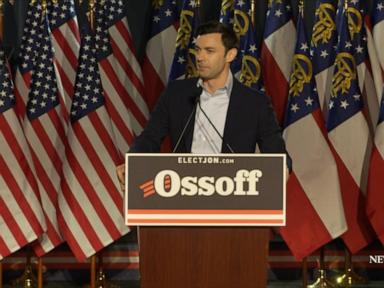
A victory speech delivered immediately after a projected win in a high-stakes Georgia Senate race—such as Jon Ossoff’s address to supporters—functions less as a celebratory ritual and more as a strategic pivot from electoral mobilization to governing legitimacy. While standard political coverage reduces these moments to emotional reactions and surface-level soundbites, an operational breakdown reveals a calculated communication architecture designed to consolidate a fractured electorate, establish an immediate policy mandate, and neutralize post-election procedural friction.
The Structural Function of the Post-Projection Address
In tightly contested statewide elections, the window between network projections and official certification represents a vulnerability gap. Opposition operatives use this period to question ballot integrity, depress public confidence, or frame the outcome as a statistical fluke rather than a decisive mandate. A candidate stepping onto the stage immediately following a projection must execute three distinct operational objectives within a compressed timeframe:
- Legitimation of the Outcome: Converting a narrow mathematical lead into an unassailable moral and civic victory before counter-narratives solidify.
- Coalition De-escalation: Transitioning partisan campaign workers and anxious voters from an adversarial posture to a civic governance mindset.
- Agenda Anchoring: Defining the primary legislative priorities so clearly that subsequent media coverage centers on policy execution rather than electoral mechanics.
Standard reporting treats the speech as an isolated event—a reaction to winning. In reality, the address is the opening maneuver of the incoming senator’s institutional tenure. Every rhetorical choice serves as a signal to distinct stakeholder groups: base voters, swing moderates, national party leadership, and opposing partisan actors.
Deconstructing the Rhetorical Architecture
To understand how an address like Jon Ossoff’s operates under intense national scrutiny, we must separate the speech into its functional components. Rather than viewing it as a linear narrative, analysts evaluate it as a multi-layered messaging matrix addressing divergent audiences simultaneously.
1. The Gratitude and Attribution Layer
Political victory speeches universally begin with acknowledgments, yet the sequence and specificity of these attributions reveal the underlying mechanics of the campaign's ground game. In Georgia’s electoral environment, turnout differentials across urban cores, suburban rings, and rural counties dictate the final margin.
- Operational Ground Forces: Highlighting canvassers, poll watchers, and local organizers validates the labor-intensive voter contact model. This reinforces organizational loyalty for future electoral cycles.
- Demographic Coalitions: Explicit references to specific communities—particularly Black voters, young voters, and suburban ticket-splitters—acknowledge the precise mathematical drivers of the victory without reducing those groups to mere statistics.
- Institutional Stewards: Thanking election workers and local officials serves a dual purpose. It expresses standard civic appreciation while simultaneously erecting a rhetorical shield around the administrative integrity of the vote count.
2. The Unification Pivot
Campaigns rely on sharp contrast to drive turnout; governance requires broad consensus to pass legislation. The transition between these two modes occurs mid-speech through what strategists call the "broad-tent pivot."
When a candidate explicitly addresses voters who supported their opponent, the objective is not immediate ideological conversion. Instead, the goal is lowering the temperature of opposition. By promising to represent all constituents regardless of how they cast their ballots, the speaker attempts to raise the political cost for opponents who might otherwise engage in total obstruction. This rhetorical move draws directly from classic democratic theory regarding institutional legitimacy: a narrow winner governs effectively only when the losing coalition accepts the winner's commitment to baseline procedural fairness.
3. The Policy Mandate Framing
The substantive core of the address establishes the "mandate"—the specific set of problems the electorate supposedly hired the candidate to solve. Because narrow victories often invite claims that the winner lacks a broad mandate, the speaker must frame their core platform items not as partisan desires, but as urgent, non-ideological necessities.
In the context of a Georgia Senate race, this typically centers on three economic and structural pillars:
- Healthcare Access and Cost Reduction: Framing medical affordability as an immediate household solvency issue rather than an abstract regulatory debate.
- Economic Infrastructure and Job Creation: Linking federal legislative action directly to tangible state-level outcomes, such as clean energy manufacturing, logistics expansion, or rural broadband deployment.
- Voting Rights and Institutional Reform: Positioning ballot access as a foundational prerequisite for all other policy outcomes, thereby maintaining urgency among the activist base after Election Day.
Cause-and-Effect Dynamics Missed by Surface Coverage
Traditional news summaries focus on the most applause-heavy lines of a victory speech, missing the downstream effects these words trigger across the political ecosystem.
Media Framing Cascade
The first twenty-four hours following a projected win dictate the narrative arc for the subsequent weeks. When a candidate delivers a disciplined, forward-looking address devoid of partisan triumphalism, it forces national and local editors to cover the incoming senator’s legislative agenda. Conversely, an undisciplined or overly combative speech traps the candidate in a cycle of defensive media appearances, delaying the transition from candidate to legislator.
Donor and Institutional Signaling
A victory speech is closely monitored by Washington stakeholders, committee chairs, and national fundraising networks. The poise, message discipline, and thematic clarity displayed on election night act as an immediate audition for high-profile committee assignments. Senate leadership assesses whether the incoming member can effectively communicate national party priorities within a competitive swing-state environment without creating unforced errors.
Opposition Counter-Calibration
Opposing strategists analyze the victory address to identify vulnerabilities for the next election cycle. If the winning candidate leans too heavily into progressive or conservative orthodoxy during their victory remarks, opposition researchers immediately archive those clips to construct future "out-of-touch" attack narratives. By anchoring the speech in universally accepted themes—economic opportunity, public health, and constitutional duty—the speaker denies the opposition clean ammunition during a moment of peak media attention.
Tactical Mechanics of Delivery Under High Variance
Delivering a speech when a race has been projected—rather than officially certified—requires precise calibration. Projections rely on statistical modeling of remaining uncounted ballots, primarily absentee, mail-in, or provisional votes from specific jurisdictions.
- Avoiding Premature Triumphalism: Speaking as if the statutory process is irrelevant invites backlash if vote margins tighten during routine canvassing. The tone must project calm inevitability rather than boastful finality.
- Controlling Pacing and Cadence: High-stakes victory speeches are frequently clipped into ten-to-fifteen-second segments for broadcast news and social feeds. Speakers use deliberate pauses and rhythmic repetition (anaphora) to ensure that individual sentences stand alone cleanly without requiring extensive surrounding context.
- Visual Staging: The physical environment behind the speaker—the placement of family members, diverse local supporters, and national flags—is engineered to reinforce the verbal message of stability, inclusion, and mainstream appeal.
Strategic Limitations of the Victory Address
While a well-executed post-projection speech optimizes the immediate transition period, practitioners recognize strict operational limits to what rhetoric alone can achieve.
- Zero Legislative Leverage: A victory speech does not alter the mathematical realities of the Senate floor. Regardless of how compellingly a candidate frames their mandate, legislative execution remains constrained by chamber rules, committee bottlenecks, and the ideological preferences of the median voter in the Senate.
- Ephemeral Persuasion: Goodwill generated among opposing voters on election night has a short half-life. Once the incoming senator casts their first controversial procedural or policy vote, partisan polarization rapidly reasserts itself.
- Vulnerability to External Shocks: Economic downturns, geopolitical crises, or unexpected domestic events can instantly render the policy priorities outlined on election night obsolete, forcing a complete recalibration of the governing narrative.
Executing the Post-Election Transition Playbook
For political strategists and communication teams managing the immediate aftermath of a projected statewide victory, the speech itself is merely the public-facing trigger for a broader operational sequence. To maximize the strategic value of the post-projection window, teams must execute four sequential actions immediately following the address:
- Lock the Narrative Within Six Hours: Distribute targeted video clips and full transcripts to regional beat reporters before morning editorial meetings convene, ensuring local coverage mirrors the speech's core policy framing rather than national horse-race commentary.
- Deploy the Transition Infrastructure: Immediately transition senior campaign aides from voter-contact operations to constituent-service and legislative-staffing vetting, signaling institutional readiness to state and federal stakeholders.
- Initiate Silent Stakeholder Outreach: Within forty-eight hours of the speech, conduct private, off-the-record calls with key state business leaders, local mayors from opposing parties, and civic heads to reinforce the unification message delivered publicly.
- Maintain Discipline During Certification: Instruct all campaign surrogates and digital channels to avoid engaging in online disputes over uncounted ballots, allowing the calm, authoritative tone of the victory address to remain the campaign's definitive statement until official state certification is complete.