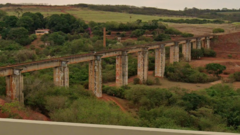
High-risk adventure tourism operates on a zero-tolerance threshold for failure. When a system allows a participant to clear the launch threshold without a primary safety mechanism attached, the event is not an accident; it is the inevitable output of a broken operational architecture. The fatal fall of a 21-year-old participant at the Ponte do Esqueleto (Skeleton Bridge) in Limeira, Brazil, exposes the exact structural gaps that occur when decentralized, unregulated adventure firms substitute casual checklists for hard engineering redundancies.
Standard media reporting focuses on human error—the physical omission of failing to attach the safety cord. A rigorous system analysis reveals that the omission was merely the final step in a compounding sequence of failure modes. By deconstructing this incident through the lens of risk management, operational redundancy, and legal liability, we can map how a catastrophic failure occurs and establish the baseline blueprint required to prevent system-level collapses in high-risk environments.
The Kinematics of Rope Jumping vs. Bungee Jumping
To quantify the failure, one must first isolate the physical forces dictating the sport. General media outlets frequently conflate rope jumping with bungee jumping. The distinction is critical because the material properties of the equipment alter the deceleration profiles and dictate the mechanical margins of error.
- Bungee Jumping: Utilizes a highly elastic, braided latex cord. The system relies on dynamic elongation (often stretching up to 200% or 300% of its static length) to absorb kinetic energy over an extended displacement window. The force attenuation is progressive, reducing peak deceleration forces on the human body.
- Rope Jumping: Utilizes low-elongation, static or semi-static nylon climbing ropes rigged in a pendulum configuration. The participant does not bounce vertically; instead, they enter a freefall that transitions into a wide, sweeping arc. Because static ropes exhibit minimal elasticity (typically less than 10% elongation under operational loads), energy absorption is achieved purely through the geometry of the high-line anchor system and the swinging trajectory.
At the Skeleton Bridge site, the vertical drop measures approximately 40 meters. In a unattenuated freefall from this height, a human body accelerates under gravitational force ($g = 9.8 \text{ m/s}^2$) for nearly 2.86 seconds, reaching a terminal velocity of approximately 28 meters per second (100 kilometers per hour) at the point of impact. Because a rope-jumping rig lacks the built-in material forgiveness of a highly elastic bungee cord, any failure in the trajectory calculation or anchor connection immediately results in catastrophic force transfer or ground impact.
The Three Pillars of High-Risk Operational Safety
An unmitigated failure occurs when three essential defensive layers fail simultaneously. In industrial risk management, this is analyzed via the Swiss Cheese Model, where hazards pass through holes in successive defense layers. In commercial adventure operations, these layers are categorized into distinct operational pillars.
[ Pillar 1: Mechanical Redundancy ] ──> Closed-loop physical links
                │
[ Pillar 2: Procedural Gatekeeping ] ──> Independent cross-verification
                │
[ Pillar 3: Legal & Risk Sovereignty ] ──> Criminal liability thresholds
Pillar 1: Mechanical Redundancy
A robust safety architecture requires that no single point of failure can cause system loss. In professional rigging, this dictates a dual-carabiner, dual-ancillary line system where the primary load path and secondary backup path are completely independent. Video documentation of the Limeira incident confirms a total absence of mechanical redundancy: the participant was physically hoisted and launched by ground crew personnel while completely decoupled from the main dynamic high-line. The failure was not a structural snap or an equipment malfunction; it was an unlinked open loop.
Pillar 2: Procedural Gatekeeping
Human checklist compliance degrades with repetition. In high-volume adventure setups, operators experience habituation, where the repetition of a dangerous task lowers the perceived risk. To counter this, professional operations use a three-stage verification process:
- The Rigger: Fits the harness and connects the hardware.
- The Safety Marshal: An independent actor who must physically touch and verify every locked gate, carabiner, and knot, completely independent of the rigger.
- The Launch Master: Verifies the final clear path and commands the release only after receiving verbal and visual confirmation from the Marshal.
The structural breakdown in Limeira occurred because the individuals hoisting the participant functioned simultaneously as the riggers and the launch masters, completely bypassing independent cross-verification.
Pillar 3: Legal and Risk Sovereignty
The legal aftermath of the incident introduces a precise framework for liability: dolus eventualis (implied intent or eventual malice). Brazilian authorities detained individuals associated with the operating agency under this specific doctrine.
In tort and criminal law, dolus eventualis occurs when an operator does not explicitly desire the death of a client but consciously accepts the distinct probability of that outcome by omitting basic, life-preserving protocols. Operating a 40-meter drop without an active, verified physical connection represents a transition from simple negligence (accidental omission) to criminal recklessness (proceeding with total indifference to a known deadly hazard).
Pathological Omissions in the Launch Sequence
The breakdown of the launch sequence at the Skeleton Bridge reveals a critical design flaw in the firm's physical launch layout. In standard commercial configurations, the participant is secured to the line before entering the launch zone.
The second limitation observed in the Limeira sequence is the reliance on manual human strength to hold and launch the participant, rather than a mechanical release gate. When technicians manually lift a participant above their heads to launch them, the physical exertion and coordination required distract from the cognitive task of safety verification. The physical act of throwing or launching overrides the mental checklist. This creates a bottleneck where the physical actions of the staff blind them to the status of the equipment.
Onlookers detected the omission visually and audibly seconds prior to release, shouting warnings regarding the unattached cord. The fact that bystanders could identify the error while the operators remained oblivious demonstrates a total collapse of situational awareness. This indicates that the operators were running an open-loop process, lacking a definitive, mandatory hold-fire protocol that can be triggered by any team member or observer before the launch threshold is crossed.
Systemic Risk Mitigation for High-Risk Environments
To eliminate the systemic failure modes exposed by the Limeira event, commercial operators must transition away from human-dependent checklists and enforce hard physical and legal constraints. Relying on an instructor's memory or attention span is a flawed strategy.
First, implement Physical Interlocking Mechanisms. The launch platform must feature a physical gate that is mechanically interlocked with the main safety line anchor. If the carabiner or load-bearing tether is not locked into the high-line system, the launch gate physically cannot open. This shifts the safety burden from human vigilance to mechanical compliance.
Second, enforce Strict Separation of Operational Roles. The team member who hooks up the guest must never be the team member who authorizes the launch. The final authorization must come from a dedicated safety auditor whose sole metric of performance is finding errors, completely separated from the operational throughput or speed of the jumps.
Third, require Regulatory Standardization and Auditing. Self-regulation in extreme sports consistently fails due to economic pressures to maximize throughput. Operations must be subjected to third-party structural engineering audits, utilizing standardized hardware tracking systems where every cycle, fall, and load profile is digitally logged and audibly verified.
The final strategic move for the adventure tourism industry is clear: any operator refusing to integrate interlocking mechanical safety barriers must be treated not as an adventure provider, but as an uninsured liability risk. True systemic safety is achieved only when the physical layout of the launch environment makes it completely impossible to drop a participant without a closed safety loop.