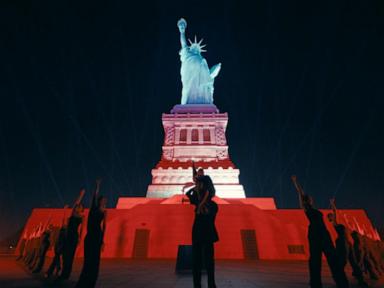
Executing large-scale cultural spectacles on isolated national monuments requires solving a complex optimization problem involving spatial constraints, atmospheric attenuation, and strict regulatory frameworks. When France’s Monumental Tour and producer Michael Canitrot staged the 15-minute "Liberty Lights" laser and light installation at the Statue of Liberty for America's 250th anniversary, media coverage focused heavily on the aesthetic sentiment of the Franco-American alliance. This surface-level interpretation misses the structural, logistical, and mathematical realities governing such operations.
Transforming a historical copper monument into a high-flux light canvas demands a deep understanding of lumen calculation, marine environment logistics, and civil aviation safety coordinates. To replicate or scale this tier of architectural entertainment, operators must look past the artistic prose and analyze the specific engineering mechanics that dictate success or failure in the field.
The Tri-Factor Constraint Model of Island Logistics
Staging a projection and laser show in a remote marine harbor introduces a severe logistical bottleneck. Unlike urban installations that tap into municipal power grids and allow for simple terrestrial transport, island-bound structures impose strict resource limits across three primary variables.
- Power Subsystem Isolation: A copper-clad structure located on an island does not possess the native electrical distribution architecture required to drive multi-kilowatt laser systems and high-lumen projection arrays simultaneously. The installation demands temporary, localized power generation. Because the site is surrounded by water, operators must transport high-capacity, sound-attenuated diesel generators via marine barges. The electrical system requires redundant mirroring; a secondary generator must run concurrently in a phase-locked configuration to assume the full load instantly if the primary unit fails.
- Atmospheric and Marine Interference: Open water environments accelerate equipment degradation and distort light transmission. High humidity levels, salt fog, and wind vectors change the refractive index of the air between the hardware platforms and the monument surface. Saltwater mist acts as a physical scatterer of light beams, reducing the effective target luminance. Equipment enclosures must meet IP66 or higher ingress protection ratings to prevent salt-air corrosion from shorting out sensitive solid-state laser diodes during the setup window.
- Geospatial Footprint Limitations: The physical geography of a historic site restricts where hardware can be anchored. Heavy structures like scissor lifts or scaffolding towers cannot be placed arbitrarily due to structural weight limits on old stone masonry and the risk of displacing historic artifacts. Projectors and laser fixtures must be positioned on specialized floating platforms or confined to designated ground-level clearings. This introduces extreme projection angles, forcing software teams to apply heavy mathematical keystone corrections and anamorphic warping to prevent the imagery from distorting along the vertical curvature of the monument.
Optical Power Dynamics and Surface Attenuation
The core technical challenge of the Liberty Lights show rests on the physics of light reflection against aged copper. The Statue of Liberty’s green patina presents a challenging canvas for projection mapping due to low albedo and highly specific color absorption.
A oxidized copper surface absorbs a high percentage of the red spectrum while reflecting a narrow band of green and blue light. To achieve white light or balanced color reproduction, engineers cannot rely on standard RGB formulas. They must over-index on blue and green wavelengths to compensate for the surface's natural spectral absorption.
The mathematical relationship governing the required projector output can be modeled through the basic target luminance equation:
$$L_t = \frac{\Phi \cdot \eta \cdot R}{\pi \cdot A}$$
Where $L_t$ is the target luminance in nits, $\Phi$ is the total luminous flux emitted by the projector array in lumens, $\eta$ is the atmospheric transmission efficiency, $R$ is the surface reflectance (albedo) of the monument, and $A$ is the total surface area of the projection zone.
Because $R$ for oxidized copper is exceptionally low—frequently dropping below 0.15 depending on the specific angle of incidence—the value of $\Phi$ must be driven up exponentially to achieve high-contrast visibility against the ambient light pollution of an adjacent urban skyline. Achieving this requires stacking multiple high-lumen laser projectors. By aligning two or three projectors to point at the exact same geometric coordinates, technicians multiply the localized lumen density without exceeding the physical thermal limits of an individual hardware chassis.
Regulatory Cleared Spaces and Aviation Safety
The deployment of high-powered lasers into open airspace introduces strict legal and operational boundaries overseen by aviation authorities. In the United States, any outdoor laser demonstration must receive formal clearance from the Federal Aviation Administration (FAA).
The primary metric used to safeguard aviation operations is the Nominal Ocular Hazard Distance (NOHD). For high-power show lasers, the raw beam can cause immediate retinal damage to pilots operating aircraft several miles away. Engineers must establish specific spatial boundaries to mitigate this risk.
- Laser Free Zones: The immediate airspace directly above and surrounding the monument where the laser irradiance must remain below the Maximum Permissible Exposure (MPE) threshold ($1 \times 10^{-3} \text{ W/cm}^2$ for standard visible wavelengths).
- Critical Flight Zones: Airspace extending further out into the harbor where beams must be physically or programmatically masked to prevent flash blindness or glare in pilot cockpits.
- Physical Interlocks and Shutter Systems: To comply with regulations, the laser control software must utilize hard-coded geometric masks that physically prevent the laser scanners from tilting past a predetermined vertical angle. Automated radar or infrared camera systems are integrated into the control loop. If an unauthorized aircraft enters the airspace vector intersected by the lasers, the system triggers a physical shutter interlock, terminating the beam in milliseconds.
Architectural Synchronization and Timecode Architecture
A multi-sensory installation involving structural projection, moving lights, and localized electronic music requires a highly disciplined control architecture. The entire 15-minute show relies on a centralized master clock using SMPTE timecode (Society of Motion Picture and Television Engineers).
The master timecode track is generated from the playback server and distributed simultaneously via robust network protocols to independent control consoles managing different elements of the performance. The audio playback feeds into the sound reinforcement system, while the timecode stream drives the video servers executing the projection mapping and the lighting desks handling the automated fixtures and lasers.
This strict dependency prevents drift. Because light travels faster than sound, spatial positioning of the audio systems must also be calculated relative to the audience footprint. For a broadcast-heavy event funded by corporate sponsorships and aired on networks like ABC, the timecode must also feed into the television production trucks, allowing cameras and broadcast graphics to align seamlessly with the automated lighting cues occurring on the monument.
Strategic Operational Directives
For organizations attempting to scale architectural projection and media spectacles on historic infrastructure, success depends on moving away from experimental setups and toward programmatic execution.
Prioritize physical surface scanning using high-density LiDAR over basic photographic blueprints. A precise 3D mesh allows content creators to map the exact physical contours of the target architecture, isolating high-absorption zones and structural deeps before hardware lands on site.
Enforce a mandatory dual-layer redundancy protocol on all critical infrastructure nodes. This means deploying parallel network rings running Art-Net or sACN protocols for lighting control, utilizing dual-host tracking video servers that mirror playback frame-for-frame, and maintaining localized fuel reserves for isolated power generation.
Finally, build the regulatory compliance timeline directly into the foundation of the project's critical path. Treat FAA, coast guard, and local historical society permissions not as bureaucratic hurdles to clear at the end of production, but as fixed design constraints that dictate the maximum power output, physical structural loads, and geometric boundaries of the entire installation.