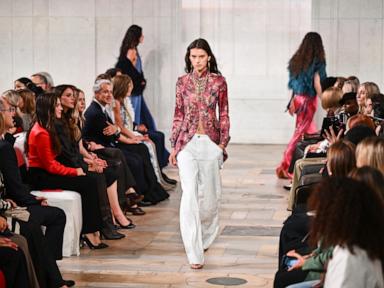
Luxury brand longevity requires balancing fixed heritage codes against shifting consumer utility functions. When a legacy house like Ralph Lauren presents a seasonal collection anchored in minimalist spatial staging and fluid, contrasting silhouettes, the underlying mechanism is not merely aesthetic adaptation. It is a calculated recalibration of brand equity designed to compress the distance between timeless archive codes and contemporary consumer behavior. Deconstructing this latest presentation reveals a precise strategic architecture: the tension between structural tailoring and fluid romance functions as a deliberate instrument for market retention across diverse demographics.
The Mechanics of Brand Continuity and Spatial Minimalism
The structural shift from ornate, maximalist runways to a stark, white minimalist environment serves a functional economic purpose. By stripping away antique props and opulent textures, the brand reduces visual noise, forcing the observer's cognitive load entirely onto the garment construction. This spatial reduction acts as a multiplier for product focus.
The collection relies on a strict binary color discipline, moving from clean whites to deep navy blue. This binary execution serves three distinct operational objectives:
- It establishes immediate visual legibility from any viewing angle in a saturated media environment.
- It reduces manufacturing complexity while maintaining high perceived value through fabric contrast.
- It anchors the transition points between daywear and eveningwear without requiring disruptive stylistic shifts.
The juxtaposition of hard and soft elements—such as a rigid white corseted top paired with flowing trousers, or a golden fringed gown layered over tailored navy trousers—creates an intentional stylistic friction. This dual-coded approach allows the brand to capture both the traditionalist consumer segment seeking architectural heritage and the modern buyer demanding fluid versatility.
The Economics of Heritage Retention
Legacy brands face a distinct depreciation risk: the archive trap. If a house relies entirely on historical silhouettes, it becomes a museum piece. Conversely, abandoning core codes alienates the foundational customer base that underwrites high-margin baseline products. Ralph Lauren navigates this trade-off through systematic code iteration.
The inclusion of archival nods, such as the homage to the brand's original women's pantsuits, operates as an authenticity signal. However, these elements are updated with contemporary proportions—low-slung waistlines, slim-fitting jackets, and distressed denim accents. This strategy exploits the consumer desire for generational continuity while keeping pace with macro shifts toward relaxed, utilitarian comfort.
The financial yield of this strategy relies on the laddering effect of accessories. Oversized floral brooches, feathered bolero jackets, and fringed waist-scarves act as entry-level psychological hooks. They provide the brand's high-margin secondary product categories with immediate editorial translation, driving high-frequency conversions without altering the core apparel manufacturing pipeline.
Strategic Execution for Legacy Houses
To replicate or counter this brand positioning strategy in modern luxury markets, execution must follow a strict operational hierarchy:
- Isolate the foundational design code that defines historical equity and cannot be altered without brand dilution.
- Introduce controlled structural friction by pairing that rigid code with its exact opposite in volume, texture, or gender association.
- Purge environmental clutter in presentation formats to maximize consumer attention on material quality and silhouette engineering.
- Scale accessory and secondary lines directly from the runway's highest-friction design elements to capture immediate commercial margin.
The long-term viability of this model depends on maintaining the exact equilibrium between nostalgia and functional utility. When a legacy house successfully executes this balance, clothing ceases to be seasonal apparel and functions instead as an enduring asset class within the consumer's lifestyle portfolio.
American Heritage Reimagined With Modern Romance
This video provides a close-up analysis of how traditional American style codes are balanced with modern romance elements in contemporary collections.