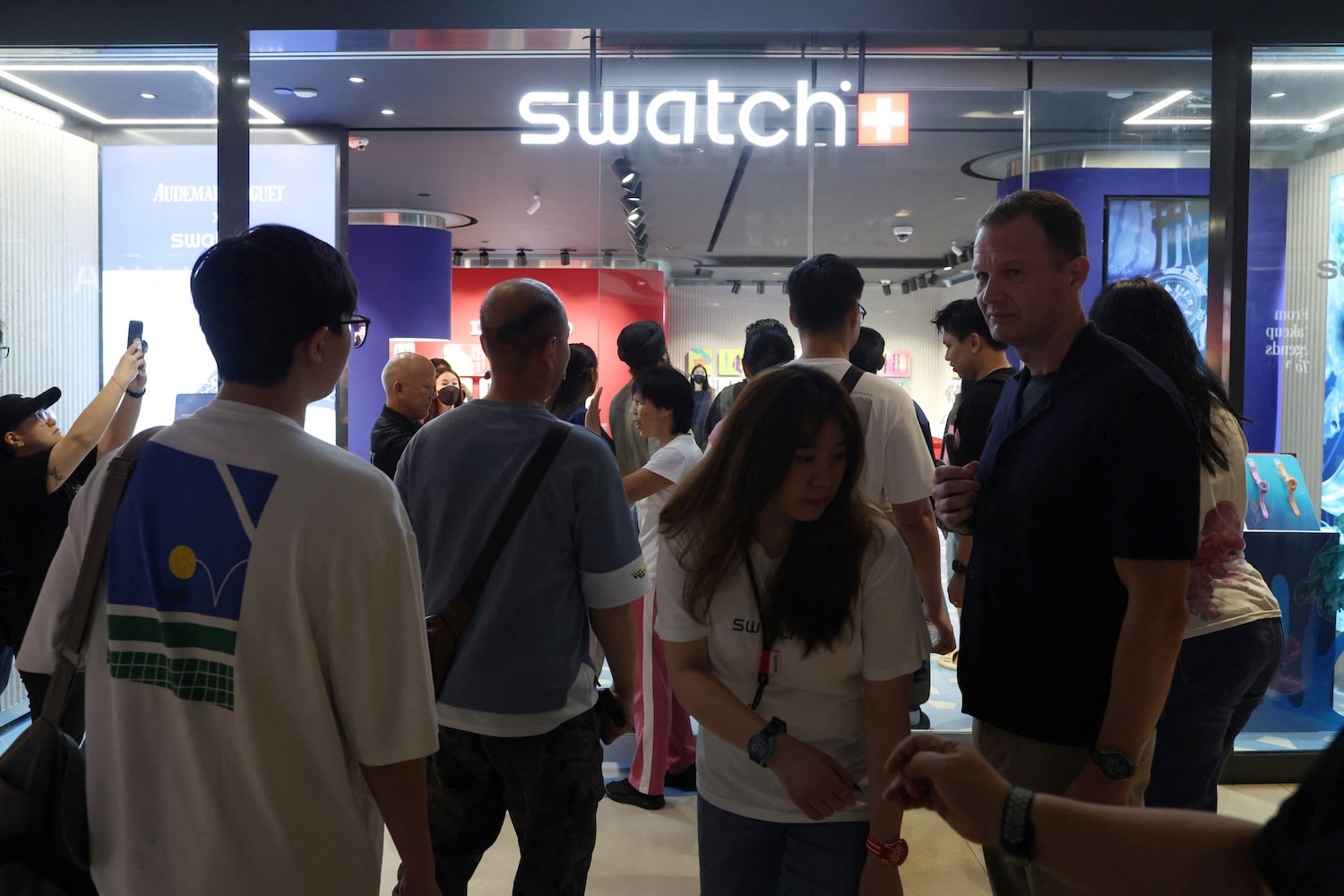
The global retail disruption surrounding the May 16, 2026 release of the "Royal Pop" collection—a collaborative project between mass-market watchmaker Swatch and haute horlogerie icon Audemars Piguet—represents a structural breakdown in modern scarcity-driven marketing. When physical storefronts in Paris, London, Milan, New York, and Dubai became sites of civil unrest, resulting in police interventions, tear gas deployment, and sweeping store closures, the conversation shifted from marketing brilliance to operational failure. This breakdown was not an unpredictable anomaly of consumer enthusiasm. It was the mathematical consequence of a mismatch between digital-era arbitrage incentives and analog brick-and-mortar distribution infrastructure.
The disruption highlights a fundamental friction in luxury brand dilution strategies: when the entry price of a prestigious brand silhouette is artificially depressed by over 95%, the resulting demand curve cannot be safely managed by conventional physical retail protocols. The "Royal Pop" collection, retailing at $400 USD, transposed the trademark design elements of the Audemars Piguet Royal Oak—a timepiece with a primary market entry point exceeding $40,000—into a mass-produced, bioceramic pocket watch format. The failure to contain the resulting market response stems directly from a misunderstanding of modern queue mechanics, speculative resale margins, and the physical limitations of retail crowd management. Discover more on a related topic: this related article.
The Asymmetric Arbitrage Function
The primary driver of the structural breakdown was the massive, immediate yield delta presented to speculative flippers. In traditional high-luxury retail, access to inventory is restricted by highly curated client relationships, historic spend thresholds, and multi-year waiting lists. By removing these institutional gatekeepers and offering an Audemars Piguet-branded asset for $400 exclusively via physical, first-come, first-served boutiques, Swatch created a highly lucrative arbitrage opportunity.
The economic motivation governing the behavior of those in the queues can be mapped using a basic expected value calculation for retail arbitrage: Further reporting by Forbes highlights similar views on this issue.
$$EV = P_{resale} - P_{retail} - C_{opportunity} - C_{risk}$$
Where $P_{resale}$ is the real-time secondary market value, $P_{retail}$ is the $400 purchase price, $C_{opportunity}$ is the capital cost of time spent queuing, and $C_{risk}$ is the probability of exiting the queue empty-handed.
Early secondary market indicators recorded units reselling for up to $4,000 within hours of the launch. This represented an immediate tenfold return on capital ($3,600 gross profit per unit). This extraordinary margin completely rewrote the opportunity cost equation for participants. When the financial reward for standing in line for 48 to 120 hours moves from a marginal wage replacement to an immediate multi-thousand-dollar payout, the demographic composition of the queue fundamentally shifts.
The line ceases to be populated by brand enthusiasts or collectors. Instead, it is dominated by professional arbitrageurs, organized flipping networks, and local labor hired specifically to secure inventory. These groups operate under strict financial incentives, making them highly resistant to standard verbal crowd control or retail etiquette.
Structural Factors of the Demand Spike
Three clear variables intensified this economic pressure point:
- The In-Store Only Mandate: Swatch explicitly banned online sales for the Royal Pop collection. By restricting the point of sale entirely to select brick-and-mortar storefronts, the brand concentrated global macroeconomic demand into highly localized, dense geographic coordinates.
- The Illusion of Scarcity vs. Production Realities: Swatch repeatedly emphasized that the Royal Pop collection is not a limited edition and would remain in production for months. However, the market responded exclusively to immediate temporal scarcity—the reality that day-one stock was finite, and initial secondary market prices would peak before subsequent production runs diluted the valuation.
- The Silhouette Premium: Unlike standard fashion collaborations, this project took the structural geometry of a "Holy Trinity" watch brand and democratized it. The consumer base recognized that the visual signaling value of the asset far outperformed its $400 material cost, driving non-enthusiast demand to unprecedented levels.
The Dynamics of Queue Failure
The escalation from peaceful waiting lines to physical altercations and police intervention follows a predictable path of crowd degradation. When a brand uses a first-come, first-served queue for an underpriced, highly coveted asset, it establishes an unwritten social contract: time invested equals asset acquisition guaranteed.
The breakdown occurs when the volume of the crowd exceeds the physical boundary capacity of the retail space, introducing variables that break this contract. At locations like New York's Times Square or Paris's suburban boutiques, crowds grew well past 300 to 1,000 individuals for footprints designed to hold a fraction of that number.
As the hours progressed, late arrivals began cutting into the front of the lines, bypassing the time investments made by early arrivals who had camped out for days. Because Swatch personnel and private mall security lacked the legal authority and physical presence to enforce the chronological integrity of the queue, the social contract failed.
When the store doors opened, the queue collapsed from a linear, self-policing structure into a high-pressure physical mass. In New York, eyewitness accounts described the environment as a high-density crush where those who utilized physical force or bypassed the line entirely secured the front positions.
The moment the crowd realized that physical aggression, rather than temporal investment, was the deciding factor for product acquisition, structural escalation became inevitable. In Paris, the crushing force against rolling security shutters and glass entryways created immediate crush hazards, forcing law enforcement to deploy tear gas as a defensive measure to clear the storefront perimeter.
The Operational Bottleneck of Localized Retail
A major operational mistake in the execution of the Royal Pop launch was the complete transfer of systemic risk from corporate headquarters to regional retail staff and local municipalities. The historical data for this exact phenomenon was readily available to Swatch leadership. The 2022 MoonSwatch launch alongside Omega yielded identical logistical challenges, public safety issues, and forced closures. Yet, the playbook remained unchanged.
Regional store managers were left with insufficient resources to handle a highly predictable influx of consumers. The operational bottleneck can be broken down into three core deficiencies:
Insufficient Security Personnel Allocation
Standard retail staff and baseline mall security guards are trained for loss prevention and customer service, not high-density crowd control. Facing hundreds of individuals motivated by immediate financial arbitrage, these small security teams were quickly overwhelmed. In cities like Birmingham, Manchester, and Cardiff, the complete lack of physical barricading meant that lines quickly spilled into public walkways, blocking thoroughfares and forcing local police to issue dispersal orders.
Information Asymmetry and Lack of Communication
Throughout the multi-day waiting periods, stores failed to provide real-time transparency regarding exact inventory numbers. If a store only possesses 100 units of an item, but allows a queue of 1,000 people to form and persist for 24 hours, it actively creates a high-tension environment.
When the 101st person in line spends an entire night on the pavement due to a lack of corporate inventory disclosure, their frustration upon discovery represents a significant security risk. The absence of digital queue tracking or physical ticketing mechanisms left crowds in a state of speculative anxiety, increasing overall volatility.
The Single Point of Failure in Inventory Access
By requiring consumers to physically enter a small boutique footprint to complete a transactional exchange, the retail model created a severe bottleneck. The processing time per transaction—including payment verification, packaging, and anti-flipping compliance checks—creates a slow throughput rate. When the processing rate is significantly lower than the crowd arrival rate, the physical density outside the storefront compounds rapidly, increasing the likelihood of structural failure.
| City | Primary Disruption Mechanism | Operational Resolution |
|---|---|---|
| Paris | Front-end line breach & structural damage to security gates | Tactical deployment of tear gas; immediate site evacuation |
| London (Battersea) | Barrier breach & aggressive crowd surging | Total cancellation of launch; indefinite store closure |
| Dubai | Early-morning crowd saturation exceeding mall holding capacity | Pre-emptive cancellation before store opening via digital channels |
| Mumbai | Severe crowd density & hostile verbal escalations | Complete event cancellation under public safety directives |
| Manchester | Post-launch crowd volatility and physical scuffles | Multi-day extended closure of the retail branch |
Strategic Alternatives for High-Hype Distribution
The events of the Royal Pop launch prove that the traditional first-come, first-served model is no longer a viable option for high-arbitrage product rollouts in major metropolitan areas. For modern brands looking to capture mass-market attention without compromising public safety or damaging their retail footprints, specific distribution alternatives must be deployed.
The Digital Allocation Lottery
Rather than forcing physical accumulation, brands can utilize localized digital lotteries via geo-fenced applications. Consumers enter a cryptographic draw within a specific geographic window. If selected, they are allocated a precise, non-transferable 15-minute time window over a staggered three-week period to purchase their unit at a designated store. This completely removes the incentive to camp out, eliminates front-end queue crowding, and reduces the retail footprint's peak density to standard operating levels.
The Inverted Micro-Drop Model
Instead of announcing a synchronized global launch time across flagship stores, brands can utilize unannounced, rolling stock allocations across a broader network of minor retail locations. By removing the predictability of the drop, speculative networks cannot coordinate multi-person line occupations. The inventory slowly filters into the market, satisfying genuine regional demand while avoiding the centralized crowd surges that break down municipal infrastructure.
The On-Demand Open Pre-Order Window
To completely break the speculative secondary market premium, a brand can open a 48-hour online pre-order window where production is guaranteed to match the total order volume, with deliveries scaled over the fiscal year. This system maintains the democratized access of the collaboration while instantly lowering the secondary market price delta.
Flippers will not camp out or fight for an item that any consumer can order online for future delivery at retail price. This preserves physical retail spaces for standard brand interactions rather than turning them into high-stress distribution centers.
The Long-Term Impact on Brand Equity
While Swatch achieves short-term revenue spikes and massive algorithmic engagement from the mainstream media coverage of these disruptions, the long-term impact on brand equity tells a more complex story. For Audemars Piguet, the calculation is highly risky. The value of a luxury watchmaker relies heavily on the maintenance of perceived exclusivity, exceptional craftsmanship, and controlled access.
When the iconic aesthetic of the Royal Oak is linked globally with viral videos of shopping mall brawls, police interventions, and tear gas, the elite signaling power of the parent brand risks dilution. The elite consumer class that spends mid-five-figure sums on haute horlogerie generally seeks distance from mass-market frenzies.
For Swatch, the repeated failure to protect its frontline retail employees from hostile, unsafe work environments presents a real operational liability. Relying on local police forces to manage the fallout of commercial marketing strategies is a unsustainable business practice.
The strategic play moving forward requires a complete retirement of the unmanaged physical queue. If mass-accessible luxury collaborations are to remain a pillar of modern retail business models, the infrastructure governing their delivery must match the digital sophistication of the consumer networks pursuing them. Until these distribution channels are re-engineered around verified digital identities and staggered fulfillment windows, the physical storefront will remain an inherently unstable environment for high-demand product launches.


