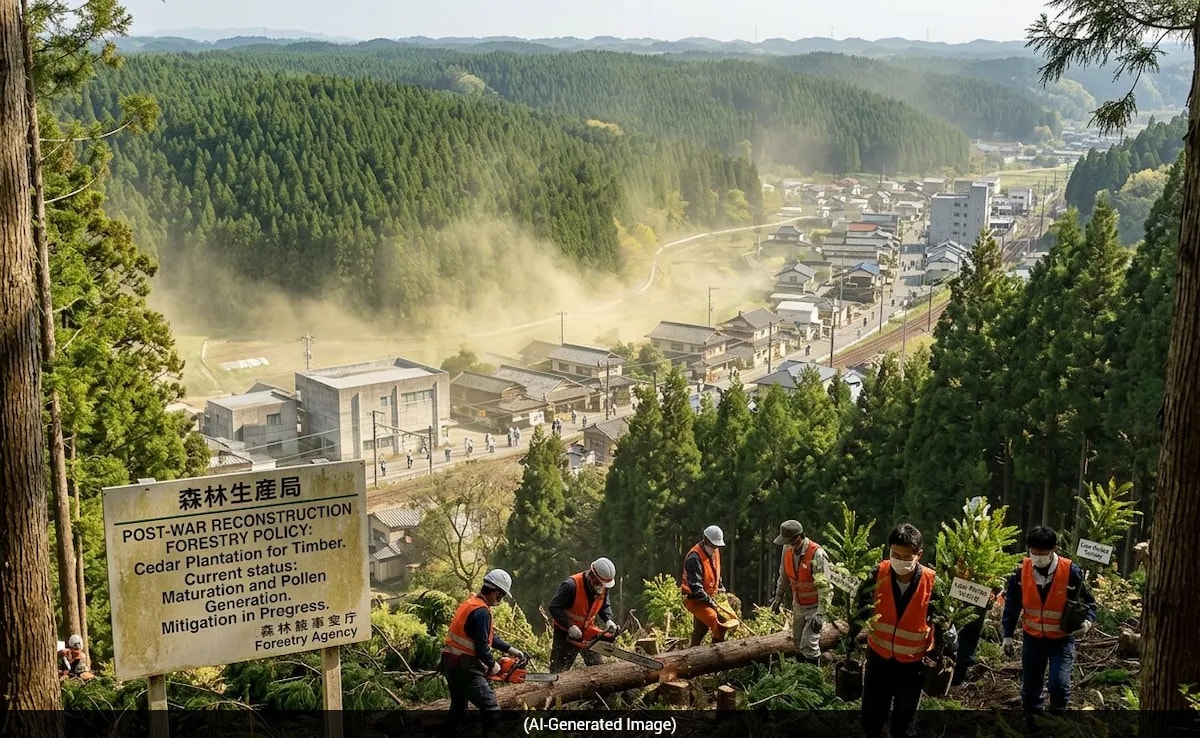
Japan’s annual spring allergy crisis is not a natural phenomenon; it is a calculated byproduct of mid-century industrial policy. Known locally as Kafunsho (pollen illness) and often designated as Kokumin-byo (the national disease), seasonal allergic rhinitis affects over 40% of the domestic population. The origin of this public health emergency traces directly back to a sequence of post-World War II silviculture mandates enacted in the 1950s. To evaluate this crisis requires analyzing it not as a biological inevitability, but as a multi-decade system failure driven by economic decoupling, delayed ecological maturity, and urban environmental compounding.
The Genesis: Postwar Silviculture as an Economic Engine
The structural roots of Kafunsho were established during the reconstruction era. Following the widespread destruction of urban infrastructure during World War II, the Japanese government faced an acute shortage of timber required for housing and industrial construction. Simultaneously, wartime deforestation had stripped hillsides, creating severe risks of soil erosion, landslides, and flooding during typhoon seasons. If you enjoyed this piece, you might want to read: this related article.
The Ministry of Agriculture, Forestry and Fisheries responded with an aggressive national reforestation initiative. The strategy relied on monoculture cultivation, prioritizing two indigenous conifer species: Cryptomeria japonica (Japanese cedar, or Sugi) and Chamaecyparis obtusa (Japanese cypress, or Hinoki).
These species were selected based on a specific optimization framework: For another look on this event, check out the recent coverage from Medical News Today.
- Volumetric Growth Velocity: Both species exhibit rapid vertical development, minimizing the time required to establish canopy cover and stabilize topsoil.
- Structural Uniformity: The straight trunks of Sugi and Hinoki are highly optimized for mechanized sawmills and standardized architectural framing.
- High Adaptability: These conifers thrive across diverse elevations and soil qualities throughout the Japanese archipelago.
Between the 1950s and 1970s, native broadleaf forests were systematically cleared and replaced. Artificially planted forests expanded to cover approximately 4.3 million hectares of Sugi and 2.6 million hectares of Hinoki, accounting for roughly 40% of Japan’s total forested area. At the inception of this policy, individual immunogenic responses to airborne pollen were a negligible variable within the state’s macro-economic calculus.
The Maturation Bottleneck and Economic Decoupling
The transformation of a strategic timber reserve into a public health liability occurred due to an economic shift in the late 20th century. Cryptomeria japonica exhibits a distinct biological lifecycle: the tree reaches reproductive maturity and begins generating significant quantities of pollen at approximately 30 years of age, with pollen volume peaking as the tree ages further.
[Postwar Deforestation]
       │
       ▼
[Monoculture Planting of Sugi/Hinoki (1950s-70s)]
       │
       ▼
[Global Timber Liberalization (1960s-80s)] ──► [Domestic Forestry Collapse]
       │                                               │
       ▼                                               ▼
[Trees Reach Maturity (30+ Years)]              [Forests Left Unmanaged/Uncut]
       │                                               │
       └───────────────────────┬───────────────────────┘
                               │
                               ▼
               [Exponential Pollen Volumetrics]
In the 1970s and 1980s, precisely as the first massive waves of postwar plantations approached maturity, global trade dynamics shifted. Japan liberalized its timber import policies, opening the domestic market to cheaper lumber from Southeast Asia, North America, and Russia. The economic viability of domestic forestry collapsed rapidly:
- Price Deflation: Imported timber undercut the price of domestic wood, rendering labor-intensive mountain logging unprofitable.
- Labor Depletion: As profitability evaporated, younger generations migrated to urban centers. The forestry workforce shrank and aged rapidly, leaving a critically low density of active workers available for forest management.
- Abandonment of Silviculture Cycles: Standard forestry protocols require systematic thinning—cutting down a percentage of trees to allow remaining trees to grow thicker rather than taller. Unthinned forests grow into dense, crowded stands where stressed trees produce even higher concentrations of reproductive cones.
By the 1990s, millions of hectares of Sugi had crossed the 30-year maturity threshold simultaneously. Instead of being harvested and converted into housing, they were left standing, operating as an unmanaged, expanding biometric factory producing fine, highly aerodynamic pollen.
The Pollen Cost Function: Urban Mechanics and Adjuvants
The severity of Kafunsho in modern Japan is structurally amplified by the physical characteristics of its urban environments. The Tokyo metropolitan area, which holds over 37 million residents, consistently reports some of the highest allergy rates despite being miles away from major mountain plantations. This geographical distribution is explained by two primary mechanisms.
The Re-Entrainment Effect
In a natural ecosystem, airborne pollen lands on soft soil, grass, or water, where it is absorbed, degraded, or trapped. In modern Japanese megalopolises, the ground cover is predominantly non-porous asphalt and concrete. When Sugi pollen drifts down from the surrounding mountains (such as the Kanto region’s western hills), it settles on these hard urban surfaces.
Wind currents generated by weather systems, passing trains, and vehicular traffic continuously launch these particles back into the breathing zone. This creates a high-density, recirculating suspension of allergens that exposes urban populations for weeks after the initial mountain release has ceased.
The Adjuvant Effect of Urban Air Pollution
The human immune system’s reaction to Sugi pollen is altered by common urban pollutants, specifically Diesel Exhaust Particles (DEPs), Suspended Particulate Matter ($PM_{2.5}$), and nitrogen dioxide ($NO_2$).
When pollen grains interact with these chemical compounds in the atmosphere, a synergistic degradation occurs:
$$\text{Pollen Grain} + \text{Diesel Exhaust/PM}_{2.5} \longrightarrow \text{Fractured Allergen Fragments}$$
The chemical pollutants abrade the outer shell (exine) of the pollen grain, causing it to rupture. Instead of a single large particle that might get trapped by nasal hairs, the pollen fractures into microscopic sub-micron fragments coated in industrial toxins. These smaller fragments penetrate deeper into the human respiratory tract, bypassing primary physical filtration defenses and interacting directly with mucosal tissue.
Furthermore, DEPs act as immunological adjuvants. They stimulate immunoglobulin E (IgE) production, lowering the threshold of exposure required to trigger an inflammatory mast-cell response. This environmental compounding explains why urban residents frequently develop severe Kafunsho symptoms at lower raw pollen counts than rural residents living near the forests.
Quantifying the Macroeconomic Drag
The systemic impact of Kafunsho extends far beyond individual physical discomfort; it functions as a predictable, annual drag on macroeconomic productivity. This impact can be assessed across three major cost categories.
| Direct Out-of-Pocket Expenses | Presenteeism and Absenteeism | Sectoral Economic Distortion |
|---|---|---|
| Annual household expenditure on antihistamines, steroid nasal sprays, specialized protective eyewear, and high-efficiency particulate air (HEPA) purification systems. | Quantifiable drops in cognitive function, focus, and physical endurance across the workforce during peak pollination windows (February to April). | Suppressed retail foot traffic and outdoor leisure spending balanced against temporary spikes in pharmaceutical and indoor entertainment revenue. |
Market analysis indicates that during peak pollen years, the contraction in consumer spending caused by allergic exhaustion can measurably impact quarterly GDP figures. Workers operating with inflamed nasal passages and sleep disruption caused by nocturnal congestion show decreased operational efficiency, creating a hidden tax on corporate output every spring.
Technical and Policy Interventions: The Replacement Frontier
Resolving a structural crisis of this scale requires moving away from short-term pharmaceutical management toward aggressive, long-term environmental remediation. The Japanese government has initiated a multi-decade containment strategy focused on three specific technological vectors.
1. Low-Pollen and Pollen-Free Cultivar Substitution
The primary objective is to phase out high-emission conifers. Forestry research institutes have successfully isolated and cloned mutant strains of Sugi and Hinoki that produce up to 99% less pollen than standard wild types, alongside entirely sterile, pollen-free varieties.
The operational barrier is logistical velocity. The government’s current target is to reduce the highest-emitting cedar forest acreage by 20% within a decade. However, logging mature trees on steep mountain terrain, transporting the timber, and replanting the sites with low-pollen saplings is highly resource-intensive. The transition is also slowed down by a biological bottleneck: newly planted saplings are highly vulnerable to foraging by expanding populations of wild sika deer, requiring extensive fencing infrastructure and ecological population management to ensure sapling survival.
2. Aerial Anti-Fungal Bio-Sprays
To achieve faster results, researchers are testing specialized fungal pathogenetic agents, such as Sydowia polyspora. When sprayed via automated drones onto mature cedar canopies during the late autumn flower-bud formation phase, the fungus selectively colonizes the male cones. This process shrivels the buds and prevents them from releasing pollen the following spring.
While this approach offers a faster way to suppress emissions without clear-cutting whole mountainsides, scaling it across millions of hectares requires resolving complex environmental impact assessments. Policymakers must guarantee that wide-scale aerial applications will not disrupt local biodiversity or affect non-target plant species.
3. Structural Lumber Subsidization and Biomass Conversion
To address the underlying economic bottleneck—the low profitability of domestic logging—the state has introduced structural incentives designed to artificialize demand for domestic wood. These include subsidies for utilizing domestic timber in large-scale public architecture projects and converting low-grade forest residue into wood pellets for biomass power generation plants.
By restoring the economic viability of logging, the state can accelerate the removal of mature, high-emission trees, clearing the land for low-allergen replanting cycles.
The Strategic Outlook
The Kafunsho crisis highlights the long-term risks of optimizing public policy for a single immediate variable—such as rapid timber production—while ignoring long-term ecological and public health feedback loops. A monoculture strategy designed to solve a 1950s infrastructure shortage has created a decades-long health liability for the modern population.
Complete remediation of this crisis cannot be achieved through medical therapies or air filtration alone. The solution requires a sustained, multi-decade capital commitment to restructure the country's rural ecology. Until the domestic forestry market is fully revitalized and low-pollen cultivars replace the mature postwar plantations, the annual economic and physiological drag of Kafunsho will remain a fixed structural constraint on Japan’s domestic economy.