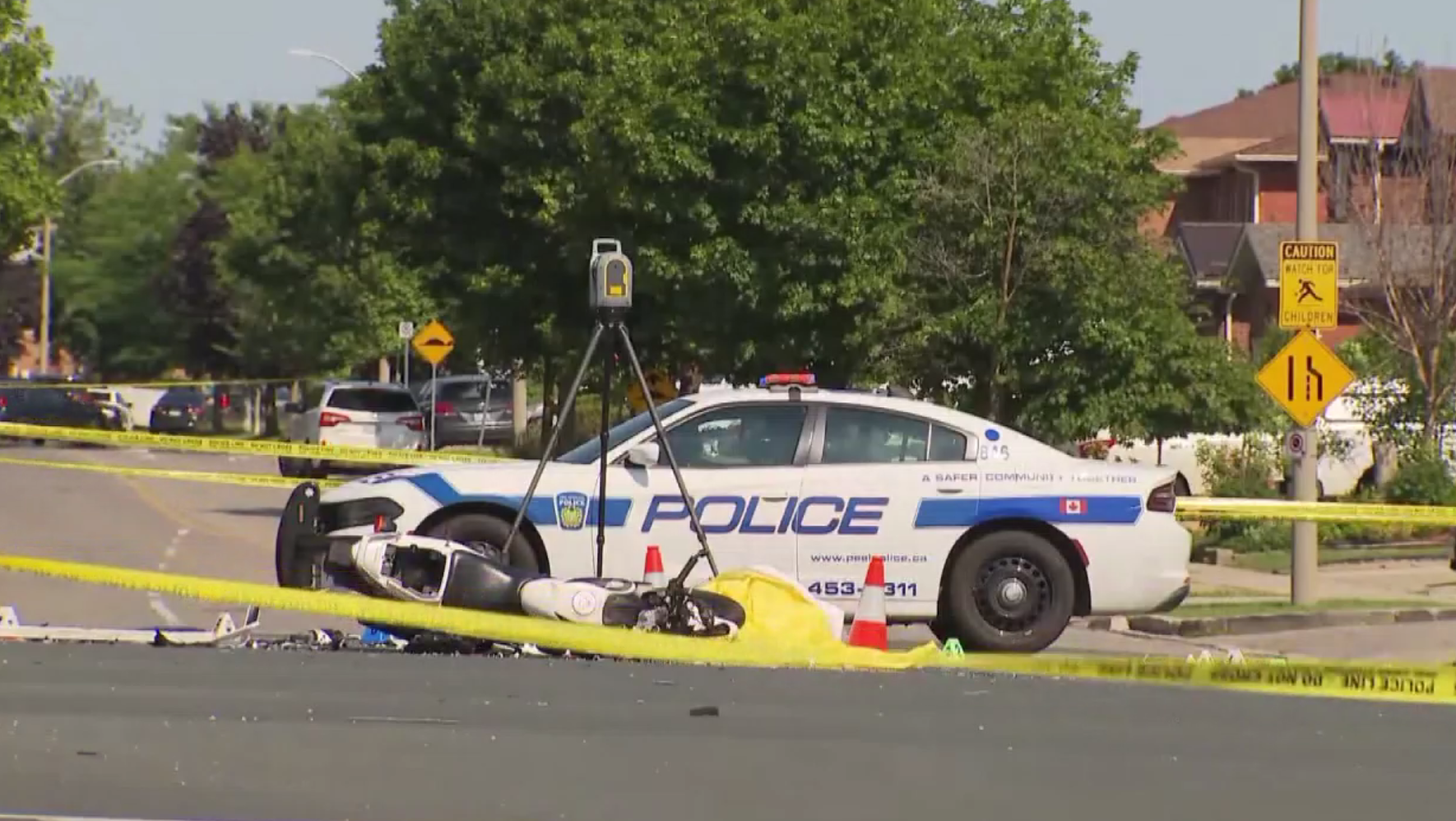
The intersection of Bovaird Drive and Yellow Brick Road in Brampton, Ontario, serves as a stark case study in the structural, mechanical, and legal vectors that govern fatal multi-vehicle collisions. On June 27, 2026, at approximately 3:47 a.m., a collision occurred between a white sport utility vehicle (SUV) operated by a 48-year-old male and a motorcycle operated by a 21-year-old male. The operational reality of this event reveals the profound vulnerability of two-wheeled operators when subjected to asymmetric mass distribution, degraded operator performance via impairment, and the legal mechanics of post-collision behavioral choices.
To evaluate this event with rigorous precision, the incident must be broken down into three distinct operational domains: physical kinematics, human performance degradation, and the statutory architecture of the Canadian Criminal Code.
The Kinematics of Asymmetric Mass Disparity
The physical interaction between an SUV and a motorcycle is governed by fundamental principles of classical mechanics. In any multi-vehicle collision, the structural disparity between the platforms dictates the distribution of kinetic energy and the subsequent survival envelope of the occupants.
The mass of a standard mid-size SUV ranges between 1,800 and 2,400 kilograms, whereas a standard sport or commuter motorcycle yields a total operational mass—including the rider—of approximately 250 to 350 kilograms. This establishes a mass ratio minimum of approximately 5:1, and frequently exceeding 8:1.
According to the conservation of momentum:
$$p = m v$$
In an intersection collision where the velocity vectors intersect perpendicularly or obliquely, the momentum change ($\Delta p$) experienced by the lower-mass vehicle is exponentially higher than that of the higher-mass vehicle. The formula for kinetic energy transfers this mechanical work directly into the structural deformation of the vehicles and the body of the vulnerable road user:
$$E_k = \frac{1}{2} m v^2$$
Because kinetic energy scales quadratically with velocity, even moderate urban speeds create unsurmountable forces for an unprotected operator. When an SUV and a motorcycle collide, the motorcycle lacks a sacrificial crumple zone or a protective cabin structure. The rider is subjected to immediate deceleration, followed by secondary impacts against either the striking vehicle, the roadway, or municipal infrastructure.
Peel Regional Police investigators noted two conflicting initial trajectories: one indicating both vehicles were travelling straight through the intersection (one eastbound, one southbound), and another suggesting a left-turn execution across oncoming traffic. Each trajectory presents specific mechanical profiles:
- The Perpendicular T-Bone Trajectory: If both vehicles proceeded straight on intersecting paths, the motorcycle or SUV suffered a direct lateral impact. Lateral impacts on motorcycles result in immediate unstable rotation, causing the rider to be launched over the hood or directly crushed between the shifting masses.
- The Left-Turn Intercept Trajectory: If the SUV attempted a left turn across the path of an oncoming motorcycle, the configuration creates a visual tracking failure known as "motion camouflage." Because a motorcycle presents a narrow frontal profile, an impaired driver struggling with depth perception cannot accurately calculate the rate of closure, leading to an turn execution directly into the rider's path.
Physiological Degradation and System Failure
The arrest of the 48-year-old operator on charges of impaired driving introduces a quantifiable variable into the crash timeline. Alcohol consumption systematically degrades the human cognitive and motor control loops required to operate heavy machinery safely.
Safe driving requires the continuous execution of the Perception-Reaction Time (PRT) model. Under baseline conditions, a sober driver exhibits a PRT of approximately 1.5 seconds. This duration encompasses four distinct cognitive phases:
- Detection: The eye registers the physical presence of an object within the visual field.
- Identification: The brain processes the object, defining it as an oncoming motorcycle rather than background noise or ambient light.
- Decision: The cognitive center selects an action, such as applying brakes or steering away.
- Response Execution: The motor cortex signals the physical limb to depress the brake pedal or alter the steering column.
The introduction of ethanol into the bloodstream disrupts this entire loop. Alcohol acts as a central nervous system depressant by binding to gamma-aminobutyric acid (GABA) receptors and inhibiting glutamate receptors. The operational consequence is a measurable slowdown in neural transmission.
At blood alcohol concentrations (BAC) exceeding the legal limit of 0.08 grams per 100 milliliters of blood, the PRT often doubles or triples, stretching to 3.0 or 4.5 seconds. At a standard urban transit speed of 60 kilometers per hour, a vehicle travels 16.7 meters every single second. A two-second delay in reaction time translates directly to an additional 33.4 meters of unbraked vehicle travel.
This delay completely eliminates the opportunity for evasive maneuvering or emergency braking. The vehicle maintains its velocity entirely up to the point of impact, ensuring maximum kinetic energy transfer. Furthermore, alcohol consumption induces peripheral vision narrowing and diminishes low-light contrast sensitivity, which explains the heightened statistical frequency of fatal motorcycle encounters during the 3:00 a.m. window.
Post-Collision Behavioral Mechanics and Forensic Reality
The driver of the SUV initially fled the scene of the intersection collision, later returning while emergency crews and Peel Regional Police officers were actively processing the site. The decision to flee followed by a subsequent return highlights a specific psychological and forensic progression.
The immediate reaction to flee an incident is driven by acute panic and a cognitive avoidance mechanism, frequently exacerbated by the disinhibiting effects of alcohol. The operator prioritizes immediate self-preservation over civic and moral obligations. However, as the initial surge of adrenaline subsides, reality imposes itself.
The return to the scene presents specific strategic challenges for a defense council and distinct opportunities for forensic investigators. When an impaired operator leaves the scene of a fatal crash and returns hours later, a primary investigative challenge is establishing the exact BAC at the precise moment of impact. This requires a process known as retrograde extrapolation.
Forensic toxicologists track the elimination rate of alcohol from the human body, which generally occurs at an average rate of 15 to 20 milligrams percent per hour.
[Time of Impact: 3:47 AM] ---> [Driver Flees Scene] ---> [Driver Returns / Arrest] ---> [Breath/Blood Sample Obtained]
                                                                                                 |
                                                                                    [Retrograde Extrapolation Calculated]
By measuring the BAC at the time of processing and calculating backward using the elapsed time, toxicologists can prove the driver was over the legal limit at 3:47 a.m. If the driver claims to have consumed alcohol after fleeing the scene to calm their nerves—a common defense tactic known as the "intervening drink" defense—investigators must deploy forensic accident reconstruction, cellular localization data, and witness statements to invalidate the timeline.
Statutory Frameworks and Penal Accountability
The legal jeopardy facing the 48-year-old Brampton resident is structured under federal Canadian criminal jurisprudence. Peel Regional Police have initiated charges encompassing three severe categories under the Criminal Code of Canada:
- Impaired Driving Causing Death (Section 320.14(3)): This statutory offense requires the prosecution to prove beyond a reasonable doubt that the accused operated a conveyance while their ability to do so was impaired to any degree by alcohol, and that the operation of the vehicle caused the death of another person.
- Operation with a BAC Over 80 mg Cause Death (Section 320.14(2)): A distinct technical charge requiring scientific proof via breathalyzer or blood draw that the accused possessed a BAC equal to or exceeding 80 milligrams of alcohol per 100 milliliters of blood within two hours of operating the vehicle, resulting in a fatality.
- Failure to Remain at the Scene Causing Death (Section 320.16(3)): Commonly designated as a hit-and-run involving a fatality, this charge establishes that the operator knew or was reckless to the fact that their vehicle was involved in an accident, yet failed to stop, offer assistance, and provide their name and address, with the intent to escape civil or criminal liability.
The maximum penalty for impaired driving causing death and failure to remain causing death under Canadian law is life imprisonment. The structural sentencing guidelines emphasize denunciation and general deterrence for alcohol-related driving fatalities. The fact that the driver returned to the scene does not absolve the initial statutory breach of failing to remain; rather, it merely truncates the duration of the flight. It may be weighed by a judiciary during the sentencing phase as a mitigating factor regarding remorse, but it offers zero structural defense against the core liability of the collision itself.
The structural engineering of urban intersections must adapt alongside these legal enforcement mechanisms. While the judiciary punishes the human system failures of impairment and flight, municipal frameworks must look toward reducing physical points of conflict through geometric alterations, restricted left-turn phases, and automated enforcement loops to isolate vulnerable road users from heavy vehicle trajectories.