When an industrial chemical containment vessel undergoes runaway thermal overpressurization, municipal emergency management is forced into a reactive trade-off between logistical disruption and potential mass-casualty exposure. Media reports frequently framing these incidents as sudden race-against-the-clock dramas obscure the predictable thermodynamic principles and systemic engineering failures that drive them. Effectively managing an industrial containment crisis requires an understanding of the mechanical, chemical, and logistical variables that govern pressurized chemical storage.
Industrial facilities utilize pressurized containment vessels to stabilize volatile chemical compounds under specific operational limits. When these boundaries are breached, the physical state of the stored material transforms from a controlled process asset into an active threat vector. Deconstructing these incidents requires a systematic evaluation of thermodynamic escalation, containment mechanical physics, and the logistical mechanics of exclusion zone calculations.
The Thermodynamic Mechanics of Runaway Storage Systems
The escalation of a stationary chemical tank from a stable storage state to an imminent blast threat follows a definitive thermodynamic trajectory. Understanding this progression requires analyzing the system through a heat-transfer equilibrium model, where the rate of internal heat generation ($\dot{Q}{gen}$) competes against the vessel's ambient heat dissipation capacity ($\dot{Q}{loss}$).
Under standard operational parameters, the thermal equilibrium satisfies the following condition:
$$\dot{Q}{gen} \le \dot{Q}{loss}$$
In a runaway scenario—frequently initiated by mechanical cooling failure, external fire exposure (Natech events), or the accidental introduction of a catalytic contaminant—the internal chemistry shifts to an uncontrolled exothermic reaction. Because chemical reaction rates accelerate exponentially with temperature according to the Arrhenius equation, $\dot{Q}{gen}$ quickly outpaces $\dot{Q}{loss}$. This structural imbalance triggers a multi-phase cascading failure sequence within the vessel:
- Phase Change and Vapor Accumulation: As the liquid temperature surpasses its localized boiling point, rapid vaporization occurs. The accumulating gas occupies significantly more volume than its liquid precursor, driving a steep linear increase in internal pressure.
- Thermal Stress and Yield Strength Degradation: Simultaneously, extreme heat transfers directly into the structural steel walls of the tank. High temperatures drastically compromise the tensile yield strength of industrial alloys, lowering the pressure threshold at which structural failure becomes inevitable.
- The BLEVE Threshold: If internal vapor pressure continues to ascend while the container wall structural integrity degrades, the vessel reaches the threshold of a Boiling Liquid Expanding Vapor Explosion (BLEVE).
A BLEVE does not strictly require a flammable substance; it is a mechanical failure driven by the instantaneous, explosive flashing of a pressurized liquid into vapor upon the sudden rupture of the containment boundary. If the escaping substance is flammable, the subsequent mechanical dispersion mixes with atmospheric oxygen, leading to immediate ignition and a catastrophic fireball.
The Containment Mitigation Framework
When a storage system experiences a runaway thermal gradient, incident command teams deploy specific technical countermeasures designed to interrupt the thermodynamic feedback loop. These interventions focus on pressure suppression, thermal management, and chemical stabilization.
Pressure Relief Infrastructure
Industrial pressure vessels are equipped with mechanical pressure relief valves (PRVs) designed to vent vapor when internal forces exceed pre-set safety thresholds. While PRVs reduce the mechanical stress on the tank walls, their operational efficacy is bounded by structural constraints.
If the internal reaction transitions from a single-phase gas release to a two-phase liquid-vapor mixture, the volumetric flow capacity of a standard PRV becomes severely choked. The valve cannot discharge volume fast enough to match the volumetric generation rate of the reaction, causing internal pressure to continue rising despite a fully open relief system.
Thermal Mass Cooling
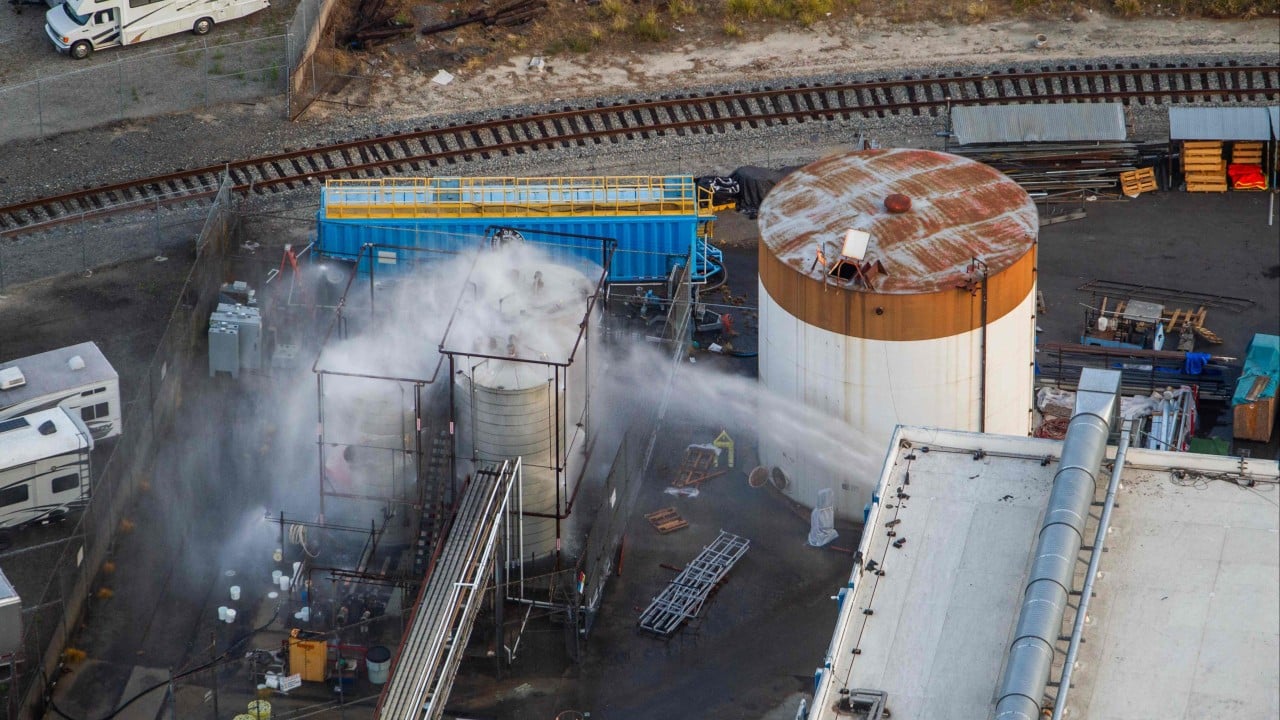
To artificially boost $\dot{Q}_{loss}$, emergency response teams deploy high-volume water monitors to continuously shroud the exposed steel surfaces of the tank. This tactic serves a dual purpose:
- Convective Heat Extraction: Direct water application extracts thermal energy via sensible heat transfer and latent heat of vaporization, lowering the internal temperature of the tank shell.
- Structural Tempering: The continuous liquid barrier prevents the steel from reaching its critical weakening temperature, preserving its structural yield capacity against internal stress.
The deployment of cooling streams carries operational constraints. First responders must balance water application to avoid thermal shock—unequal, rapid cooling across a compromised steel structure that can inadvertently trigger a mechanical fracture along stressed weld lines.
Chemical Retardation
When structurally feasible, technicians may attempt to inject chemical inhibitors directly into the failing vessel. These neutralizing agents are designed to terminate the reaction by scavenging free radicals or binding with active catalysts, halting $\dot{Q}_{gen}$ at the molecular level.
The viability of chemical mitigation depends entirely on the remaining operational window; if internal pressure has already distorted the vessel's injection ports or if the reaction rate has bypassed the mixing induction timeline, physical intervention becomes impossible.
Quantifying the Exclusion Zone: Logistical Mechanics
When mechanical and chemical mitigation strategies fail to stabilize the vessel, defensive emergency operations prioritize population protection via geographic isolation. Deriving the radius of an evacuation zone is not an arbitrary safety buffer but a precise calculation based on explosive blast overpressure calculations and atmospheric plume dispersion modeling.
[Containment Failure]
       │
       ├─► Blast Overpressure (TNT Equivalence) ──► Structural Blast Radius
       │
       └─► Toxic/Flammable Vapor Release ────────► Downwind Plume Dispersion Area
Blast Overpressure Estimation
To determine the physical radius of structural destruction and lethality, engineers calculate the total explosive energy release of the vessel utilizing a TNT equivalence model:
$$W = \frac{\eta \cdot E_{sub}}{E_{TNT}}$$
Where $W$ represents the equivalent mass of TNT, $\eta$ is an empirical explosion efficiency factor, $E_{sub}$ is the total thermodynamic energy released during the rapid expansion or combustion of the chemical substance, and $E_{TNT}$ is the standard energy constant of TNT ($4.184 \times 10^6 \text{ J/kg}$).
Once the TNT equivalent yield is established, incident commanders map blast overpressure radii using scaled distance equations to identify thresholds where structural collapse and fatal blast injuries occur.
Atmospheric Dispersion Dynamics
If the chemical asset is toxic or corrosive rather than strictly explosive, the exclusion zone must shift dynamically to mirror atmospheric conditions. Using predictive tools like the ALOHA (Area Locations of Hazardous Atmospheres) model, analysts map chemical plume dispersion by indexing real-time ambient variables:
- Wind Velocity and Vector: Dictates the direction and speed of the primary transport path.
- Atmospheric Stability Class: Measures vertical thermal turbulence to determine whether the chemical cloud will rapidly dilute or remain highly concentrated near ground level.
- Relative Vapor Density: Chemicals with a molecular weight greater than ambient air ($>28.97 \text{ g/mol}$), such as chlorine gas or heavy hydrocarbons, exhibit negative buoyancy (Business, 2010). These substances hug geographic topography, settling into low-lying residential sectors and resisting standard atmospheric dispersion (Business, 2010).
The second limitation of geographic isolation lies in logistical execution. Evacuating thousands of citizens demands clear execution grids to prevent traffic bottlenecks that leave populations immobilized within the calculated impact zone.
Systemic Vulnerabilities in Industrial Risk Assessment
The occurrence of an imminent tank failure points to deep-seated systemic gaps within an industrial facility's risk management architecture. Robust process safety management requires recognizing that mechanical failures are almost always the symptoms of latent organizational and design flaws.
Over-Reliance on Active Systems
Many industrial operations over-index on automated, active safety measures—such as digital sensors, automated deluges, and electronically actuated valves—while neglecting passive containment architecture. Active systems are inherently vulnerable to common-mode dependencies; a localized power grid failure, a facility-wide water pressure drop, or a digital control loop malfunction can simultaneously neutralize every line of defense.
Integrating passive safety measures, such as earth-bermed containment dikes, gravity-fed cooling reservoirs, and intrinsically safe fail-closed valving, ensures structural mitigation remains operational when secondary systems go offline.
The Normalization of Deviance
Catastrophic failures are rarely isolated anomalies. They are typically preceded by a chronic history of unaddressed minor deviations, such as drifting temperature gauges, weeping seals, or small pressure spikes. When these operational variances occur repeatedly without causing immediate failure, organizations build an artificial tolerance for risk, misinterpreting a lack of disaster as proof of systemic safety.
This normalization of deviance blinds management to the incremental erosion of their safety margins, transforming a predictable process drift into an acute emergency.
Operational Action Play
To insulate industrial operations and surrounding municipal sectors from catastrophic containment failures, asset managers and emergency planners must transition from reactive crisis response to a proactive engineering posture.
- Execute Transition to Passive Thermal Defense: Audit all high-consequence chemical storage assets and replace or supplement active cooling arrays with passive fireproofing insulation capable of enduring high-intensity thermal exposure for a minimum of four hours without structural yield degradation.
- Implement Multi-Phase Flow Relief Redundancy: Re-engineer vessel relief systems to include parallel, rupture-disk coupled surge lines specifically sized to exhaust two-phase liquid-vapor mixtures, preventing choked-flow overpressurization during exothermic runaway events.
- Establish Dynamic Evacuation Triggers: Replace fixed-radius emergency response plans with GIS-integrated, real-time atmospheric modeling software connected directly to facility sensor arrays, enabling automated, predictive exclusion zone adjustments based on instantaneous weather data.
References
Business, A. (2010). Chlorine gas exposure at a metal recycling facility — California, 2010. Morbidity and Mortality Weekly Report, 60(28), 951-954.
Cited by: 0