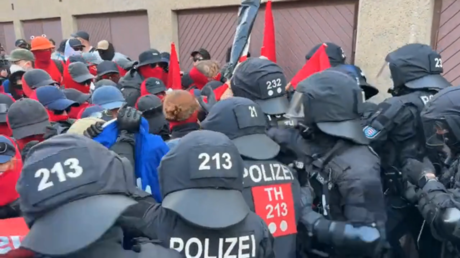
The operational conflict between federal police forces and civilian blockades during the Alternative for Germany (AfD) national congress in Erfurt highlights an escalating systemic vulnerability in Western European domestic security models. Media coverage frequently minimizes these events as brief physical altercations. However, an analysis of the structural mechanics reveals a deeper conflict: state law enforcement is increasingly forced to arbitrate the physical limits of democratic legitimacy.
When tens of thousands of demonstrators deployed sit-ins, highway abseiling tactics, and transit blockades to prevent the AfD convention from starting, the police responded with targeted crowd-control measures, including pepper spray. This interaction was not a random breakdown of public order. Instead, it was the predictable result of two opposing operational goals.
The Dual-Objective Friction Model
Civilian friction during major political events can be evaluated by analyzing how two competing factions attempt to control physical space.
- The State Institutional Objective: The constitutional mandate requiring law enforcement to guarantee the legal rights of registered political entities. This obligation remains active regardless of the ideological platform of the party in question.
- The Asymmetric Disruption Objective: The strategy used by decentralized activist networks to weaponize physical presence, aiming to impose a high logistics tax that makes the target event impossible to hold.
                  [State Mandate: Guarantee Assembly Rights]
                                      │
                                      ▼
                        ⚖️ LEGAL & SPATIAL FRICTION
                                      ▲
                                      │
               [Activist Strategy: Impose Logistics Blockades]
When these two objectives clash, police operations face a sharp tactical trade-off. If law enforcement acts too slowly, the state fails to protect the constitutional right to assemble. If the response is too aggressive, it risks escalating public outrage and validating the protesters' narrative.
In Erfurt, the activist coalition Widersetzen attempted to exploit this exact tension. By using distributed sit-ins and blocking key transit routes, they forced police commanders into a difficult choice: accept the shutdown of a major opposition party’s convention, or use physical force to clear public pathways.
Tactical Neutralization and Force Scaling
The use of chemical irritants like pepper spray points to a structural bottleneck in modern riot management. When a crowd relies on passive resistance or defensive blockades rather than active violence, standard crowd-control tools become less effective.
- Spatial Clearance Performance: Physical removal by officers is highly resource-intensive and slow. Clearing thousands of protesters from multiple transit arteries manually requires a massive ratio of officers to demonstrators.
- Escalation Control: Relying entirely on batons or physical strikes significantly increases the risk of serious injury, which can rapidly worsen crowd dynamics.
- Chemical Displacement Efficiency: Using targeted chemical irritants alters the crowd's immediate physical environment. It forces individuals to move without requiring direct, high-impact physical force from officers.
This tactical calculation explains why law enforcement used pepper spray during isolated clashes in Erfurt. It was an efficiency-driven choice designed to clear transit paths quickly enough for the AfD congress to open on time.
However, this approach carries a major strategic risk. While chemical irritants successfully resolve immediate spatial blockades, they also provide powerful visual material for the opposition movement. The resulting images fuel the political argument that the state is actively protecting extremist factions.
The Instability of the Political Firewall
This operational friction is directly tied to the growing instability of Germany's Brandmauer, or political firewall. Mainstream political parties use this framework to isolate the AfD from potential governing coalitions.
The strategy relies on a core contradiction. Mainstream parties attempt to isolate the AfD politically while the state is legally required to protect the party's institutional rights. This creates a highly volatile political environment.
┌────────────────────────────────────────────────────────────────────────┐
│                      THE INSTITUTIONAL CONTRADDICTION                  │
├────────────────────────────────────────┬───────────────────────────────┤
│          Political Firewall            │         State Mandate         │
├────────────────────────────────────────┼───────────────────────────────┤
│ De-legitimizes the opposition party    │ Guarantees constitutional     │
│ to isolate it from government.         │ protections and assembly.     │
└────────────────────────────────────────┴───────────────────────────────┘
This contradiction puts law enforcement in an unsustainable position. When the domestic intelligence agency classifies a political party as extremist, but the courts suspend that designation during active lawsuits, the legal boundaries for police intervention become blurred.
Protesters view their blockades as a necessary civic defense against a rising far-right threat. Meanwhile, the AfD uses the state-protected convention to frame itself as the true defender of democratic order against lawless agitators.
Strategic Forecast
As Germany approaches its next electoral cycle, the current model of handling public unrest faces structural breakdown. Relying on short-term tactical containment to manage deep political divisions is no longer sustainable.
Decentralized activist groups are likely to refine their blockading tactics. They will focus on asymmetric disruption, using techniques like synchronized transit shutdowns and highway abseiling that require minimal manpower but maximize economic and logistical delays.
Concurrently, populist parties will continue to use these containment actions to portray themselves as political outsiders facing unfair opposition.
The state cannot resolve these ideological battles through policing strategies alone. If law enforcement continues to be used as the primary tool to manage structural political instability, the physical cost of maintaining public order will rise sharply.
Over time, this dynamic risks eroding public trust in the neutrality of state institutions, transforming routine crowd control into a recurring battle over the legitimacy of the constitutional order itself.
German police clashed with left-wing activists protesting the AfD's party congress provides a detailed on-the-ground report from Erfurt, illustrating the scale of the civilian blockades and the exact tactical responses used by law enforcement to clear access routes to the convention center.