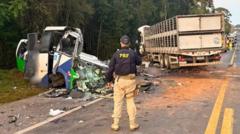
Mass casualty transit disasters rarely stem from isolated errors; they expose systemic vulnerabilities across infrastructure design, fleet management, and regulatory enforcement. The collision on Brazil's BR-373 highway in Paraná state, which resulted in at least 23 fatalities following a head-on impact between a municipal health transport bus and a heavy freight lorry, serves as a high-consequence case study in systemic transit risk. Deconstructing the mechanics of this event requires examining the variables that turn routine transport operations into critical failure points.
The Vector of Failure Infrastructure and Geometry
The physical environment dictates the kinetic energy bounds of any vehicular collision. The BR-373 corridor operates primarily as a two-way, two-lane arterial lacking central physical barriers. In transport engineering, undivided highways carrying mixed-mass traffic configurations feature a baseline vulnerability index driven entirely by opposing momentum vectors.
When a heavy commercial freight vehicle interacts with a lighter passenger transport vehicle on an undivided geometry, mass asymmetry dictates the severity outcome. The kinetic energy transfer heavily penalizes the lighter vehicle during trajectory deviations. Federal Highway Police preliminary data indicated that the lorry crossed the centerline at kilometer 209 in the early morning hours, around 03:30 local time.
This timing introduces compounding operational variables:
- Circadian fatigue degradation in long-haul commercial drivers.
- Reduced ambient visibility requiring absolute reliance on lane discipline markings and retroreflective infrastructure.
- Sub-optimal reaction windows when closing speeds compound across opposing lanes.
The Institutional Transport Model Risk Aggregation
The operational context of the passenger vehicle reveals structural strains in public sector resource allocation. The minibus belonged to the municipal health department of Imbituva, deployed to transport patients and their caregivers over long distances to medical centers in Curitiba.
This municipal medical transit model creates specific logistical risk multipliers. Smaller municipalities frequently rely on long-distance road transit to bridge healthcare access gaps between regional towns and major capital hubs. These journeys often occur during off-peak hours to secure early morning medical appointments.
The institutional risk profile encompasses three structural vulnerabilities:
- Extended transit durations operating outside standard commercial fleet safety management systems.
- High passenger occupancy configurations within lightweight commercial chassis conversions lacking heavy-duty crash survivability cells.
- Economic pressures that limit redundancy in driver staffing, pushing vehicles onto high-speed arteries during high-fatigue windows.
The Regulatory and Enforcement Deficit
Macro-level statistics place these incidents within a predictable distribution rather than marking them as statistical anomalies. Traffic mortality data published by international bodies and Brazilian transport ministries demonstrate tens of thousands of annual fatalities on national road networks.
The regulatory framework faces persistent execution bottlenecks. Enforcement agencies operate under severe resource constraints across vast geographic expanses, limiting continuous monitoring of commercial driving hours, vehicle maintenance compliance, and load management. Weight violations, mechanical degradation, and fatigue management slip through structural oversight gaps.
Mitigating these recurring systemic failures requires shifting from reactive post-accident investigations to predictive network hardening. Highway authorities must prioritize the installation of rigid central New Jersey barriers on high-density corridors, expand mandatory telematics for municipal transport fleets, and enforce strict rest-period compliance for both commercial freight and public-sector logistics operators to decouple transit volume from catastrophic mortality rates.