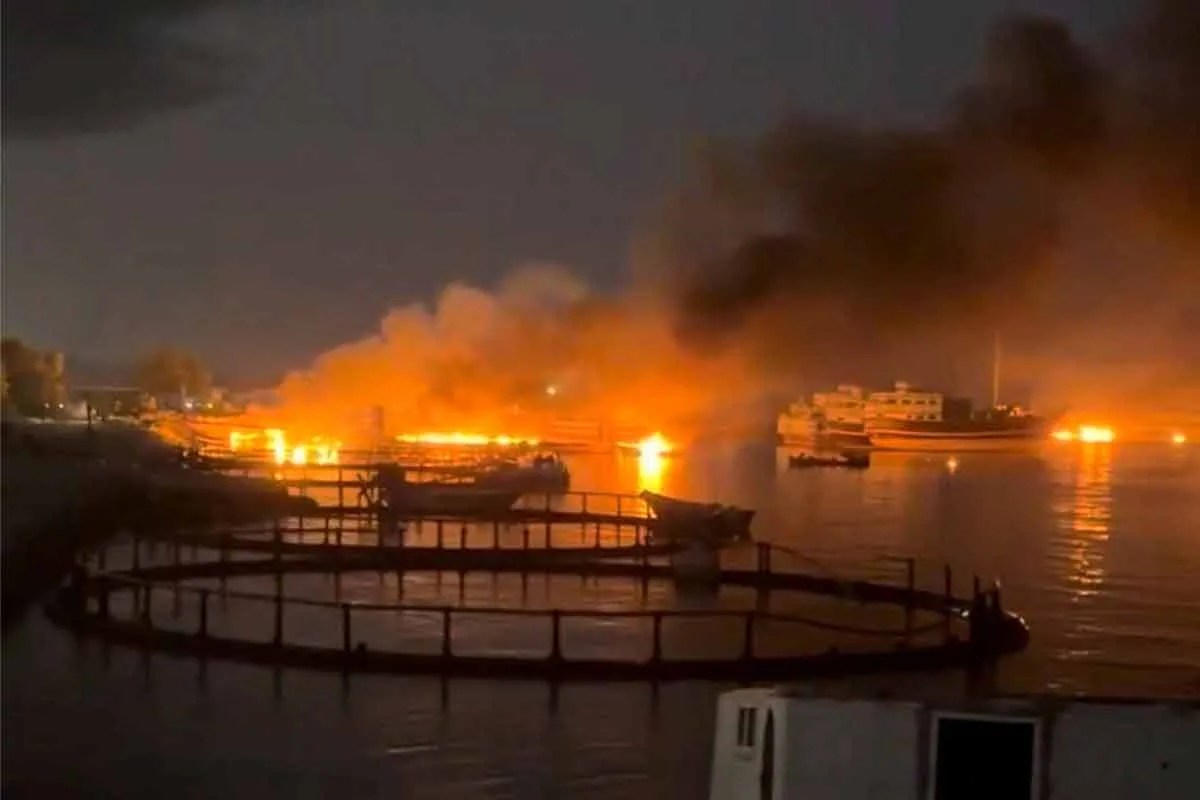
Kinetic friction in the Persian Gulf has reached a critical threshold, shifting from asymmetric maritime proxy warfare to direct infrastructural targeting. The recent sequence of coordinated explosions reported across multiple Iranian port cities—specifically concentrating around the strategic energy and nuclear logistics hub of Bushehr, alongside Konarak and Choghadak—demonstrates a structural failure of regional deterrence frameworks.
Understanding this escalation requires analyzing the interplay between tactical missile defense operations, international communication vectors, and the underlying geopolitical friction points that govern the Strait of Hormuz.
The Strategic Triad: Mapping the Escalation Matrix
The concurrent events reported within the last 48 hours are best classified under three structural pillars. Each pillar represents a separate layer of communication, military action, and diplomatic maneuvering.
Pillar 1: Kinetic Vectors and Air Defense Saturation
Initial reports from the semi-official Mehr News Agency noted approximately ten distinct detonations across southern Iranian littoral zones. Local governance within Bushehr attributed these kinetic events to a "U.S.-Israeli projectile" striking near a military installation.
Conversely, official state media apparatuses, including the Islamic Republic News Agency (IRNA), heavily minimized the incident. They assigned the acoustic signatures to the planned or reactive activation of local surface-to-air missile (SAM) defense systems.
This divergence highlights a classic informational asymmetry during kinetic events. The state attempts to maintain the illusion of absolute airspace sovereignty, while regional operational commands inadvertently leak tactical vulnerabilities.
Pillar 2: The Washington-Tehran Attribution Void
A critical variable in this escalation cycle is the immediate breakdown of direct attribution. Following the explosions, senior U.S. defense officials explicitly denied launching active kinetic operations inside Iranian borders during that specific operational window.
This creates a distinct attribution void. This void can be explained by two highly probable operational hypotheses:
- The Stand-off Proxy Hypothesis: The strike was executed exclusively by Israeli long-range assets using regional stand-off munitions. This allows Washington to maintain a layer of plausible deniability while benefiting from the degradation of Iranian infrastructure.
- The Air Defense Panic Cascade: The localized activation of Iranian SAM batteries was triggered not by an incoming strike, but by electronic warfare operations. This caused automated systems to engage phantom targets, resulting in self-inflicted kinetic signatures.
Pillar 3: The Bilateral Coordination Axis
Simultaneously, a high-level diplomatic communication vector opened between Washington and Jerusalem. Former U.S. President Donald Trump engaged in a direct telephone brief with Israeli Prime Minister Benjamin Netanyahu.
The Prime Minister’s office confirmed that the discussion focused primarily on "American operations in the Gulf" and "continued coordination across multiple sectors". This exchange indicates that while the U.S. may deny immediate kinetic execution, it acts as the primary logistical and intelligence anchor for ongoing regional operations.
The Economics of Friction: The Strait of Hormuz Bottleneck
The immediate catalyst for this military friction is the breakdown of maritime economic protocols. At the core of the dispute lies the failing implementation of Article 5, a treaty provision designed to guarantee the unhindered passage of commercial vessels through the Strait of Hormuz.
[Treaty Article 5 Framework]
         │
         ▼
┌──────────────────────────────────────────────┐
│ 60-Day Free Commercial Passage Mandate        │
└──────────────────────┬───────────────────────┘
                       │
         ┌─────────────┴─────────────┐
         ▼                           ▼
┌──────────────────┐       ┌──────────────────┐
│ US/Gulf Allies   │       │ Iran (IRGC)      │
│ Interpretation   │       │ Interpretation   │
├──────────────────┤       ├──────────────────┤
│ Absolute open    │       │ Conditional text │
│ transit without  │       │ equals primary   │
│ regional tolls.  │       │ sovereign veto.  │
└──────────────────┘       └──────────────────┘
The text dictates a 60-day window for clear, un-tariffed commercial transit while regional actors clear residual mines and naval hazards. However, the structural flaw of Article 5 is its lack of precise enforcement mechanism definitions.
The Trump administration interpreted the clause as an absolute opening of global energy lanes. Hardline factions within Tehran, specifically the Islamic Revolutionary Guard Corps (IRGC), interpreted the text as a legal recognition of their sovereign right to control and vet passing maritime traffic.
The IRGC’s insistence on a mandatory approval architecture for transiting tankers directly challenges Western naval hegemony in the region. This has driven the recent tit-for-tat cycles of tanker seizures and drone deployments.
Tactical Realities of the Bushehr Perimeter
Bushehr cannot be analyzed as a standard municipal target. It houses Iran's primary operational nuclear power facility, alongside significant naval infrastructure.
Any projectile impacting the perimeter of Bushehr carries profound strategic weight. It signals that the informal red lines established during the April 8 ceasefire have been completely discarded.
The technical limitation of evaluating these strikes via open-source intelligence is the lack of verifiable target damage assessments (BDA). If the explosions were purely air defense interceptions, the system functioned as intended but revealed its battery locations. If the perimeter was breached, it demonstrates that the saturation threshold of Iran's localized terminal defenses is significantly lower than claimed by state media.
The Strategic Play
The regional security landscape is moving toward a decisive confrontation regarding maritime access. The U.S. and its regional allies are unlikely to tolerate an IRGC veto over the Strait of Hormuz. Conversely, Tehran cannot back down without structurally compromising its primary geopolitical leverage point.
The optimal strategic play for Western allied naval forces is the implementation of an unyielding, convoy-based defensive umbrella over commercial shipping. This must be coupled with systematic, non-attributable cyber and electronic warfare operations targeting southern Iranian early-warning radars.
By blinding the littoral radar networks without launching highly visible kinetic missiles, the alliance can force Iran’s air defense networks into a permanent state of hyper-reactivity. This will degrade their operational readiness through false alarms and internal logistics strain, all while keeping escalation just below the threshold of open, region-wide conventional warfare.