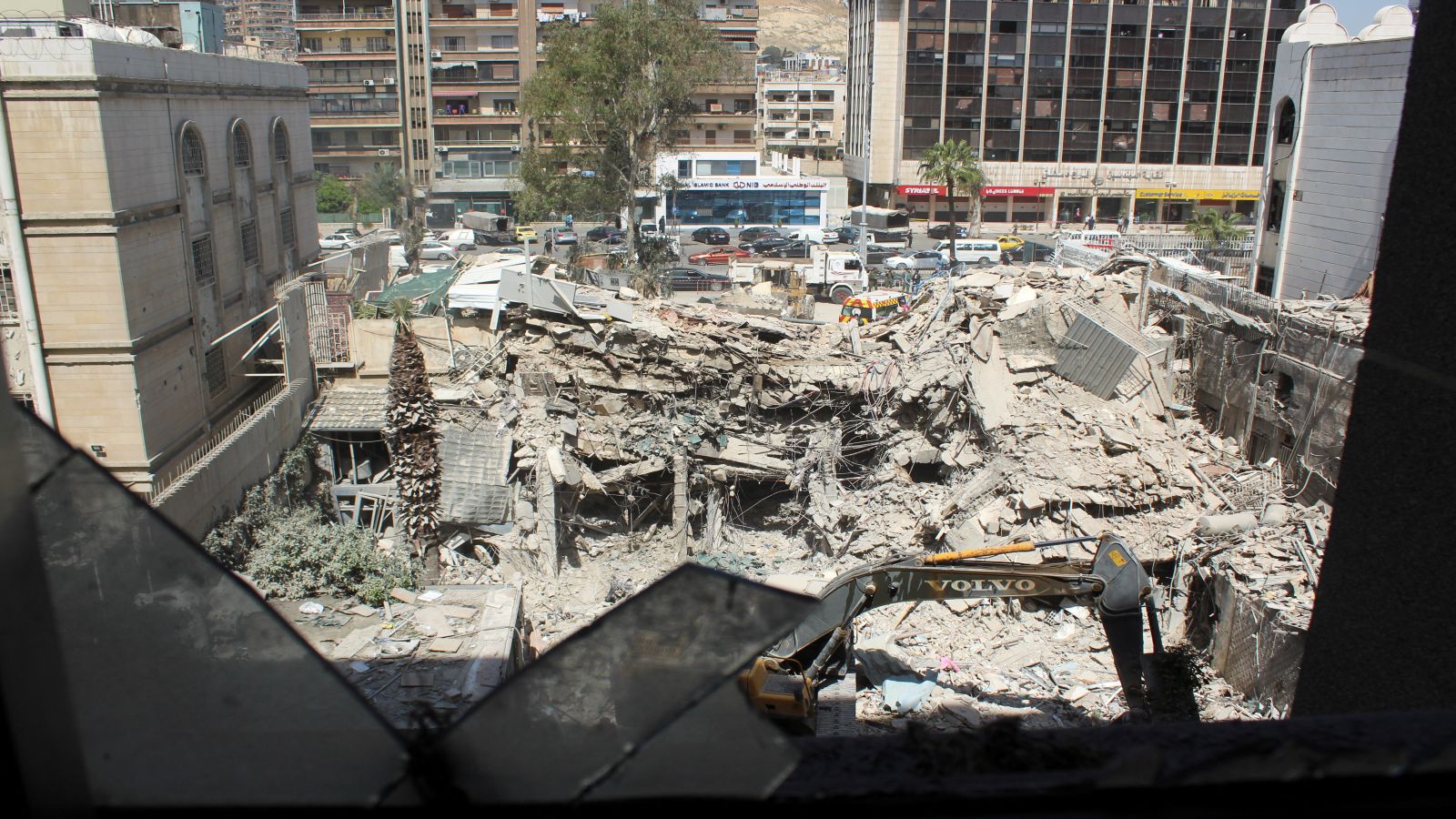
The announced strike by Iran’s Islamic Revolutionary Guard Corps (IRGC) against the Al-Tanf military outpost in Syria represents a distinct shift in Tehran’s regional confrontation strategy. Rather than relying on deniable proxy operations, the IRGC directly claimed a complex, multi-axis assault as part of "Operation Nasr-2". While public reporting focuses heavily on the immediate casualties and tactical destruction claimed by Iranian state media, an analytical deconstruction of the event reveals a broader structural calculation.
Understanding this escalation requires analyzing the operational mechanics of the strike, the strategic signaling of the targets chosen, and the regional constraints governing both Washington and Tehran.
The Strategic Triad: Map of the Escalation Loop
The escalation between the United States and Iran operates within a highly structured feedback loop. The strike on Al-Tanf was not an isolated tactical decision; it was the direct outcome of a three-stage retaliatory cycle.
- The Catalyst: A prior U.S. missile attack targeted an Iranian Army Ground Force base in Bampur, Sistan and Baluchestan. This strike crossed a critical threshold by targeting sovereign Iranian territory and killing seven military personnel.
- The Retaliatory Pivot: Rather than executing a symmetric strike within Iranian borders, the IRGC projected power outward. By targeting Al-Tanf—a key hub situated at the tri-border junction of Syria, Jordan, and Iraq—Tehran selected a high-value U.S. footprint designed to signal vulnerability without initiating a direct homeland-to-homeland exchange.
- The Chokepoint Leverage: Simultaneously, the IRGC linked the land-based strike to its maritime leverage, warning that continued U.S. operations would result in a total blockade of energy exports through the Strait of Hormuz.
This triad demonstrates how Iran uses localized tactical strikes to establish broad strategic deterrence.
Technical and Operational Reality Checks
Iranian state media claimed the strike destroyed a radar system, eliminated multiple special operations helicopters, and inflicted high casualties. However, a clinical assessment of the operational environment reveals significant discrepancies between rhetorical objectives and tactical realities.
The Al-Tanf Relocation Variable
The primary structural flaw in the IRGC’s messaging lies in the physical status of the target. In February 2026, the U.S. military completed a planned withdrawal of its primary footprint from the Al-Tanf garrison. While the site remains a geographic point of interest and may host minimal residual assets or local partner forces, the claim of destroying an active "special operations command center" with massive American casualties is highly inconsistent with known U.S. force posture changes.
The Air Defense Deficit
The claim that IRGC Aerospace Force fighters or long-range assets launched a surprise strike capable of completely neutralizing radar and rotary systems overlooks the density of regional air defense networks. To reach Al-Tanf, ballistic missiles or unmanned aerial vehicles (UAVs) must traverse heavily monitored airspace. Jordan’s active interception of Iranian ordnance during the same operational window highlights the formidable interception barrier that any strike package faces before reaching Syrian airspace.
The Strait of Hormuz Cost Function
The threat to halt all oil and gas exports through the Strait of Hormuz represents Tehran’s primary economic weapon. This choke point handles roughly 20% of the world's liquefied natural gas and petroleum consumption.
However, implementing a total blockade carries a severe, non-linear cost function for Iran itself:
$$C_{\text{blockade}} = E_{\text{lost}} + S_{\text{diplomatic}} + M_{\text{retaliation}}$$
Where:
- $E_{\text{lost}}$ represents the immediate loss of Iran's own energy export revenues, primarily to Asian markets.
- $S_{\text{diplomatic}}$ represents the severe diplomatic friction generated by disrupting the economic interests of non-aligned global powers, including China.
- $M_{\text{retaliation}}$ represents the certainty of a massive, multinational naval coalition response led by the United States and its allies.
Because this cost function is prohibitively high, the threat of a blockade is far more valuable as a diplomatic bargaining chip than as an active military operation. By raising the hypothetical cost of conflict, Iran attempts to force international pressure onto Washington to de-escalate.
Regional Geopolitical Friction Points
The strike has triggered immediate second-order effects across neighboring states, each operating under its own strategic constraints.
Syria’s Neutrality Objective
Syrian leadership under President Ahmed al-Sharaa has consistently attempted to insulate Damascus from the broader regional conflict. The Syrian government’s official policy remains that it will not enter active hostilities unless its own territory is directly targeted. By launching strikes from or into Syrian territory, the IRGC directly challenges Damascus's sovereignty and its efforts to maintain strategic distance from the U.S.-Iran escalatory spiral.
Jordan's Defensive Posture
Jordan finds itself physically caught in the crossfire. With the IRGC simultaneously claiming strikes on the Muwaffaq Salti Air Base in Al-Azraq, Amman has been forced to activate its air defense systems to intercept incoming threats. This escalation places immense strain on Jordanian internal stability and its defense agreements with Western allies.
Strategic Action Playbook
For defense analysts and regional security planners, managing this escalation cycle requires moving away from reactive tactical deployments toward a comprehensive containment strategy.
First, the United States must maintain a highly distributed force posture in the region. The withdrawal from centralized bases like Al-Tanf should be accelerated in favor of mobile, hard-to-target logistics nodes that deny the IRGC easy symbolic targets.
Second, air defense integration among regional allies—specifically Jordan, Saudi Arabia, and the Gulf States—must be standardized. By sharing real-time radar telemetry, these nations can create an overlapping interception grid that neutralizes the military utility of Iranian drone and missile salvos before they reach their targets. This collective defense approach systematically reduces the tactical value of Iran's "Nasr" operations, rendering their regional strike strategy cost-prohibitive.