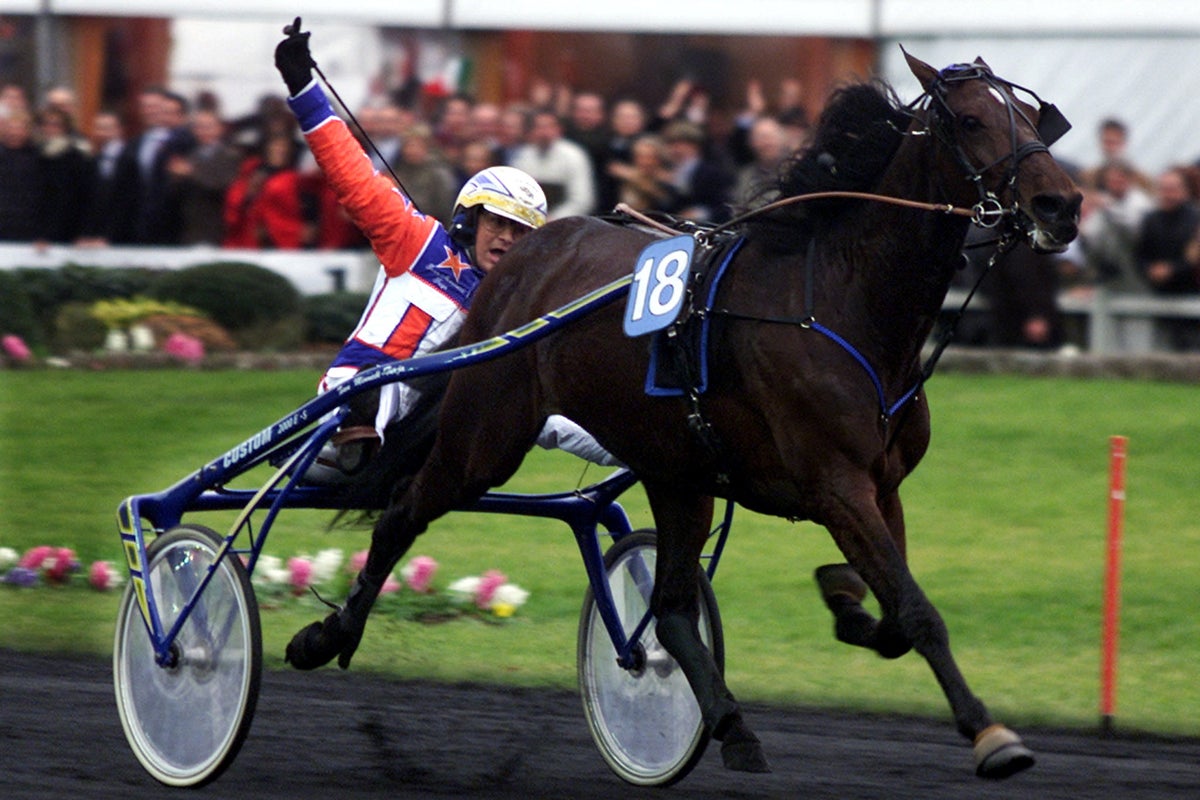
The death of Varenne at age thirty-one marks the conclusion of an extraordinary biological experiment in harness racing. Accumulating sixty-two victories across seventy-three starts and generating approximately six million euros in direct purse earnings establishes a baseline performance metric, but the true economic and genetic valuation of the horse lies elsewhere. Understanding the systemic impact of an elite equine athlete requires shifting focus from racecourse statistics to the mechanics of genetic propagation, bloodline concentration, and the structural economics of the standardbred breeding industry.
The Biomechanics of the Trotter and the Efficiency Frontier
Standardbred racing differs fundamentally from Thoroughbred flat racing through its strict gait requirements. Competitors must pull a two-wheeled sulky while maintaining a specific two-beat diagonal gait known as a trot, avoiding a break into a gallop under penalty of disqualification. This mechanical constraint places a severe premium on coordination, structural soundness, and neuromuscular efficiency.
Varenne redefined the upper bound of this efficiency frontier. Most elite trotters possess a natural pacing or trotting rhythm optimized for specific track curvatures and surface densities. Varenne demonstrated an exceptional capacity to maintain maximum velocity through turns without losing mechanical integrity. This anatomical asset—characterized by an unusually long stride length relative to body mass and rapid neuromuscular recovery—allowed him to dominate international circuits across Italy, France, Sweden, and North America.
Evaluating equine athletic supremacy requires breaking down performance into three distinct variables:
- Propulsion Force: The raw muscular output generated by the hindquarters translated through the hocks and stifles.
- Kinetic Economy: The minimization of vertical oscillation and lateral sway during high-speed locomotion, reducing metabolic waste.
- Stress Distribution: The structural capacity of the distal limbs to absorb repetitive impact forces on varied track surfaces over a multi-year career.
When an animal optimizes all three variables simultaneously, it ceases to be a mere competitor and becomes an outlier that skews the competitive landscape of the sport.
The Industrial Scale of Genetic Distribution
The transition of an elite athlete into a breeding stallion initiates a completely different economic engine. Over his stud career, Varenne sired more than two thousand offspring. This high-volume progeny output illustrates the modern industrialization of equine reproduction, heavily reliant on artificial insemination and sophisticated shipped-semen logistics rather than traditional live cover models.
In biological terms, siring two thousand descendants creates a massive genetic footprint within a specific population pool. However, probability theory dictates that extreme phenotypic outliers do not distribute in a linear fashion. The economics of the breeding shed operate on a power-law distribution. While thousands of offspring inherit fractions of the champion's genotype, only a minute percentage—often less than one percent—achieve Group or Grade One racing status.
The value creation mechanism depends on standing fee optimization. A stallion's market value is determined by a discounted cash flow model based on the projected auction prices of his yearlings and the anticipated racing success of his progeny. By siring a vast quantity of foals, the management syndicate diversified the risk profile while maximizing short-term stud fee revenue, even if it simultaneously saturated the market with varying grades of genetic potential.
The Bottleneck of Standardbred Inbreeding Coefficients
Deploying a single sire across more than two thousand offspring introduces structural vulnerabilities into the broader standardbred gene pool. Modern harness racing already suffers from closed stud books and intensive linebreeding aimed at concentrating desirable traits such as speed, stamina, and tractable temperament.
When a single dominant stallion accounts for an outsized share of a generation's pedigree charts, breeders face the long-term risk of genetic drift and inbreeding depression. The concentration of mitochondrial and nuclear DNA from one exceptional individual compresses genetic diversity. While this strategy yields short-term performance spikes—producing elite international winners who inherit the sire's specific gait mechanics—it narrows the biological buffer against novel equine pathogens and systemic weaknesses.
Managing this risk requires a disciplined counter-strategy among breeders:
- Outcrossing Protocols: Actively pairing Varenne-line mares with divergent North American or Scandinavian trotting lines to preserve heterozygous vigor.
- Coefficient Tracking: Utilizing genomic selection tools to map the exact percentage of shared ancestry before booking breedings, moving beyond visual pedigree inspection.
- Trait Isolation: Selecting offspring that specifically mend structural deficiencies observed in the sire line rather than blindly doubling down on speed metrics.
The Quantification of Brand Longevity and Cultural Capital
Beyond the biological footprint, Varenne achieved a rare status: an equine asset that generated value outside the racing oval. Cultural capital in equestrian sports typically evaporates the moment an animal retires from competition. Varenne defied this trajectory by maintaining sustained public visibility, commercial sponsorship integration, and media relevance for two decades post-retirement.
This longevity transforms a champion horse into a permanent intellectual property and marketing anchor for studs and racing associations. The economic return of this status manifests in increased track attendance, enhanced wagering volume during major stakes races bearing the animal's historical association, and sustained interest from demographics outside traditional gambling circles.
The death of such an asset triggers a structural revaluation across the breeding network. Without the physical presence of the stallion, the market must transition entirely from primary genetic generation to secondary lineage validation through sons standing at stud and daughters producing the next generation of broodmares.
Allocate capital toward proven broodmare sires carrying the Varenne genotype while heavily penalizing unverified third-generation descendants that lack functional racing validation on heavy European tracks.