The containment of the current Bundibugyo ebolavirus outbreak in the Democratic Republic of the Congo (DRC) is not failing due to a lack of international intent; it is failing because the operational mechanics of the response are fundamentally mismatched with the structural realities on the ground. When the Congolese government formally declared the outbreak on May 15, the official registry captured a fraction of the epidemiological reality. By late May, suspected cases surpassed 1,000, with more than 240 deaths recorded across Ituri, North Kivu, and South Kivu provinces, alongside spillover cases in neighboring Uganda.
The declaration of a Public Health Emergency of International Concern (PHEIC) by the World Health Organization (WHO), combined with high-profile diplomatic travel by Director-General Tedros Adhanom Ghebreyesus to Kinshasa and Bunia, follows a well-worn institutional playbook. However, evaluating the efficacy of an outbreak response through the volume of incoming aid or top-level funding pledges introduces a dangerous metrics bias. To accurately assess the trajectory of the Bundibugyo outbreak, analysts must decouple macro-level pledges from micro-level execution. The response is governed by three distinct structural bottlenecks: biological asymmetry, logistical friction, and geopolitical financing volatility.
The Biological Asymmetry of the Bundibugyo Strain
Epidemiological models designed for Ebola response are heavily indexed on data from the Zaire ebolavirus strain, which has historically driven the largest outbreaks in Central and West Africa. This reliance creates an immediate structural bottleneck when applied to the Bundibugyo ebolavirus (BDBV), a distinct species within the Orthoebolavirus genus.
The primary operational constraint is the total absence of countermeasure architecture for BDBV. While the Ervebo vaccine and monoclonal antibody treatments like Ebanga and Inmazeb have effectively altered the mortality curve for the Zaire strain, these interventions possess zero cross-protective efficacy against Bundibugyo. The containment strategy is therefore forced to regress to mid-20th-century public health protocols: absolute isolation, manual contact tracing, and supportive hydration therapy.
This lack of pharmaceutical interventions accelerates the transmission velocity through secondary mechanisms. In Ituri province, frontline medical personnel face an acute supply deficit, forcing personnel in municipal areas like Bambu to utilize expired personal protective equipment (PPE). When the clinical environment lacks baseline biosafety integrity, health facilities transform from containment nodes into amplification vectors. The clinical mathematical reality of an unmitigated BDBV outbreak is dictated by a high baseline reproduction number ($R_0$) that cannot be depressed via ring vaccination. Containment relies entirely on behavioral modification and physical barriers, both of which are currently compromised.
Furthermore, the official data exhibits severe reporting latency. The virus circulated undetected for several weeks prior to the May 15 declaration. In epidemiological systems, undetected circulation expands the geographical distribution of the pathogen exponentially rather than linearly. This explains the rapid manifestation of cases in South Kivu and across the Ugandan border, rendering localized quarantine lines obsolete.
The Logistical Friction Function
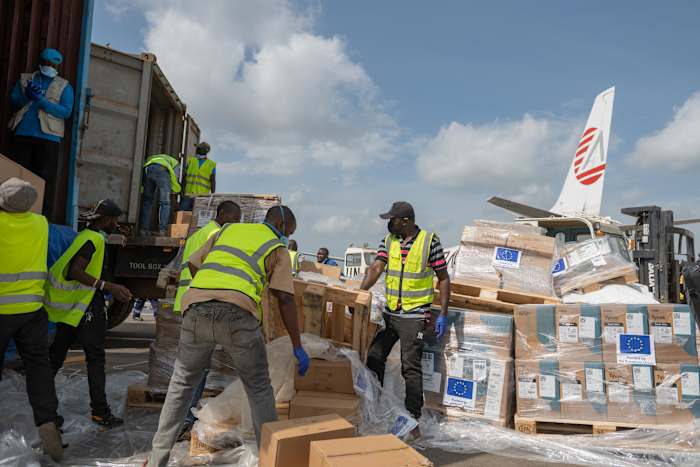
The arrival of a European Union cargo aircraft carrying medical infrastructure to Bunia National Airport represents a necessary, yet insufficient, stage of the supply chain. The operational utility of aid diminishes sharply as it moves from the tarmac to rural isolation centers. The distribution of emergency cargo in eastern DRC is governed by a logistics friction function, where delivery velocity is degraded by infrastructural deficits, bureaucratic inertia, and geographic friction.
Supply Chain Velocity = (Infrastructure Capacity × Administrative Efficiency) / (Geographic Isolation + Security Risk)
Humanitarian assessments indicate that the physical movement of cargo from regional hubs to localized clinics is impeded by three distinct systemic bottlenecks:
- Cold Chain and Storage Deficits: BDBV diagnostic test kits and supportive medications require climate-controlled storage. The lack of reliable electrical grids and localized refrigeration facilities in rural Ituri causes a rapid depreciation of consumable medical assets.
- Physical Transport Infrastructure: The road networks connecting Bunia to the epicenters of the outbreak are largely unpaved and subject to seasonal degradation. This transforms a short geographical distance into a multi-day transit vector, delaying the replenishment of PPE at critical moments.
- Customs and Bureaucratic Impediments: Despite the emergency status of the PHEIC declaration, international supply lines remain subject to central government administrative processing, creating a multi-day lag between the arrival of goods in country and their clearance for domestic deployment.
These physical constraints mean that while the UN and UNICEF can report metric tons of delivered cargo to international audiences, the actual volume of functional equipment available to a doctor treating a suspected patient in a remote village remains below the minimum safety threshold.
Geopolitical Financing Volatility and the Funding Chasm
The financial architecture supporting the global health response is highly unstable, characterized by a sharp disconnect between public commitments and capital liquidation. The Africa Centres for Disease Control and Prevention (Africa CDC) documented this phenomenon directly: an initial projection of $500 million in secured emergency funding pledges evaporated to $290 million within the span of 48 hours as international partners revised or retracted their commitments.
This volatility introduces severe planning friction. Outbreak containment requires long-term capital deployment to build out surveillance networks, hire local community trackers, and sustain supply pipelines. When funding structures experience a 42% contraction in the span of days, operational commanders cannot execute forward-looking strategies. They are forced instead to ration existing resources, prioritizing short-term stabilization over systemic containment.
While the United States announced an $80 million capital injection—escalating its total bilateral commitment to $112 million—the allocation of these funds reflects geopolitical risk management rather than optimized epidemiological positioning. A significant portion of Western funding is structurally diverted toward defensive containment: enhanced border screenings, airport surveillance, and regional quarantine infrastructure in peripheral nations like Kenya. This strategy aims to insulate external borders rather than suppress the viral load at the epicenter. By disproportionately funding global biosecurity perimeters over local clinical containment, international actors leave the primary source of transmission under-resourced.
Armed Conflict and the Breakdown of Sociomedical Trust
The most critical variable compounding the transmission dynamics of the Bundibugyo strain is the intersection of the outbreak with an active conflict zone. Eastern DRC is a highly fragmented security environment, with Ituri and the Kivus contested by armed groups including the Allied Democratic Forces (ADF) and the M23 rebel coalition.
The presence of non-state armed actors fundamentally breaks the traditional epidemiological playbooks in two ways:
1. The Geometry of Contact Tracing
Effective containment requires identifying, tracking, and monitoring 100% of an infected individual's contact network for a 21-day period. In territories controlled by rebel factions or subject to asymmetric insurgent attacks, epidemiologists cannot physically enter communities to map these networks. The geography of the conflict creates data blind spots. When contact tracing drops below a critical threshold, the chain of transmission becomes invisible, rendering mathematical modeling of the outbreak's trajectory impossible.
2. Displacements as Vector Multipliers
Military engagements generate sudden, mass civilian displacements. Populations fleeing violence are forced into informal, high-density internally displaced person (IDP) camps. These environments lack basic sanitation, clean water, and physical isolation capabilities. If ebolavirus enters an overcrowded IDP camp, the transmission dynamics shift from sporadic clusters to explosive, population-wide propagation.
This security crisis directly fuels a breakdown in community trust. Decades of conflict have conditioned local populations to view external interventions—whether military or medical—with intense skepticism. When international teams impose stringent medical protocols, such as non-traditional secure burials that disrupt deeply ingrained cultural rites, the local population perceives it as an administrative assault rather than a medical necessity.
This friction manifests as direct physical resistance. The registration of multiple targeted attacks against healthcare infrastructure in Ituri highlights a profound misalignment in risk communication. For a community experiencing chronic violence and structural neglect, an influx of heavily funded, foreign-led medical teams focused exclusively on a single pathogen generates alienation rather than cooperation. This alienation drives symptomatic individuals away from formal isolation centers and into hidden, domestic care settings, further driving community-wide transmission.
Operational Realignment Strategies
Continuing to deploy standard public health frameworks within a volatile conflict environment will not yield containment. To alter the current trajectory of the Bundibugyo outbreak, international and domestic state actors must shift from an administrative model to an agile, context-specific operational strategy.
- Decentralize Diagnostic Architecture: Shift from centralized laboratory testing in major urban centers to the immediate deployment of mobile, field-ready molecular diagnostic units at the village level. This removes the logistical lag of transporting blood samples across contested territories and reduces the time to isolation from days to hours.
- Implement Localized Co-Management: Cease top-down, mandate-driven risk communication. Operational control of community isolation nodes must be co-managed with trusted local authorities and traditional leaders. Burial protocols must be co-designed to respect cultural imperatives while preserving biosafety parameters, transforming the community from a point of resistance into the primary line of defense.
- Establish Neutral Humanitarian Corridors: Negotiate localized, strictly enforced medical ceasefires specifically for epidemiological surveillance. Public health entities must leverage neutral intermediaries to secure access guarantees from all combatant factions in Ituri and the Kivus, decoupling the medical response from the state's military apparatus.
- Stabilize Africa CDC Capital Flows: International donors must transition from discretionary, highly volatile pledge models to legally binding, upfront capital liquidations managed through an emergency escrow structure. This removes the operational whiplash caused by retracting pledges and allows Africa CDC to execute multi-month resource mapping.
The window for localized containment of the Bundibugyo outbreak is closing. If the infection rate inside eastern DRC's IDP camps breaches critical thresholds, the regional public health infrastructure will face systemic collapse, transforming a manageable regional crisis into an uncontained transnational emergency.