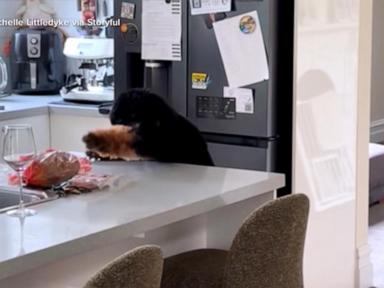
When a domestic dog attempts to seize a piece of cured pork from an elevated surface, observers typically register a simple behavioral glitch: a pet succumbing to immediate temptation. This surface-level interpretation collapses under systematic behavioral analysis. The event represents a precise intersection of evolutionary adaptation, olfactory optimization, immediate environmental feedback loops, and a temporary breakdown in executive function. To understand why a canine targets bacon with such singular focus, we must deconstruct the mechanics of stimulus salience, the neurology of delayed gratification in non-human animals, and the physical constraints governing home-environment foraging strategies.
The operational sequence begins with sensory input. Domestic dogs possess an olfactory apparatus containing up to three hundred million olfactory receptors, compared to approximately six million in humans. Furthermore, the canine olfactory cortex occupies a relative brain volume forty times larger than its human equivalent. When pan-fried pork undergoes the Maillard reaction, it releases volatile organic compounds—specifically heterocyclic amines, aldehydes, and sulfur-containing molecules—that travel on thermal air currents through a room. For a different view, see: this related article.
The canine olfactory system does not merely detect these molecules; it maps them in three-dimensional space through independent nostril movement, determining concentration gradients and directional vectors with high precision. This sensory input creates an immediate state of physiological arousal. Heart rate increases, salivary secretion spikes via autonomic nervous system activation, and the behavioral motor program shifts from resting homeostasis to goal-directed foraging.
The Cost Function of Canine Decision Making
Behavioral economists model animal decision-making through optimal foraging theory, which posits that animals maximize net energy intake per unit time spent foraging, adjusted for the metabolic cost and risk of the acquisition. In a controlled domestic environment, the traditional constraints of foraging—predator risk, search time, and metabolic expenditure—are effectively zero. The calculus shifts entirely to energy yield versus immediate reward proximity. Related coverage on this trend has been published by Vogue.
Bacon represents an optimal target under this biological cost function. It possesses an exceptionally high fat-to-protein ratio, signaling dense caloric concentration to an opportunistic carnivore. In ancestral environments, high-calorie resources were scarce and ephemeral; evolutionary pressure favored individuals who capitalized on high-density energy sources immediately upon detection, rather than deferring consumption for strategic reasons.
When a dog evaluates the bacon on a counter or plate, it executes a rapid, subconscious cost-benefit analysis. The cost is potential human reprimand or physical barrier restriction. The benefit is immediate consumption of concentrated lipids and sodium. Because the domestic dog has been selected for millennia to inhabit human niches, it also calculates human proximity and attentiveness. If the human agent is distracted, the perceived probability of successful acquisition increases, shifting the threshold required to trigger physical action.
The Neurology of Impulsive Motor Programs
Impulse control in the canine brain is governed by the prefrontal cortex and its regulatory circuits communicating with the limbic system, specifically the amygdala and the nucleus accumbens. When the visual and olfactory confirmation of high-value food hits the nervous system, the limbic system fires reward-prediction error signals. Dopamine pathways light up, driving motivation and motor output.
In young, untrained, or fatigued dogs, the prefrontal cortex fails to inhibit the motor cortex. The physical act of reaching, jumping, or lunging is an automated ballistic movement. The animal does not consciously decide to break the rules; rather, the neural impulse bypasses inhibitory control mechanisms because the incentive salience of the stimulus outweighs the internal braking system.
This dynamic explains why verbal commands to leave the item frequently fail during the critical window of execution. Once the motor program initiates, auditory processing is heavily filtered by hyper-arousal. The dog's sensory bandwidth is entirely consumed by the kinetic objective: bridging the spatial gap between its jaws and the target lipid source.
Environmental Variables and Spatial Mechanics
The physical success or failure of the attempt depends heavily on environmental variables that most casual observers ignore. Counter height, surface friction, spatial geometry, and the dog's biomechanical leverage dictate the mechanics of the lunge.
A medium-sized canine standing on a standard domestic floor surface must generate sufficient rear-limb drive to elevate its center of mass vertically while simultaneously projecting its cervical spine forward. The coefficient of friction between the floor and the animal's paw pads determines whether this launch is stable or slips. If the surface is slick hardwood, the animal must recalibrate its muscle activation patterns to prevent translational slippage, resulting in a distinct behavioral stutter or an aborted attempt.
Furthermore, visual angles play a critical role. If the target is occluded even partially by a plate rim or pan edge, the dog relies entirely on olfactory vectors, which decreases motor confidence. Unobstructed visual confirmation paired with olfactory proximity creates the highest probability of an execution attempt.
Strategic Interventions and Behavioral Modification
Managing this specific behavioral manifestation requires altering the environmental architecture and resetting the animal's associative learning pathways, rather than relying on post-hoc punishment, which fails to register temporally with the dog's cognitive processing window.
Environmental control represents the first line of defense. By removing high-value stimuli from accessible horizontal planes, owners eliminate the trigger before the cost-function calculation even begins. When environmental design is insufficient, systematic desensitization and counter-conditioning must be applied. This involves exposing the animal to the stimulus at a distance where impulse control remains intact, rewarding voluntary disengagement, and progressively decreasing the distance until the neural pathway favoring inhibition outcompetes the ancestral drive for immediate consumption.
The baseline reality remains unchanged by training: the biological imperative to secure dense calories is ancient and deeply encoded. Human co-habitants do not eliminate this drive; they establish artificial barriers and alternate reward schedules that make compliance more calorically or socially profitable than direct acquisition.
Implement a strict spatial protocol where high-value protein sources are restricted to vertical zones exceeding the animal's maximum extension height plus a twenty percent safety margin. Concurrently, establish a conditioned 'leave' cue using intermittent reinforcement schedules to rebuild the prefrontal cortex's inhibitory braking capacity during high-arousal states.