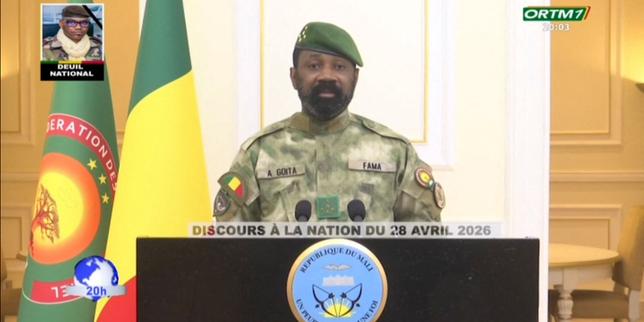
The survival of a military regime in a collapsing security landscape does not rely on territorial control, but on the systematic engineering of institutional, geopolitical, and narrative dependencies. In Mali, General Assimi Goïta has executed a textbook structural capture of the state apparatus. While conventional commentary focuses on the surface-level metrics of jihadist violence or shifting foreign alliances, the underlying reality is a highly calculated, tri-pillar framework designed to insulate the executive branch from both domestic democratic pressure and external economic shocks.
Understanding how a junta transitions from a temporary transitional authority to an indefinite governing structure requires breaking down the mechanisms of power consolidation into distinct operational variables: the monopolization of legal architecture, the weaponization of a national dignity narrative, and the strategic outsourcing of kinetic violence. Meanwhile, you can read other events here: Why the US China Summit 2026 Matters More Than You Think.
The Legal and Institutional Optimization Framework
The first pillar of autocratic longevity is the transformation of the state's judicial and legislative machinery into an executive rubber stamp. The transition from the initial August 2020 coup against Ibrahim Boubacar Keïta to the internal "coup within a coup" in May 2021 established a precedent: institutional compliance is maintained through the targeted elimination of civil equilibrium.
This mechanism reached its logical zenith through three specific interventions: To explore the full picture, we recommend the detailed report by The New York Times.
- The National Dialogue Instrument: Rather than risking an electoral challenge, the regime engineered the National Dialogue process—a controlled civic forum structurally dominated by junta loyalists. This mechanism provided the pseudo-legitimacy required to dismantle previous transition timelines.
- The Indefinite Term Extension Law: The statutory transformation of the presidency was formalized via legislation granting Goïta a five-year mandate, designed to be renewable without elections until "the country is pacified." This legal loophole creates an elastic time horizon, tethering the regime's political survival directly to an ongoing security crisis.
- The Dissolution of Civic Space: In a synchronized sequence, the Council of Ministers banned political party meetings and systematically dissolved active political associations. By treating political coordination as an existential threat to national security, the regime eliminated the structural infrastructure required for a civilian opposition to mobilize.
This institutional capture functions as an optimization loop. By replacing constitutional checks with executive decrees, the regime ensures that any legal challenge to its authority is structurally impossible. The judiciary does not arbitrate the law; it formalizes the executive's survival strategy.
The Geopolitical Cost Function and the Russian Alliance
The second pillar shifts the regime’s dependency away from Western security architectures toward a highly transactional arrangement with Russian state-aligned forces, specifically the Africa Corps. The expulsion of French forces under Operation Barkhane and the forced termination of the United Nations stabilization mission (MINUSMA) were not merely ideological gestures; they were strategic calculations to alter Mali's geopolitical cost function.
Western security assistance is inherently bound to conditionalities regarding human rights, democratic benchmarks, and institutional transparency. By cutting these ties, the junta removed the friction of external oversight. The replacement model relies on a clean, binary exchange: natural resource concessions and sovereign logistical access in exchange for regime-survival security.
This structural pivot operates through a specific cause-and-effect matrix. The departure of MINUSMA and French air assets created an immediate tactical vacuum in northern and central Mali, allowing groups affiliated with al-Qaeda (JNIM) and the Islamic State to expand their rural footprint. However, from the perspective of regime retention, a deteriorating rural periphery is an acceptable cost if the core urban center of Bamako and key military installations are insulated by private military contractors. The tactical deployment of Russian airpower and personnel is optimized for executive defense and high-impact symbolic operations, such as the temporary reclamation of Kidal, rather than comprehensive counterinsurgency.
The fundamental limitation of this strategy is its economic volatility. Sidelining Western donors and facing regional isolation from ECOWAS strains the national treasury. The state must fund its security apparatus through domestic extraction and mining revenues, creating a bottleneck where economic degradation could eventually outpace the coercive capacity of the military.
Myth Making and the Cultural Social Contract
The third pillar is the engineering of a domestic social contract based entirely on dignity and historical myth-making, effectively decoupling public satisfaction from material economic delivery or physical safety. Despite an inflationary environment and an expanding insurgency, popular support within urban centers remains insulated due to a sophisticated narrative architecture.
The regime has successfully positioned Goïta not as a conventional political administrator, but as an archetypal "hunter-warrior" savior, drawing direct parallels to historical epics like Sunjata Keita and the ancient Mali Empire. This narrative works because it capitalizes on a decade of deep-seated public frustration with the perceived failures of liberal state-building and international interventions.
The mechanics of this narrative leverage public psychology through three distinct phases:
[Decade of International Failure / Insecurity]
                       │
                       ▼
[Rejection of Liberal State-Building Frameworks]
                       │
                       ▼
[Acceptance of Sovereign Sacrifice for National Dignity]
By framing the current conflict as a war for absolute sovereignty against neocolonial interference, the junta has shifted the criteria by which it is judged. Economic hardship, electricity shortages, and localized security failures are rebranded as necessary sacrifices in a grand historical struggle. Foreign Minister Abdoulaye Diop structurally integrates references to historical hunter guilds (dozo) and traditional community structures into state rhetoric, transforming political compliance into a cultural and patriotic duty.
The Strategic Bottlenecks of Indefinite Rule
The long-term viability of Goïta's consolidation strategy is fundamentally constrained by two structural contradictions that cannot be resolved through narrative manipulation or localized coercion.
The first contradiction is the peripheral governance vacuum. While the regime retains absolute control over the institutional architecture in Bamako, its actual governance footprint in the north and east is rapidly shrinking. Insurgent networks like JNIM do not seek overt territorial conquest; they employ a strategy of rural penetration and negotiated influence. By alienating northern Tuareg and Arab populations through the dismantling of previous peace frameworks and centralizing all political authority within a southern military elite, the state accelerates the permanent detachment of its peripheral territories.
The second bottleneck is succession risk and institutional personalization. Following the elimination of senior figures, such as the late Defense Minister Sadio Camara, Goïta has increasingly consolidated personal control over the defense apparatus, effectively doubling as his own chief security architect.
When power becomes completely personalized within an individual rather than an institution, the internal stability of the regime becomes highly vulnerable to localized shocks. The elite military units that guard the executive must be continuously subsidized, creating an unsustainable fiscal burden in a sanctioned, donor-fatigued economy.
The definitive trajectory for Mali under this consolidated framework is not a return to constitutional normalcy, nor is it a total collapse of the capital. Instead, the strategy points toward a permanent state of militarized siege governance. The Alliance of Sahel States (AES) confederation with Niger and Burkina Faso serves as a mutual defense pact against both external intervention and internal dissent, formalizing a bloc of indefinite military rule across the Sahel.
The final strategic play for the regime is to continuously escalate the perception of external threat to justify internal repression, maintaining a closed political system where the state is structurally optimized for survival, even as the nation-state itself fragments.


.jpg)