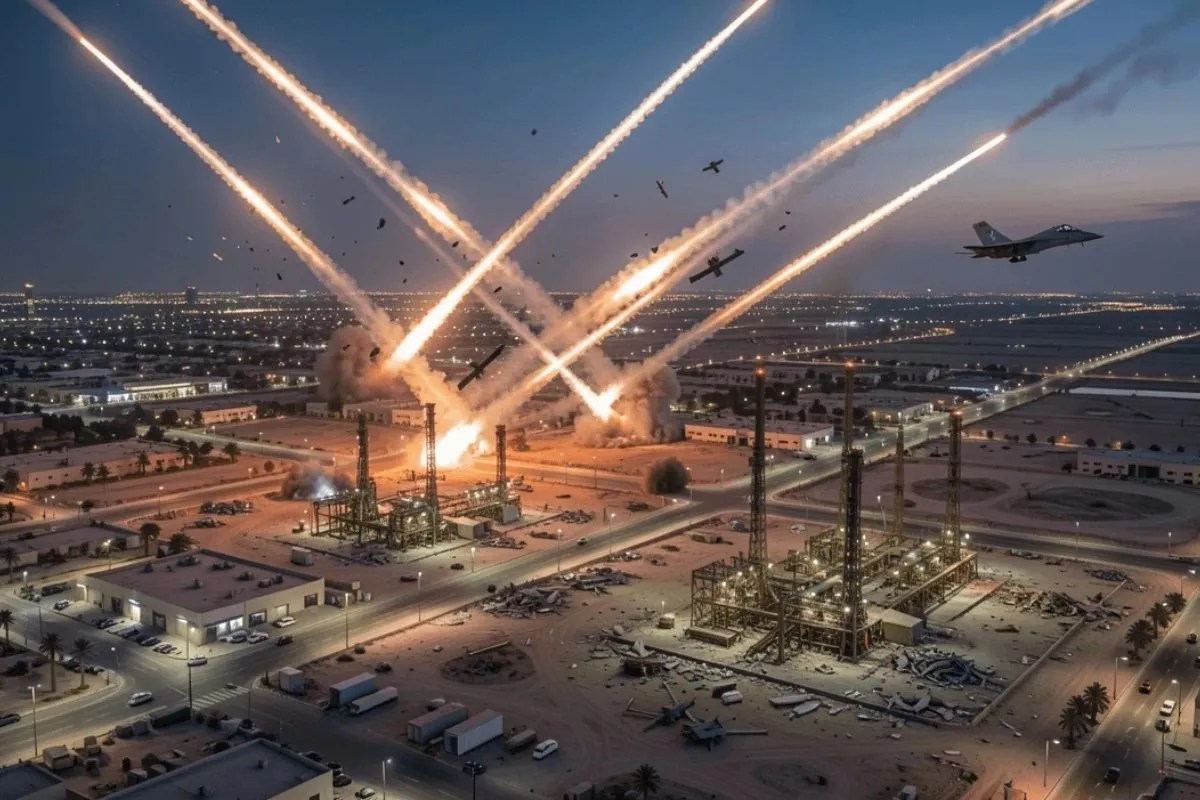
The targeted kinetic strikes on Kuwaiti power generation and water desalination facilities represent a deliberate shift from proxy skirmishes to high-consequence asymmetric infrastructure warfare. By isolating a state’s primary life-support systems, an aggressor can achieve strategic paralysis without requiring prolonged territorial occupation. Evaluating this conflict requires bypassing sensationalized headlines to map the structural vulnerabilities of specialized utility grids, the economic compounding effects of resource scarcity, and the regional security bottlenecks that dictate modern escalations.
The Dual Variable Vulnerability of Gulf Sub-Systems
The escalation model relies on a brutal reality: in hyper-arid zones, energy security and water security are not merely linked—they are the exact same variable. Kuwait’s domestic infrastructure operates on a tightly coupled feedback loop. Co-generation plants utilize thermal energy from electricity production to drive multi-stage flash (MSF) distillation and reverse osmosis (RO) systems.
Disrupting this architecture triggers a compounding failure cascade:
- The Power-Water Bottleneck: A kinetic strike on a primary thermal power station immediately lowers the steam output required for MSF desalination units. This causes an instantaneous drop in potable water production, long before water reserves themselves are physically compromised.
- Grid Frequency Instability: Sudden loss of generation capacity introduces severe frequency fluctuations across the national grid. Industrial desalination pumps require highly stable current; grid instability trips these automated systems, self-inflicting further operational shutdowns across surviving facilities.
- The Storage Cushion Fallacy: While strategic water reservoirs offer a temporary buffer, their distribution relies entirely on electrically driven pumping stations. Without localized backup power configurations optimized for prolonged isolation, static water reserves remain trapped in regional storage nodes.
The strategic intent behind choosing these targets is clear: maximize civilian and economic pressure while minimizing the direct military footprint required to force a diplomatic stalemate.
The Economic Cascading Cost Function
The immediate impact of infrastructure degradation is measured in megawatts and gallons, but the secondary crisis manifests as an economic compounding failure. When a nation's core utilities are compromised, the damage scales non-linearly across three distinct horizons.
[Kinetic Strike on Utilities]
       │
       ▼
[Industrial Output Halts] ──► [Supply Chain Levers Collapse]
       │
       ▼
[Logistical Bottlenecks]  ──► [Port & Distribution Stagnation]
Immediate Capital Diversion
Repairing specialized MSF desalination components or high-output gas turbines requires long-lead-time capital equipment. Because these components are highly customized, replacement timelines span months, forcing the state to secure expensive mobile desalination assets and temporary generation fields at premium spot-market rates.
Industrial Output Stagnation
Refineries, petrochemical processing plants, and light manufacturing facilities require vast volumes of cooling water and uninterrupted electrical loads. Forcing these sectors to scale down operations starves the state of export revenue precisely when capital requirements for reconstruction are peaking.
Supply Chain Contraction
Domestic logistics slow to a crawl as ports and cold-storage distribution networks shift to emergency rationing protocols. The cost of basic goods spikes due to increased operational risk premiums insurance underwriters levy on vessels entering the localized conflict zone.
Tactical Deficiencies in Point-Defense Systems
The vulnerability of these installations exposes a critical gap in contemporary air defense frameworks. Traditional integrated air and missile defense (IAMD) systems are optimized to protect high-value military command nodes or densely populated urban centers. Protecting sprawled, highly visible industrial infrastructure presents distinct tactical challenges.
The sheer physical footprint of a modern co-generation plant—comprising sprawling boiler structures, massive fuel storage tanks, and vulnerable coastal water intake pipelines—creates an excessively large radar cross-section. This makes masking or camouflaging these facilities nearly impossible.
Aggressors exploit this through saturation tactics, deploying low-cost, low-altitude loitering munitions in tandem with high-velocity ballistic assets. The low-cost drones deplete the interceptor stocks of localized defense batteries, creating a clear vector for heavier ordnance to strike the unhardened turbine halls and control blocks. Furthermore, proximity to the coast allows sea-skimming cruise missiles or unmanned surface vessels to target the critical marine intake valves, rendering the entire facility inoperable without ever breaching the heavily defended airspace directly above the plant.
Strategic Realignment and Deficit Mitigation
Mitigating the vulnerabilities exposed by this infrastructure crisis demands an immediate departure from centralized utility architecture. Reliance on monolithic, co-located power and water hubs creates single points of failure that invite asymmetric targeting. Resilience requires a multi-layered restructuring of national utility assets.
States must aggressively decentralize their water production by deploying modular, containerized reverse osmosis units powered by localized, off-grid renewable arrays. These decentralized nodes must be geographically dispersed inland, away from vulnerable coastlines, and linked via bidirectional pipeline networks that can automatically isolate damaged sectors without collapsing the wider distribution matrix.
Simultaneously, the transition toward smart, micro-grid electrical architectures is non-negotiable. By dividing the national grid into semi-autonomous islands capable of shedding industrial loads and sustaining critical civilian lifelines independently, the systemic threat of a total grid collapse is mitigated. Hardening existing high-output facilities requires the installation of dedicated point-defense layers—specifically counter-unmanned aerial systems (C-UAS) utilizing directed energy or high-rate-of-fire kinetic weaponry—optimized exclusively to protect infrastructure control rooms and turbine hulls.
Ultimate strategic survivability depends on transforming utility networks from rigid, fragile loops into fluid, redundant ecosystems designed to absorb structural shocks and maintain operational continuity under active kinetic duress.