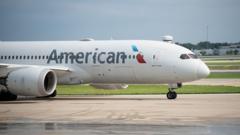
For over a decade, legacy carriers preached a specific gospel to the flying public. The narrative went that passengers no longer cared about built-in entertainment systems. Executives in Dallas, Atlanta, and Chicago insisted that personal mobile devices, tablets, and smartphones had rendered seatback monitors obsolete dead weight. Carrying less weight burned less jet fuel. Less fuel meant higher margins. The math was clean, corporate, and completely divorced from actual human behavior.
American Airlines is reversing that multi-billion-dollar bet. The carrier is quietly acknowledging what frequent flyers knew during every single flight where phones slipped off tray tables or batteries died halfway across the country. Seatback screens are returning to narrowbody domestic fleets because the experiment of relying exclusively on passenger-provided hardware failed to capture the attention of modern travelers. If you found value in this article, you should check out: this related article.
Passengers did not stop wanting in-flight entertainment. They simply grew tired of propping their phones against coffee cups or paying for inflated Wi-Fi connections that crawl at glacial speeds. The corporate rationale behind stripping out cabins a decade ago was never about passenger preference. It was always an exercise in balance sheet optimization disguised as a modernization trend.
The Economics of Stripping the Cabin
When airlines began removing seatback monitors in the mid-2010s, the public relations messaging relied heavily on consumer empowerment. Carriers argued that passengers preferred streaming content to their own devices. This minimized hardware maintenance costs and shaved hundreds of pounds off individual aircraft hulls. Over a fleet of hundreds of planes, shedding that weight translated into millions of dollars in annual fuel savings. For another perspective on this development, see the latest coverage from Travel + Leisure.
Yet the strategy ignored the secondary costs of the bring-your-own-device model. Cabin crews spent countless hours mediating disputes over broken tray tables, dead charging ports, and sluggish connectivity. Passengers grew frustrated trying to balance a laptop, a beverage, and a smartphone on a shrinking surface area.
Financial analysts rarely factor user friction into capital expenditure decisions until customer satisfaction metrics start hurting yield management. When flyers have choices, comfort dictates loyalty. Premium cabins always retained monitors because high-paying customers demanded them. Main cabin passengers, meanwhile, were told that progress looked like an empty plastic seatback pocket.
The industry eventually reached a breaking point. Wi-Fi infrastructure above the clouds remains expensive to operate and prone to bandwidth bottlenecks. When an entire Boeing 737 or Airbus A321 tries to stream high-definition video simultaneously over satellite links, connections stall. Free messaging works well enough, but heavy streaming strains network capacity. Hardware installed directly into the airframe solves this bottleneck entirely by storing content locally on onboard servers rather than relying on an erratic satellite feed thousands of feet below.
The Hardware Logistics of Retrofitting a Fleet
Reintroducing seatback screens across hundreds of narrowbody aircraft is an expensive, logistically grueling undertaking. An airplane generates revenue only when it is in the air. Pulling an aircraft out of service for cabin reconfiguration means lost capacity on high-demand routes.
Engineering teams must rewire power distribution systems, reinforce seat structures to support added weight and touch-sensitive monitors, and install onboard media servers. This is not a weekend project. It requires heavy maintenance checks scheduled months in advance.
Consider the supply chain reality. Sourcing aviation-grade touchscreens that meet rigorous Federal Aviation Administration crashworthiness standards takes time. Every bracket, wire harness, and display unit must pass flammability and stress tests. American Airlines is stepping back into a capital expenditure cycle that leadership previously claimed to have permanently closed.
This pivot exposes the cyclical nature of airline strategy. Every decade, executives convince themselves that a new digital trend will permanently alter passenger psychology. Then reality reasserts itself. People sitting in metal tubes for four hours want reliable, effortless entertainment that does not require auxiliary battery packs, tangled headphone cords, or constant troubleshooting.
What This Means for the Skies Ahead
The return of cabin monitors signals a broader shift in how airlines compete for domestic market share. When basic product offerings converge—when every carrier flies similar planes with similar seating configurations—differentiators matter.
Reliable seatback entertainment creates a baseline of comfort that changes the perceived value of a ticket. It reduces the cognitive load of travel. A passenger does not need to remember to charge three different devices before leaving home. They simply plug in and press play.
Competitors like Delta Air Lines maintained seatback screens through the entire industry-wide strip-down, using that consistency as a subtle club against rivals. Delta positioned itself as the premium choice for domestic travelers precisely because its seats featured functioning displays. American is now closing that gap, recognizing that abandoning the screen was a strategic miscalculation born of short-term cost-cutting ambition.
The era of telling passengers that less hardware equals a better experience is over. The monitors are coming back because comfort is a tangible asset, and the market finally forced the boardrooms to admit it.