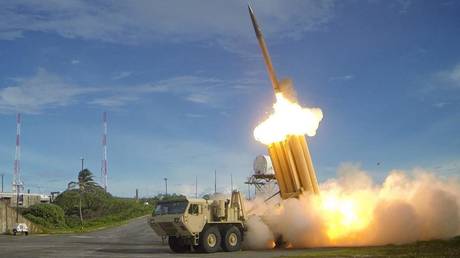
The United States is running dangerously low on its most advanced air defense missiles, and the reason points directly toward the recent conflict with Iran. A damning defense assessment revealed that Washington basically exhausted its own strategic stockpiles to protect Israeli skies, while Israel managed to keep its own highly touted defense systems largely under wraps.
It's a stark reality that shatters the narrative of a balanced military partnership. While the Pentagon scrambled to intercept wave after wave of Iranian ballistic missiles, it burned through critical interceptors that take years to manufacture. Now, the US faces a massive security deficit that leaves its allies in Europe and Asia dangerously exposed.
The Brutal Numbers Behind Operation Epic Fury
During the height of the conflict, the Pentagon threw everything it had at incoming Iranian threats. According to figures leaked to The Washington Post, US forces fired more than 200 Terminal High Altitude Area Defense (THAAD) interceptors.
To put that into context, that single campaign consumed roughly half of the total THAAD inventory the US possesses worldwide.
The numbers get worse. The US Navy also launched over 100 Standard Missile-3 (SM-3) and Standard Missile-6 (SM-6) interceptors from guided-missile destroyers stationed in the Mediterranean.
Meanwhile, Israel sat on its hands—or at least on its arsenal. The Israeli Defense Forces (IDF) fired fewer than 100 Arrow 3 missiles and only about 90 David’s Sling interceptors. Even then, a huge chunk of those Israeli interceptors weren't even aiming at the heavy Iranian ballistic missiles; they were swatting down slower, less sophisticated threats from the Houthis in Yemen and Hezbollah in Lebanon.
Missile Interceptors Fired During Iran Conflict:
- US THAAD Interceptors: 200+ (50% of global stock)
- US Navy SM-3/SM-6: 100+
- Israeli Arrow 3: <100
- Israeli David's Sling: ~90
The Pentagon's chief spokesman, Sean Parnell, tried to spin the data, claiming both countries carried the defensive burden equitably during Operation Epic Fury. The Israeli Embassy in Washington echoed the sentiment, praising the close coordination. But look past the diplomatic corporate speak, and the math tells a totally different story. Washington absorbed the brunt of the financial and material shock, while Jerusalem kept its powder dry.
Why Israel Saved Its Missiles While Uncle Sam Paid the Bill
This wasn't an accident. It was a calculated operational choice that favored Israeli long-term security at the expense of American readiness.
Israel operates a layered defense network, but its top-tier systems like the Arrow 3 are expensive and exist in finite quantities. By letting US forces deploy THAAD and naval interceptors as the primary shield, Israel ensured that if the war dragged on for months, its own homeland defenses would remain fully stocked.
There's also a tactical reality to consider. The US military deployed its own THAAD batteries directly to the region ahead of the escalation, essentially positioning American soldiers and hardware as the frontline tripwire. When Iran launched its salvos, the US systems fired early and often. In air defense, standard doctrine frequently dictates firing two interceptors at a single high-speed ballistic target to guarantee a kill. The US burned through its inventory at a rapid clip because it was occupying the outermost layer of the defensive umbrella.
The True Cost of Empty Arsenals in Washington
The immediate financial cost to the US military hit $18 billion early in the conflict, prompting the Pentagon to request a staggering $200 billion supplemental funding package from Congress. But you can't just print money to solve this issue. The real bottleneck is production capacity.
Defense contractors like Lockheed Martin and Raytheon cannot simply ramp up production of complex interceptors overnight. These systems require highly specialized solid-rocket motors, advanced guidance chips, and rare materials. The current US defense industrial base is notorious for sluggish lead times. Experts warn it will take years of uninterrupted factory output just to replace the 200 THAAD missiles left behind in the sands of the Middle East.
This isn't just a headache for the Pentagon. It's causing outright panic for American allies globally.
The Pacific Vulnerability
Both Japan and South Korea rely explicitly on the US extended deterrence umbrella to counter threats from China and North Korea. Before the escalation with Iran, the US even considered shifting THAAD assets from South Korea to the Middle East. Seoul and Tokyo are now looking at Washington’s depleted stockpiles and wondering what happens if a flashpoint ignites in Asia. If Taiwan faces an escalation tomorrow, the US simply doesn't have the interceptor surplus to shield its allies there like it did for Israel.
The European Shortfall
European allies are watching their own security buffers erode. With the US burning through Patriot and THAAD components, the global pipeline for air defense parts is completely choked. Nations on NATO’s eastern flank are waiting in a long line for hardware that got used up in a matter of weeks during a Middle Eastern conflict that many argued Washington shouldn't have been leading in the first place.
The Hidden Losses of the Air War
The missile deficit is only part of the damage. While the public focus stayed on spectacular mid-air interceptions, the attrition of other critical US assets has been brutal.
Intelligence reports indicate that the US lost more than two dozen MQ-9 Reaper drones during the hostilities, wiping out nearly 20 percent of its entire pre-war Reaper inventory. Whether shot down by sophisticated Iranian air defenses or caught on the ground during missile strikes on US regional facilities, that's a cool $1 billion in unmanned aircraft gone.
Congressional records suggest total US hardware losses—including radar units, command-and-control vehicles, and support aircraft—hover near $2.6 billion. The conflict wasn't a clean, clinical showcase of Western tech superiority. It was a grinding war of attrition that dug deep into America's strategic reserves.
What Happens Next
The temporary ceasefire brokered by Pakistan has brought a fragile pause to the region, but the strategic damage to the US military posture is already done. Washington can't afford to repeat this playbook.
The next immediate step for US policymakers isn't diplomatic; it's industrial. Congress needs to forcefully condition future emergency military aid on domestic stockpile minimums. The Pentagon must enforce strict co-production agreements, forcing allies who use these defense systems to build localized manufacturing hubs rather than treating the continental United States as their personal, bottomless ammo crate.
If Washington keeps playing the role of the world's exclusive security shield without fixing its broken industrial base, it's going to find itself holding an empty gun in a much larger global fight.