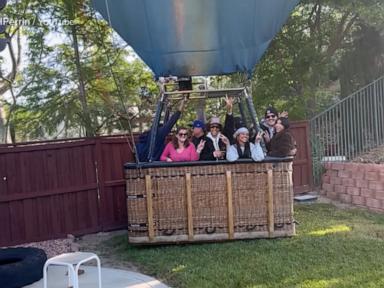
The silence of a Monday afternoon in the suburbs has a specific frequency. It is the hum of a distant lawnmower, the rhythmic ticking of a cooling car engine, and the occasional bark of a dog defending a chain-link fence. Residents of a quiet cul-de-sac in Winnipeg were well-acquainted with this soundtrack. They knew the geometry of their lives: the height of the oak trees, the distance between the curb and the front door, and the vast, predictable emptiness of the prairie sky.
Then, the sky grew teeth.
It began as a shadow, a creeping blotting-out of the sun that didn't move like a cloud. It was followed by a sound that didn't belong in a residential zip code—the violent, guttural roar of a propane burner. For the passengers suspended in the wicker basket of a hot air balloon, the world had suddenly shrunk from a panoramic vista to the terrifyingly intimate details of a stranger's backyard.
They weren't supposed to be there.
The Illusion of Control
A hot air balloon is an exercise in surrender. While a pilot can control vertical movement by heating the air inside the envelope or letting it cool, the horizontal path is a gift—or a curse—granted by the wind. You do not steer a balloon so much as you negotiate with the atmosphere. On this particular flight, the atmosphere decided the negotiation was over.
Consider the physics of the predicament. You are drifting in a craft that weighs several tons when fully loaded, yet it is essentially a giant bubble of nylon and hot air. As the wind shifted, pushing the vessel toward a dense residential pocket, the pilot faced a choice that every aviator hopes to avoid: find a gap or risk the power lines.
In the suburbs, power lines are the invisible web that keeps the modern world humming. To a balloonist, they are a death trap. One touch can turn a pleasure cruise into a tragedy. The pilot’s eyes wouldn't have been on the beautiful horizon anymore. They would have been locked on the silver wires, the roof peaks, and the tiny, insufficient patches of green between the fences.
The Backyard Invasion
Down on the ground, the perspective shifted from curiosity to a mild, bewildered panic.
Imagine you are standing in your kitchen, pouring a glass of water, and you look out the window to see a three-story-tall sphere of rainbow-colored fabric descending toward your shed. It is an absurdity. It defies the logic of property lines and privacy.
The balloon didn't just land; it occupied.
As the basket scraped over a wooden fence—a sound like a giant rubbing sandpaper against a violin—the passengers were no longer tourists. They were intruders in a private sanctuary. They could see the specific brand of charcoal next to the grill. They could see the discarded dog toys in the grass. The sheer scale of the aircraft made the backyard look like a dollhouse.
When the wicker finally hit the turf, the impact wasn't a crash, but it wasn't a soft landing either. It was a heavy, jolting thud that announced the arrival of the impossible. The passengers, who an hour earlier were sipping champagne or snapping photos of the Red River, were now staring at a bewildered homeowner who had just come out to see why the sun had disappeared.
The Fragile Mechanics of Gravity
We often treat flight as a clinical process. We check our gate numbers, we complain about legroom, and we trust the turbines. But lighter-than-air travel is different. It is visceral. It relies on the basic principle that hot air is less dense than cold air. To stay aloft, the air inside that nylon skin must be kept at roughly 100°C.
When that heat is lost, or when the wind shears downward, the descent becomes a mathematical certainty.
The witnesses who pulled out their phones to record the event weren't just capturing a "viral moment." They were documenting a glitch in the suburban matrix. There is something deeply humbling about seeing a vehicle designed for the heavens sitting between a trampoline and a vegetable garden. It reminds us that our mastery over the elements is, at best, a temporary arrangement.
The passengers climbed out, legs shaking, their adrenaline high-lining through their veins. They were safe. The pilot had managed the impossible, threading the needle between high-voltage risks and structural damage. But the "why" of the situation lingered long after the nylon was deflated and packed into a chase truck.
The Invisible Stakes of a Shift in Wind
Why do we do it? Why do we climb into a basket and let the breeze take us?
It is the pursuit of the perspective that only comes from being unmoored. We spend our lives following roads, sidewalks, and hallways. We move in right angles. A balloon offers the curve. It offers the chance to see the world not as a map, but as a living, breathing organism.
But the cost of that perspective is the risk of the "tiny backyard" ending.
The wind is not a static thing. It moves in layers. At 500 feet, it might be blowing North at ten knots. At 200 feet, it might be swirling West, caught in the thermal eddies created by asphalt parking lots and concrete buildings. A pilot must read these invisible rivers. On this day, the river led to a cul-de-sac.
The homeowners didn't call the police to report a crime; they called because they didn't have a protocol for a "sky-ship in the petunias." There is no box to check on an insurance form for "unexpected aeronautical arrival."
The Aftermath of the Impossible
As the crew worked to fold the massive envelope, the neighborhood gathered. The tension of the descent gave way to the peculiar camaraderie of a shared anomaly. Neighbors who hadn't spoken in months stood shoulder-to-shoulder, watching the giant silk lung breathe its last breath of hot air.
There is a lesson in the debris of such an event.
We build our lives around the idea of the "contained." We fence our yards, we lock our doors, and we assume the sky is a separate entity that stays firmly above the roofline. Then, a shift in the breeze reminds us that the boundaries are thinner than we think.
The passengers eventually drove away in a van, leaving behind nothing but flattened grass and a story that no one would believe without the video footage. The homeowner was left with a quiet yard once more. But the silence was different now.
Every time a shadow crosses the grass, they will look up. They won't just see a cloud or a bird. They will look for the roar of the burner and the flash of color, waiting for the moment the heavens decide to drop in for a visit.
The sky, once a distant backdrop, is now a neighbor who doesn't always knock before entering.