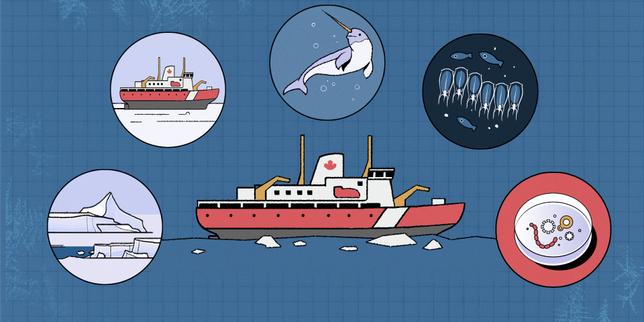
Commercial maritime expansion into polar latitudes introduces high-amplitude anthropogenic noise into habitats previously governed strictly by natural acoustic baselines. When heavy icebreakers fracture multi-year pack ice, their propulsion systems and hull-ice interactions generate low-frequency acoustic signatures that propagate efficiently through cold, dense polar water. For the narwhal, Monodon monoceros, this acoustic intrusion represents an invisible structural stressor that disrupts behavioral ecology, metabolic stability, and predator avoidance mechanisms.
Evaluating the impact requires breaking down the physical propagation of sound in polar oceans and mapping it against the sensory biology of specialized odontocetes.
The Acoustic Profile of Polar Transit
Water acts as an efficient wave guide for acoustic energy, and polar oceans feature unique sound speed profiles due to temperature and salinity stratification. Icebreakers operating at high latitudes utilize extreme shaft horsepower to break rigid sea ice. This mechanical strain produces two primary forms of underwater noise: continuous tonal components from cavitation and machinery, and broadband impulses generated when steel hulls crush and scrape against crystalline ice structures.
Unlike open-ocean shipping lanes where ambient noise scales primarily with vessel speed and displacement, Arctic transit operates under conditions of extreme acoustic impedance matching. Ice acts as a hard boundary that traps acoustic energy within the water column, preventing surface dissipation. Consequently, noise generated by a single icebreaker can propagate across hundreds of kilometers of unfragmented fjord systems and narrow straits, such as the Nares Strait between Canada and Greenland.
This creates an expanding acoustic footprint that overlaps directly with the sensitive hearing ranges of marine mammals. Odontocetes rely on acoustic sensing for spatial orientation, intraspecific communication, and foraging success. The introduction of persistent broadband noise elevates the local ambient sound pressure level, compressing the active communication space of these animals.
Physiological and Behavioral Disruptions
The biological cost of acoustic saturation manifests as a cascade of behavioral modifications and physiological stress responses. Narvals are notably sensitive to environmental disturbance, exhibiting high site fidelity to specific summering grounds in deep glacial fjords.
The primary mechanism of disruption is acoustic masking. Narvals emit echolocation clicks to locate deep-water prey such as Greenland halibut, alongside pulsed calls and whistles for social cohesion. When icebreaker noise floods the frequency bands utilized by these cetaceans, the target signals become indistinguishable from the background cacophony.
- Foraging Efficiency Reduction: Echolocation range contracts proportionally to ambient noise intensity. If the effective detection radius for prey decreases by half, the animal must expend significantly more energy searching for equivalent caloric intake.
- Hyper-Vigilance and Displacement: High-amplitude sound pulses trigger acute stress responses. Telemetry data indicate that narvals exposed to sudden industrial noise exhibit immediate flight behaviors, characterized by sustained rapid diving, erratic movement paths, and increased heart rates. This escape response consumes finite energy reserves stored as blubber, which are essential for overwinter survival.
- Habitat Abandonment: Persistent maritime traffic forces animals to abandon optimal feeding zones and retreat into marginal habitats characterized by higher predation pressure from killer whales or restricted access to open water leads.
The Cumulative Cost Function of Industrial Expansion
The transformation of the Arctic from a seasonal barrier into an active transit corridor alters the baseline vulnerability of endemic species. Single-vessel transit events impose acute stress, but cumulative commercial and research shipping introduces chronic physiological wear.
The cumulative cost function depends on three variables: transit frequency, hull-ice interaction intensity, and geographic constriction. Narrow fjords and straits act as acoustic amplifiers, bouncing sound waves off steep rock walls and concentrating energy within restricted biological corridors.
When shipping schedules overlap with seasonal aggregation periods—such as summer calving and nursing phases—the disruption scales non-linearly. Mothers nursing calves face compounded energetic penalties. The increased metabolic cost of displacement combined with reduced foraging efficiency compromises calf growth rates and lowers first-year survival probability.
Traditional management frameworks rely on static marine protected areas, but fixed geographic boundaries fail to account for mobile acoustic fields that travel with vessels. Mitigating the degradation of polar acoustic habitats requires shifting toward dynamic spatial management, mandatory speed restrictions during sensitive biological windows, and the retrofitting of commercial ice-class hulls to minimize cavitation and mechanical noise output. Future policy design must treat ocean silence as a finite natural resource subject to depletion through industrial accumulation.