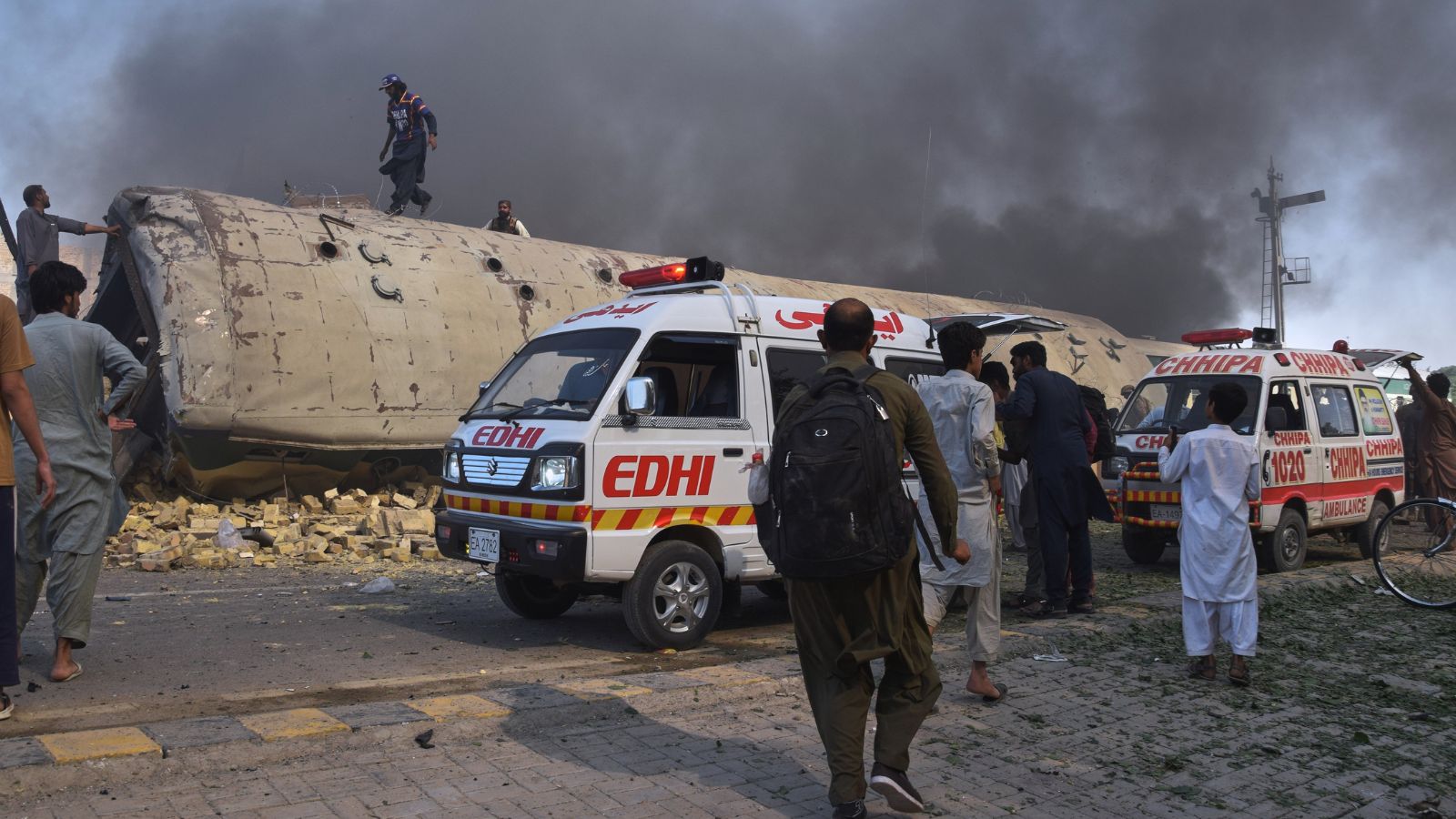
The smell of diesel smoke mixes with green tea and wet wool on a Saturday morning at Quetta Railway Station. It is November. The air in the capital of Balochistan carries the sharp, biting chill of the high desert. Passengers huddle over battered aluminum trunks. Children, bright-eyed and wrapped in oversized shawls, share pieces of flatbread.
On the tracks sits the Jaffar Express. Its iron flanks are painted a faded green, a familiar beast that connects this isolated frontier outpost to the sprawling heart of Punjab. The departure time is fast approaching.
Then, the world tears open.
A flash of blinding white light swallows the platform. The sound is not a bang; it is a physical weight that punches the air out of every lung within a mile. Metal twists like wet paper. Concrete turns to dust. For a fraction of a second, there is a total, absolute silence as the brain struggles to process the cataclysm.
Then come the screams.
When the smoke thins, twenty-four people are dead. Dozens more lie scattered across the debris, bleeding into the gray gravel of the tracks. The Jaffar Express remains stationary, its windows shattered, its destination suddenly irrelevant.
The Weight of Twenty-Four Names
To read the global ticker tape, the event is distilled into a sparse string of data: twenty-four dead, over fifty injured, a railway station targeted in southwestern Pakistan. It reads like a mathematical equation.
But violence is never mathematical. It has a smell—burnt hair and sulfur. It has a color—the stark crimson staining a dropped leather shoe.
Consider a young man named Tariq. He is not a real person, but he represents three of the soldiers who died that morning. Tariq had just finished his training at the infantry school. His uniform was crisp, the creases sharp enough to cut paper. He was going home to see his mother in a village near Lahore. He had a box of local almonds in his bag, a gift for his sisters. He was thinking about the warmth of his family's kitchen when the ball of ball bearings and explosives ripped through his chest.
The blast was timed with cruel precision. The platform was packed not just with civilians, but with a large contingent of military personnel returning from a nearby course. They were men who had spent weeks in the harsh terrain, looking forward to a few days of respite. Instead, they became the epicenter of a geopolitical blood feud.
The Baloch Liberation Army, a separatist militant group that has waged a low-intensity insurgency against the state for decades, wasted no time claiming responsibility. Their statement was cold, political, and entirely detached from the human wreckage left on the concrete. To them, the platform was not a place of human transition; it was a theater of war.
A Landscape Forged in Isolation
To understand why a railway station in Quetta becomes a slaughterhouse, one must look at the map. Balochistan is Pakistan's largest province by landmass, yet it is the least populated and the most impoverished. It is a vast expanse of jagged mountains, hidden mineral wealth, and deep-seated grievances.
For seventy years, the relationship between the central government and the province has been a volatile mix of neglect and exploitation. The local population watches trillions of cubic feet of natural gas piped out of their soil to fuel the factories of Punjab, while their own villages burn wood for heat.
This sense of alienation is the soil in which militancy grows. The BLA and other separatist factions argue that the state is an occupying force, stealing resources while offering nothing but checkpoints in return.
But the nature of the conflict has shifted dramatically. What used to be a hit-and-run campaign against gas pipelines and military outposts has transformed into urban terrorism. The targets are no longer just remote pylons; they are the arteries that connect Balochistan to the rest of the country.
The railway is symbolic. It is the literal thread binding Quetta to the federal capital. By cutting that thread, the insurgents are trying to prove a terrifying point: you are not safe here, and you cannot leave.
The Illusion of Security
The aftermath of any bombing follows a predictable, agonizing choreography.
First come the sirens—the frantic, desperate wails of ambulances navigating Quetta's congested streets. Then come the citizens, ordinary men running toward the danger to pull bodies from the wreckage, their clothes ruined by the soot and blood of strangers.
Later, the politicians speak. There are statements of condemnation. Words like "cowardly" and "unforgivable" are thrown around by officials sitting in heavily fortified offices in Islamabad. They promise retribution. They vow to eradicate the menace of terrorism.
But for the people who must walk through those station gates tomorrow, those words are hollow.
Security at a South Asian railway station is often an exercise in theater. There are walk-through metal detectors that beep constantly and are largely ignored. There are guards with aging rifles, their eyes heavy with fatigue. How do you stop a person who is willing to turn their own body into a fragment bomb? How do you protect a space whose very purpose is to be open, crowded, and accessible?
The reality is that the state is fighting a ghost. The insurgents do not hold territory; they blend into the bazaars, the student hostels, and the mountain passes. They strike when the glare of the media is brightest, ensuring that the terror is amplified across television screens nationwide.
The Long Road Back to the Platform
By late afternoon, the bodies have been moved to the Civil Hospital. The floors of the emergency ward are slick. Families gather outside, their faces frozen in a collective mask of shock. Some search for names on handwritten casualty lists pinned to the wall. Others hold phones to their ears, listening to rings that go unanswered.
The Jaffar Express will eventually be cleaned. The glass will be swept away. The blood will be hosed off the tracks, disappearing into the dirt below. Another train will pull up to the platform, and people will board it because they have no choice. They have jobs to keep, families to feed, lives that refuse to stop for tragedy.
But something fundamental breaks in a community when a space as mundane as a train station becomes a graveyard. The simple act of buying a ticket becomes a gamble. Every glance at a heavy backpack carries a seed of suspicion. The trust that holds a society together erodes, replaced by a quiet, pervasive dread.
The sun sets over the mountains surrounding Quetta, casting long, purple shadows across the valley. The station stands quiet now, guarded by men with automatic weapons and tense expressions. The smoke has cleared, but the air still tastes of iron.
A single leather shoe, scuffed and missing its mate, remains on the edge of the platform, just inches from where the train tracks lead out into the dark, empty desert.