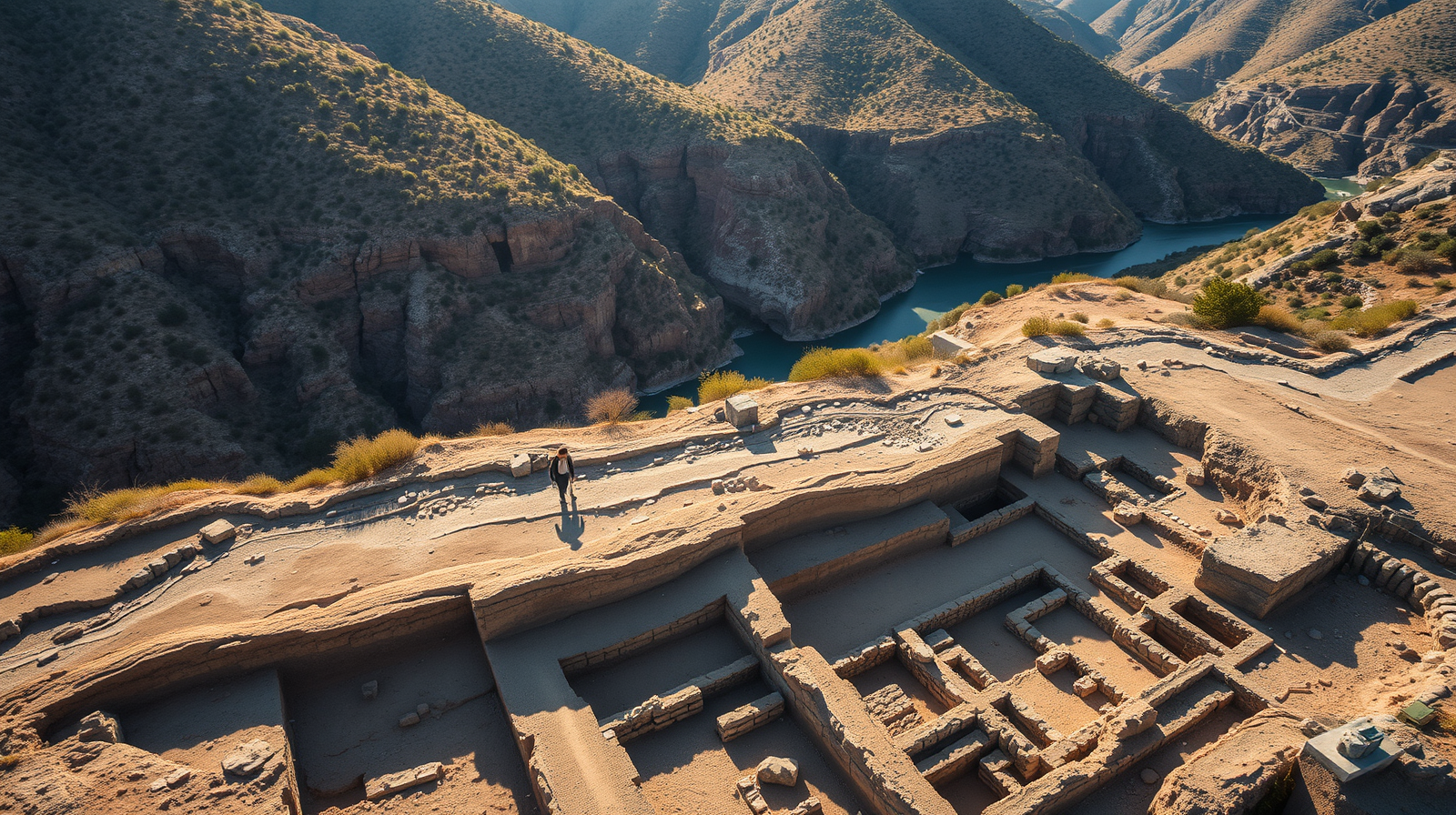
Archaeological sites rarely speak in clear sentences. More often, they whisper through fragmented teeth, charred seeds, and the microscopic wear patterns on stone tools. For decades, the transition from foraging to farming across the Iberian Peninsula was taught as a clean break. The narrative went that waves of Neolithic migrants arrived, displaced indigenous hunter-gatherer populations, and imposed an entirely new economic system upon the Mediterranean basin.
Recent excavations at a specific rock shelter in Spain complicate that tidy story. By examining the micro-stratigraphy of human occupation dating back roughly 8,000 years, researchers are finding that the boundary between hunting and farming was not a wall, but a long, messy hallway.
When we look at the transition to agriculture in prehistoric Europe, we tend to project modern efficiency onto ancient populations. We imagine a sudden epiphany where someone dropped a seed, watched it grow, and permanently abandoned the spear. That is a fiction. The stratigraphic record from this Spanish site reveals centuries of overlap. Wild red deer bones sit right alongside early domesticated sheep remains. Wild acorns and pistachios are crushed on the exact same grinding stones used for newly introduced domestic wheats.
Understanding this site requires abandoning the assumption that ancient humans woke up one morning and decided to domesticate the world. Agriculture did not spread as a sudden enlightenment. It spread as a series of calculated risks taken by people who were hedging their bets against environmental instability.
The Anatomy of a Prehistoric Transition
To trace how these ancient communities lived, we have to look closely at the physical evidence left behind in the sediment. Chemical residue analysis on ceramic fragments tells a story of dietary shifts that happened over generations, not weeks.
In the lowest layers of the shelter, dated to the peak of the Mesolithic era, the refuse piles consist almost entirely of wild fauna. Red deer, wild boar, and marine resources from nearby river systems sustained small, highly mobile bands of people. These populations knew their landscape intimately. They understood seasonal migrations, local water tables, and the cyclical availability of wild flora.
Move up just a few centimeters—representing decades of accumulated dust, hearth ash, and discarded bone—and the picture changes, but subtly. Domesticated caprine teeth appear. Yet, the wild game does not disappear. Instead, the inhabitants of the rock shelter appear to have adopted a dual-economy strategy.
Mesolithic Layer: 100% Wild Fauna / Mobile Foraging
       │
       ▼ (Centuries of Cultural Exchange & Environmental Shifting)
       │
Neolithic Layer: Dual-Economy (Domestic Sheep + Wild Game + Early Cereal Cultivation)
This dual economy is the crucial detail that standard textbook summaries gloss over. Managing livestock requires permanent or semi-permanent settlement, which directly clashes with the lifestyle of a nomadic hunter-gatherer. Yet these Iberian populations did not choose one or the other. They combined them. They herded sheep while continuing to hunt deer. They planted small, experimental plots of emmer wheat while continuing to scour the forests for wild nuts and tubers.
Why take on the immense labor of farming if the old ways still worked? The answer lies in climate pressure and population density.
Environmental Stress and the Economic Pivot
Around 8,000 years ago, the western Mediterranean experienced subtle but impactful climatic fluctuations. Rainfall patterns shifted, making wild game less predictable in certain micro-regions. When foraging yields fluctuate, a community faces a stark choice: migrate further afield or intensify local production.
Intensification is the engine of domestication. When wild resources become risky, planting a manageable crop near a reliable shelter acts as an insurance policy.
This brings us to a major blind spot in how prehistoric archaeology is often communicated to the public. We treat the adoption of farming as an upgrade, akin to upgrading software. In reality, early farming was backbreaking, high-risk labor. Wild food acquisition often required fewer total hours of work per week than early agriculture. Early farmers faced crop failures, livestock disease, and the constant threat of soil exhaustion.
No rational group of foragers would trade a relatively easy, high-protein wild diet for the grueling toil of weeding and harvesting early cereals unless external pressures forced their hand. The rock shelter in Spain provides the physical proof of this agonizingly slow calculation. People tinkered with farming because they had to, keeping their hunting tools sharp just in case the crops failed.
The Genetic and Cultural Melting Pot
Bones and seeds tell part of the story, but ancient DNA adds the final, complicated layer. Genetic studies across the Iberian Peninsula show that the shift to farming was accompanied by a significant influx of genetic ancestry from early Anatolian farmers who had migrated across Europe.
However, this was not a simple replacement event. The local hunter-gatherer populations did not vanish into the ether. Genetic markers indicate centuries of interbreeding and cultural synthesis between the indigenous foragers and the incoming farming groups.
The rock shelter acts as a microscopic window into this integration. The stone tool technology—lithics—shows a gradual transition rather than a sudden drop-off. Specialized geometric microliths, traditionally associated with hunting, persist alongside new types of polished stone axes used for clearing land and processing plant material.
When two distinct cultures meet, they do not merely fight or replace one another. They negotiate. They share recipes, trade animal management techniques, and experiment with new ways to structure their communities. The people using this Spanish rock shelter were cultural hybrids long before modern borders or identities existed.
The Modern Echo of Ancient Choices
It is tempting to view these ancient agricultural pioneers as distant strangers whose lives bear no resemblance to our own. That view is fundamentally mistaken. The core dilemma they faced—how to adapt to a changing environment by altering fundamental production systems while managing risk—is entirely modern.
Consider how contemporary industries react to disruption. When a new technology or market pressure emerges, companies do not instantly abandon their legacy operations. They hedge. They run dual systems. They keep the old revenue streams alive while funding experimental, high-risk alternatives until the new model proves viable.
The inhabitants of the Spanish rock shelter were running the original dual-track operational strategy. They maintained their heritage foraging skills while building the infrastructure for a completely new agricultural civilization.
Archaeologists will continue to screen the dirt from this shelter, pulling out microscopic pollen grains and fragments of charred bone. Each new data point chips away at the myth of a sudden, clean agricultural revolution. What remains in its place is something far more interesting: a portrait of resilient human beings navigating uncertainty through stubborn experimentation, careful observation, and a refusal to put all their eggs in one basket.
The transition from hunting to farming was the most consequential pivot in human history, setting the stage for permanent settlements, social stratification, and eventually, the complex modern world. But it was forged in the dirt, sweat, and doubt of people who spent centuries standing at the edge of the forest, wondering if the seeds they planted would grow, and wondering if the deer would return next season.