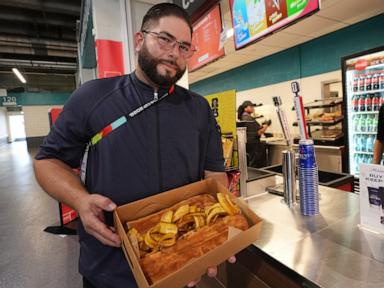
The internet is having a collective meltdown over a basket of potato tots.
With the World Cup coming to Miami, the early whispers of luxury stadium menus are already leaking. The primary target of public outrage? A $75 plate of tater tots topped with high-end caviar. The sports blogs are calling it the death of fan culture. The comment sections are filled with predictable, lazy rage about "corporate greed" and the "pricing out of the everyday fan."
They are missing the entire point.
The $75 caviar tot is not an insult to the average fan. It is a financial shield that protects them. I have spent years analyzing stadium revenue models and commercial hospitality structures, and if you understand the brutal reality of sports venue economics, you know that hyper-luxury gimmicks are the only thing keeping standard ticket prices and basic hot dogs from skyrocketing even faster than they already are.
Stop crying about the caviar. It is the best thing to happen to your wallet.
The Mirage of the Fixed-Price Stadium
The loudest critics of luxury concessions operate under a flawed premise: the idea that if a stadium removes a $75 novelty item, the price of a standard beer drops to $5.
It is basic math, but people refuse to see it. Stadiums are massive, depreciating infrastructure projects with astronomical fixed operating costs. During a massive tournament like the World Cup, FIFA and local organizing committees face immense security, staffing, compliance, and logistics overhead. That revenue must be generated within a highly condensed window.
Venues look at a crowd not as a monolith, but as a distribution curve of spending power.
Imagine a stadium with 65,000 seats. 80% of those fans have a strict budget for tickets and concessions. 5% of those fans—corporate sponsors, high-net-worth individuals, and tech executives—have effectively infinite budgets. They do not care if a food item costs $15 or $150; they want status, novelty, and an Instagram post.
[Standard Concessions Model] -> High prices across the board to meet fixed revenue targets.
[The Subsidy Model]          -> Outrageous luxury pricing on high-margin items to absorb fixed costs, easing pressure on baseline menu items.
By introducing a $75 caviar tot, the venue is capitalizing on the extreme right tail of that spending curve. The profit margins on sturgeon roe and fried potatoes are astronomical. A single sale of that item yields the same net margin as selling a dozen standard hot dogs.
Every time a corporate executive buys a plate of overpriced tots to look important in a luxury suite, they are subsidizing the operational overhead of the entire venue. If you ban luxury concessions, the stadium does not just accept a lower profit margin. They shift the burden. They raise the price of the cheap seats. They add a $3 surcharge to the standard draft beer.
The high-roller is paying your tax. Let them.
The Psychology of the Anchor Price
There is a deeper behavioral trick at play here that traditional sports journalists entirely overlook. It is called price anchoring, a concept thoroughly documented by behavioral economists like Dan Ariely.
When a stadium menu features a headline-grabbing $75 item, it fundamentally shifts the consumer’s perception of value for everything else on the board.
When the highest-priced item on a menu is $18, an $11 slice of pizza feels expensive. It sits uncomfortably close to the ceiling. But when a menu features a $75 novelty item, the psychological anchor moves dramatically to the right. Suddenly, a $22 premium Wagyu burger looks like a sensible, mid-tier bargain. The $14 craft beer feels entirely reasonable.
The $75 caviar tot exists to make the $25 item look cheap.
The stadium operators do not actually expect to sell 40,000 baskets of caviar tots a night. The item is a marketing beacon. It generates millions of dollars in free press from outraged columnists, builds an aura of elite exclusivity around the Miami venue, and primes the mid-tier consumer to spend more freely on items they previously viewed as overpriced.
The Logistics Nightmare of Gourmet Sports Food
Let's address the operational reality. High-end food in a stadium environment is almost always a logistical disaster.
I have watched venue operators try to execute fine-dining concepts in concierges designed to push through thousands of stale pretzels an hour. It rarely works. True caviar requires specific temperature controls, non-reactive spoons (mother-of-pearl, not plastic), and precise presentation. Tater tots require high-volume deep fryers that can maintain temperature under constant load.
Combining the two means the stadium is forcing a low-velocity, high-care item through a high-velocity kitchen system. The downside to this contrarian approach is obvious to anyone who has run a kitchen: it slows down the line, creates inventory waste if the product doesn't move, and frustrates staff who are trained for speed, not precision.
But that risk is exactly why the price tag is $75 and not $35. The price accounts for the inevitable waste, the specialized storage, and the friction introduced into the stadium’s supply chain. It is priced to fail safely. If they only sell twenty portions a night, the margin is high enough to cover the cost of the unused product that goes in the bin.
The Flawed Premise of "Fan First" Pricing
Whenever this debate surfaces, people point to the Atlanta Falcons and Mercedes-Benz Stadium as the holy grail of sports business. Atlanta famously introduced "Fan First" pricing, offering $2 hot dogs and $3 sodas. The media heralded it as a revolution.
What the media conveniently forgets to mention is the structural difference in ownership and asset utilization. Atlanta’s model works because Arthur Blank owns both the stadium and the teams, using cheap food as a loss leader to drive massive season-ticket retention and year-round event booking.
A World Cup stadium in Miami operating under FIFA guidelines is an entirely different beast. It is a temporary, high-stakes takeover. The organizing committees cannot rely on long-term fan loyalty or ten-year suite leases to recoup costs. They have a handful of matches to maximize revenue.
To demand Atlanta-style pricing during a global tournament in one of the most expensive entertainment markets in the world is willful economic blindness.
Stop Asking the Wrong Question
The public is asking: "How can a stadium justify charging $75 for tots?"
The real question you should be asking is: "Why are you looking at the luxury menu if you want a traditional game-day experience?"
The coexistence of hyper-luxury and baseline concessions is the only way modern mega-events remain viable without turning every single seat into a corporate-only asset. The democratization of sports viewing relies on the stratification of sports eating.
If Miami wants to sell overpriced fish eggs to tourists and crypto-millionaires, we should be cheering them on. Every dollar milked from a luxury suite is a dollar they do not have to squeeze out of the person sitting in the upper deck just trying to buy a soda for their kid.
The caviar tot isn't ruining the game. Your misunderstanding of basic economics is.