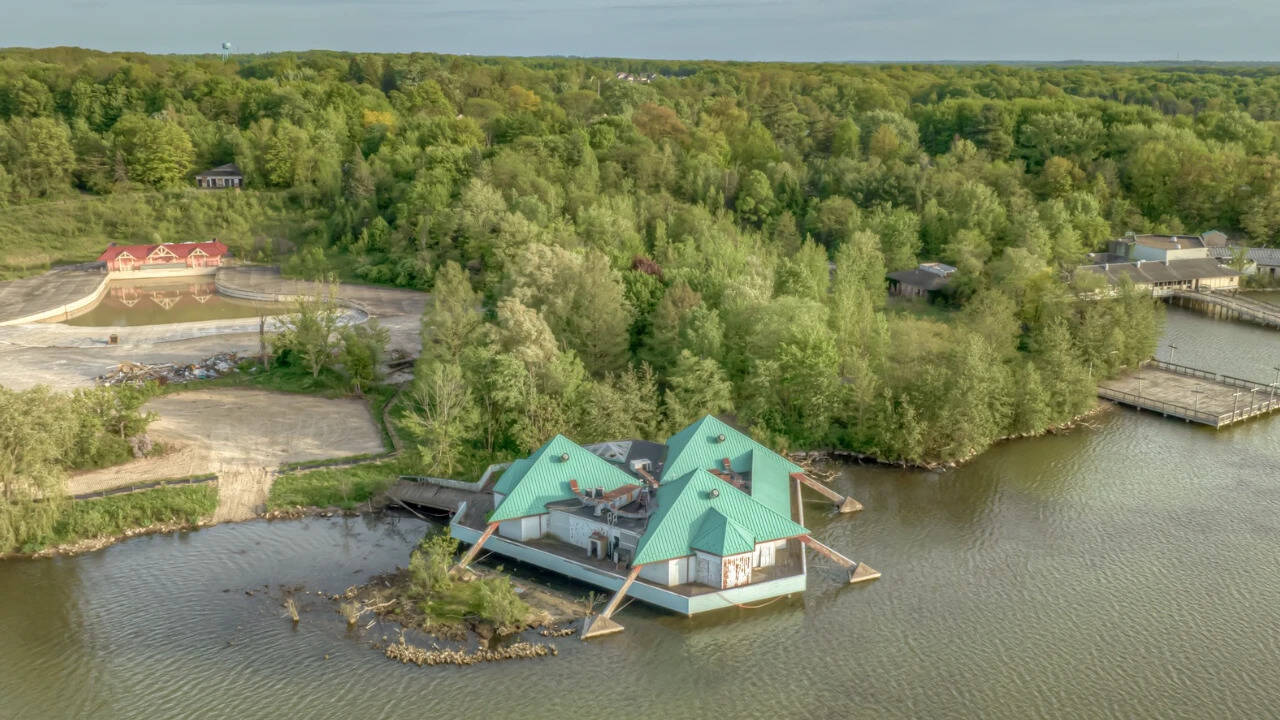
Forty-eight acres of Prime Northeast Ohio real estate, once crushed under the boots of millions of theme park tourists, officially reopened on October 25 as a public lakefront park and mixed-use gateway. After nearly two decades of rotting boardwalks, rusting steel, and bitter municipal stalemate, Aurora, Ohio, finally cut the ribbon on Geauga Lake Park. The project represents a massive public-private gamble to turn a notorious corporate casualty into a sustainable civic anchor, trading high-thrill roller coasters for public trails, waterfront access, and commercial tax revenue.
Most casual observers view the reopening through a lens of pure nostalgia. They remember Shamu splashing in the stadium on the Aurora side of the water, or the wooden rattle of the Big Dipper across the lake in Bainbridge Township. That sentiment makes for easy local news copy, yet it completely misses the real story. What happened on October 25 was not a theme park resurrection. It was the culmination of a brutal, multi-decade lesson in regional real estate economics, corporate overreach, and the high cost of municipal divorce.
How Corporate Hubris Killed a 120-Year-Old Institution
To understand why 48 acres of lakefront sat empty while weeds swallowed the concrete, you have to look at the corporate bloodbath of the early 2000s. Geauga Lake did not die from a lack of customers. It died from suffocation by consolidation.
For over a century, the park operated as a regional staple, evolving from a quiet picnic grove in the 1880s into a beloved mid-sized amusement park. Then came the arms race. In 1995, Premier Parks bought the property, rebranded it as Six Flags Ohio, and went on a frantic spending spree. When Six Flags acquired the neighboring SeaWorld Ohio from Anheuser-Busch in 2001, it merged the two properties into Six Flags Worlds of Adventure, creating a sprawling, 700-acre behemoth that instantly overwhelmed the local infrastructure.
Two-lane country roads choked on traffic. Seasonal staffing became an impossible mathematical puzzle in a region with a finite labor pool. Worse, the company tried to force a destination-resort model onto a regional drive-to market that was already saturated by Cedar Point just ninety minutes west.
By 2004, drowning in debt, Six Flags unloaded the entire complex to Cedar Fair for $145 million. Cedar Fair immediately stripped the marine animals, shuttered the wildlife side of the lake, and tried to shrink the operation back to its traditional roots. The damage was irreversible. At the end of the 2007 season, without prior warning to the community or its workforce, Cedar Fair pulled the plug permanently.
The Anatomy of a Blighted Asset
When a standard retail mall closes, you have a big box and a parking lot. When a mega-theme park closes, you have an environmental and logistical nightmare.
For seventeen years, the property sat in a state of suspended decay. Cedar Fair dismantled the rides and shipped them to other parks in its portfolio, leaving behind cracked asphalt, crumbling foundations, and miles of obsolete underground utilities. Meanwhile, the land straddled two different jurisdictions—the City of Aurora in Portage County and Bainbridge Township in Geauga County.
Every attempt to redevelop the entire 700-acre footprint hit a wall of conflicting zoning laws, infrastructure deficits, and diverging political goals. Developers wanted high-density retail or sprawling subdivisions; residents feared traffic gridlock and the permanent loss of lake access. The property became a textbook example of stranded real estate, too expensive to clear and too politically fractured to entitle.
Why Aurora Broke Rank and Bought the Dirt
The breakthrough required abandoning the fantasy of a single master-planned savior. Instead of waiting for a billionaire developer to fix all 700 acres at once, the City of Aurora made a calculated, aggressive move. In 2020, the city spent roughly $4.5 million to acquire 48 acres of the former SeaWorld parcel, including vital frontage along the 50-acre spring-fed lake.
This was not an act of civic charity. It was a defensive real estate play.
Municipalities across the Midwest have watched private developers buy up distressed waterfront land, lock it behind private gates, and wall off public access forever. By stepping in as the primary landowner for this specific 48-acre tract, Aurora secured permanent public control over the shoreline while creating a clean, debt-free anchor designed to pull private capital into the surrounding parcels.
The Financial Mechanics of the October 25 Reopening
Turning a demolished marine park into a functioning public asset required far more than laying down sod. The city had to tear out decades of specialized concrete slabs, remediate old utility corridors, and engineer modern stormwater management systems to protect the lake from runoff.
To fund the transformation without bankrupting local taxpayers, city planners stacked multiple capital sources:
- Municipal Bonds and General Funds: Direct capital outlays from Aurora's budget, backed by a strong local income tax base.
- State Capital Grants: Targeted infrastructure funds from the State of Ohio aimed at brownfield remediation and outdoor recreation expansion.
- Tax Increment Financing (TIF): A mechanism that captures future property tax increases generated by adjacent private commercial developments to pay off current public infrastructure debt.
The October 25 opening unveils the first major phase of this strategy. Visitors stepping onto the grounds today will find paved multi-use trails, fishing piers, a restored shoreline, and open greenspace where killer whales once performed for cheering crowds.
The Adjacent Commercial Gamble
A public park alone does not pay the bills. Parks are expense centers; they require mowing, policing, insurance, and ongoing maintenance. The financial viability of the entire Geauga Lake corridor depends entirely on what happens right next door to those 48 acres.
While Aurora focused on the waterfront park, private developers—most notably Industrial Commercial Properties (ICP) and PulteGroup—carved up the remaining acreage on both sides of the county line. The broader master plan introduces hundreds of residential units, a Menards home improvement store, medical offices, and retail outlots.
Here lies the core tension of modern suburban redevelopment. If the surrounding commercial and residential zones thrive, the resulting property and income taxes will easily subsidize the maintenance of the 48-acre public park. If retail stalls or housing demand cools under high interest rates, Aurora is left holding an expensive piece of waterfront maintenance with a thinner-than-projected tax cushion.
| Redevelopment Element | Previous Era (2001–2007) | Current Era (2026 Onward) |
|---|---|---|
| Primary Economic Driver | Seasonal tourism & ticket sales | Year-round property & income taxes |
| Land Ownership | Single corporate monopoly | Split public-private patchwork |
| Traffic Profile | Massive summer weekend spikes | Steady daily residential & retail flow |
| Public Lake Access | Paid admission only | Free public access via municipal park |
| Infrastructure Burden | Private internal maintenance | Shared municipal & county utilities |
The Nostalgia Trap in Urban Planning
Every time a historic entertainment venue closes, vocal segments of the public demand that it be rebuilt exactly as it was. You see it with dead shopping malls, shuttered drive-in theaters, and closed amusement parks. Planners call this the nostalgia trap, and falling into it is almost always fatal for a municipality.
The market conditions that allowed Geauga Lake to thrive in 1985 no longer exist. Insurance premiums for amusement rides have skyrocketed. Modern thrill-seekers demand $25 million roller coasters that require massive footprints and year-round operational capital. A seasonal, regional park operating in Northeast Ohio's unpredictable weather window cannot generate the margins needed to service modern construction debt.
By rejecting proposals for smaller amusement concepts and committing to a passive park paired with standard suburban commercial zoning, Aurora's leadership made an unromantic, mathematically sound choice. A walking trail does not require a $15 million capital infusion every four years to stay competitive. A lakeside pavilion does not close down because a teenager cannot be hired to operate a ticket booth on a Tuesday afternoon in August.
What Critics Get Wrong About the New Geauga Lake
The loudest complaints surrounding the October 25 reopening come from two opposite camps. On one side are the theme park purists who view a quiet public park as a tragic downgrade from a world-class entertainment complex. On the other side are anti-growth residents who argue that the surrounding retail and housing developments have ruined the rural character of the area.
Both arguments ignore the reality of municipal finance. Leaving 700 acres of private land fallow in the middle of a growing suburban corridor is not an option. Landowners pay property taxes; if they cannot generate revenue from the land, they either let it rot into an environmental hazard or sue the municipality for regulatory taking if zoning boards block every viable commercial use.
The compromise visible on October 25—carving out 48 prime acres for permanent public recreation while allowing controlled commercial and residential density on the periphery—is about as clean an outcome as modern real estate law permits. It is not flawless. Traffic along Route 43 will inevitably thicken as the retail outlots fill up, and the stark contrast between big-box retail and quiet lakeside trails will always feel slightly jarring.
The Blueprint for Dead Mega-Sites
Across North America, dozens of massive, single-use entertainment and retail complexes are sitting vacant or sliding toward bankruptcy. From defunct waterparks in the Sunbelt to dead enclosed malls across the Rust Belt, local governments are facing the exact same crisis Aurora confronted in 2007.
The lesson from Geauga Lake is clear: do not wait for a corporate white knight to restore the past. Municipalities have to use their balance sheets selectively, buy the most irreplaceable environmental or waterfront assets while the dirt is cheap, and let private developers absorb the risk on the remaining acreage.
When the gates swung open on October 25, there were no marching bands, no corporate mascots, and no roller coasters roaring overhead. There was just a clean stretch of water, a paved path, and 48 acres of land finally working for the people who actually live there.