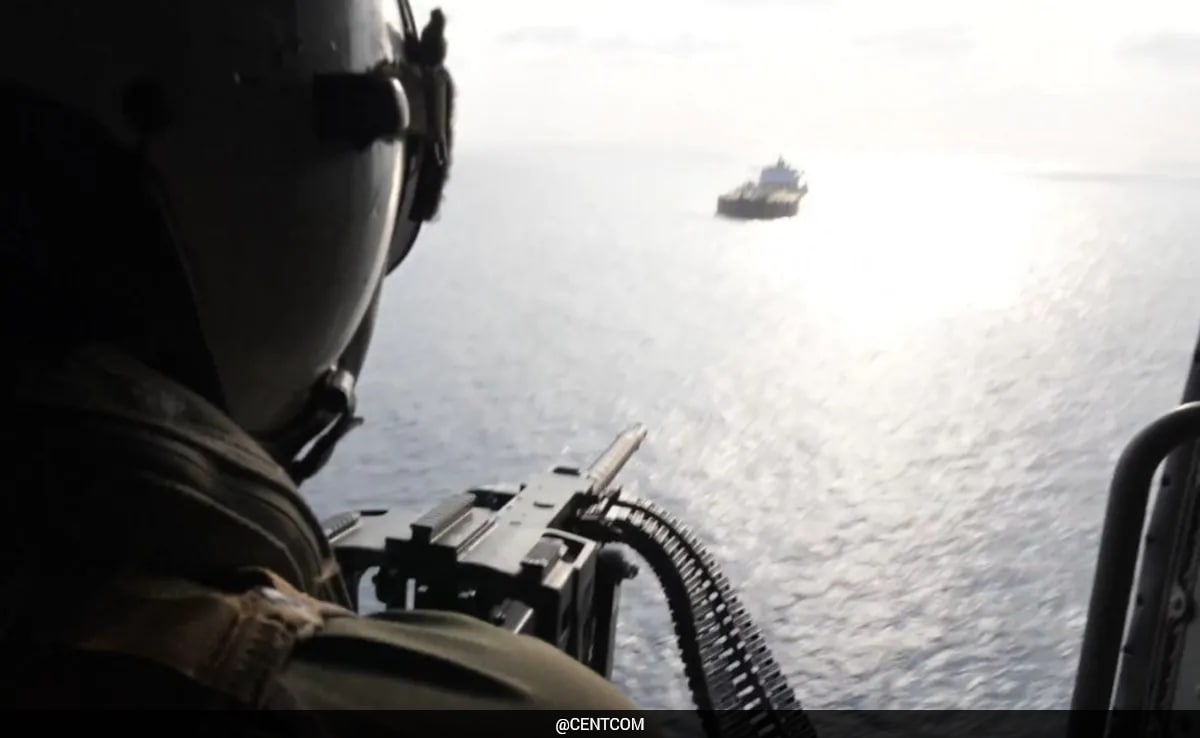
The headlines are screaming about a $4.8 billion "loss." They want you to believe the US blockade is a simple math equation: Sanctions equal poverty. They want you to think Tehran is sitting in a darkened room, staring at an empty ledger, praying for a policy shift in Washington.
They’re wrong.
That $4.8 billion isn’t a loss. It’s the cost of entry for a parallel global economy that the West is too arrogant to realize it no longer controls. While legacy media outlets obsess over "lost revenue," they ignore the massive, structural shift in how oil actually moves in the 21st century.
The blockade hasn't throttled Iran; it has forced it to become the world’s most sophisticated shadow trader.
The Myth of the "Lost" Dollar
Let’s dismantle the $4.8 billion figure immediately. This number is usually calculated by taking Iran’s peak production capacity, multiplying it by the Brent crude benchmark, and subtracting the actual realized revenue.
It’s lazy accounting.
First, it assumes that if the sanctions vanished tomorrow, Iran could dump that oil onto the global market without cratering the price. Economics 101 suggests otherwise. More importantly, it fails to account for the "Sanction Premium" that Iran’s competitors have to pay to maintain traditional shipping routes, insurance, and banking compliance.
Iran isn't losing $4.8 billion. It is reinvesting that delta into a massive, unregulated infrastructure that includes:
- The Ghost Fleet: Hundreds of aging tankers operating under flags of convenience, completely invisible to Western regulators.
- Modular Refining: Instead of exporting raw crude, Iran is increasingly pivoting to petrochemicals and refined products that are harder to track and offer higher margins.
- Barter Arbitrage: Trading oil for physical assets, technology, and food security, bypassing the SWIFT system entirely.
When you stop measuring success in US Dollars—a currency Iran can't spend easily anyway—the "loss" evaporates.
The Efficiency of the Shadow Market
Western analysts love to talk about the "steep discounts" Iran has to offer to sell its oil to China. They frame it as a sign of weakness.
I’ve spent years watching how commodity traders operate in high-pressure environments. A discount isn't a defeat; it’s a customer acquisition cost. By offering oil at a lower price point, Iran has secured a permanent, structural role in the Chinese energy mix that no amount of US diplomacy can dislodge.
These "discounts" have funded the creation of independent "teapot" refineries in China. These refineries don't care about Washington. They don't have US-based assets to seize. They have become a captive market for Iranian crude.
Imagine a scenario where a company "loses" money by giving away free samples, only to realize those samples created a million lifelong addicts. That is the Iranian strategy. They are buying market share with the money the US thinks it is "blocking."
The Death of the Petrodollar was a Choice
The $4.8 billion narrative is a security blanket for Western policymakers. It allows them to believe that the dollar is still the only game in town.
But look at the mechanics of the "blockade." To avoid the $4.8 billion hit, Iran had to master non-dollar denominations. They are trading in Yuan, Rubles, and even gold. They are building the very "multipolar world" that pundits have been theorizing about for decades.
The US blockade provided the perfect laboratory for this. If you want to kill a currency's dominance, you don't attack it directly. You make it a liability. By weaponizing the dollar, the US made it risky for any nation with a different geopolitical agenda to hold it.
Iran is the pioneer. Others are watching. The $4.8 billion is merely the tuition fee for an education in financial independence.
The Infrastructure Trap
The biggest mistake in the "Report" is the assumption that the oil stays in the ground. It doesn't.
Iran has spent the last decade building massive underground and offshore storage facilities. They have mastered ship-to-ship (STS) transfers in the middle of the night, often in the Malacca Strait or off the coast of Africa.
How the "Ghost" Mechanics Actually Work
- Dark STS Transfers: Two tankers meet. One has its transponder off. They swap oil. The receiving tanker then heads to a legitimate port, claiming the oil originated from a non-sanctioned country.
- Rebranding Crude: Iranian crude is frequently blended with other grades. By the time it hits a refinery in Asia, its chemical signature is "Malaysian" or "Omani."
- Digital Obfuscation: Using decentralized ledgers and private messaging apps to coordinate logistics, making it impossible for centralized intelligence agencies to map the entire supply chain.
This isn't a country "losing" revenue. This is a country building a rogue NASDAQ for energy.
The Sanctions Paradox
There is a point where sanctions stop being a deterrent and start being a competitive advantage.
When a nation is fully blocked, it no longer has to play by the rules. It doesn't have to worry about environmental regulations, labor standards, or international maritime law. It becomes a lean, mean, unregulated machine.
While Western oil giants are bogged down by ESG (Environmental, Social, and Governance) requirements and shareholder lawsuits, Iran is operating with the agility of a startup. They have zero "compliance" department. Their overhead is the bribe paid to a port official or the cost of a new shell company in Panama.
The "blockade" has stripped away the bloat. What’s left is a highly efficient, battle-hardened energy exporter that knows how to survive on the margins.
Stop Asking "How Much Did They Lose?"
The question itself is flawed. It’s built on the "lazy consensus" that the global financial system is a closed loop managed from DC and Brussels.
Instead, ask:
- How many new trade routes were established because of these sanctions?
- How many Chinese refineries are now permanently dependent on Iranian "discounted" crude?
- How much technical knowledge did Iran gain in bypassing digital surveillance?
The $4.8 billion isn't a hole in their pocket. It’s the price of the bricks they are using to build a wall that the West can't see over.
If you're an investor or a policy analyst waiting for Iran to "collapse" under the weight of these losses, you're going to be waiting a long time. You are measuring a 21st-century guerrilla economic war with a 20th-century spreadsheet.
The blockade didn't break the Iranian oil industry. It forced it to evolve into something much more dangerous: an industry that doesn't need you.
Go back to your reports. Keep counting the "losses." Meanwhile, the tankers are moving, the yuan is changing hands, and the shadow market is growing.
The "blockade" is a ghost story we tell ourselves to feel powerful. Iran isn't the one losing. We are losing our grip on the reality of global trade.
Stop looking at the ledger. Look at the horizon.