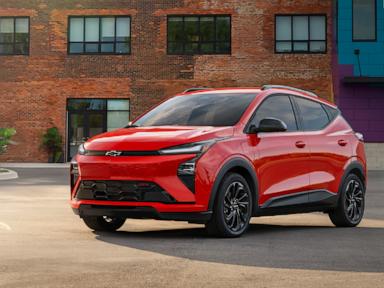
Sarah stood in the dealership lot, the late afternoon sun bouncing harshly off a row of towering, $60,000 electric SUVs. She represents a quiet majority. She wants to quit paying for gas, but she has a real-world budget. Her hard limit is $30,000. For years, the automotive industry dropped a clear hint to buyers like Sarah: if you cannot afford a luxury spaceship, stay at the pump.
But the narrative has changed. Two legacy automakers are fighting for Sarah's driveway, offering completely different visions of what an affordable electric vehicle should be.
On one side sits the Chevrolet Bolt, resurrected after a brief hiatus with a fresh overhaul. On the other sits the Nissan Leaf, the stubborn pioneer that refused to die. Both hover around that magical $30,000 threshold. On paper, they look like identical answers to the same equation.
They are not. They represent a fundamental choice between physical comfort and digital convenience.
The Reality of the Daily Commute
To understand these cars, skip the spec sheet. Consider a rainy Tuesday morning traffic jam on a potholed city street.
The Nissan Leaf handles this environment like an old-school compact car, but not necessarily in a good way. In real-world testing, it can feel harsh and bouncy over rough asphalt. The heavy battery pack fights against the suspension, letting you feel every crack in the pavement.
Switch to the Chevy Bolt, and the experience shifts. The Bolt is nimble. It threads through tight city streets with an agility that actually makes mundane driving feel engaging. It feels lightweight, darting into gaps in traffic while the Leaf lumbers behind. Both vehicles run zero-to-60 mph in about seven seconds—plenty fast for merging—but the Bolt puts that power down with a playful energy.
Then comes the highway stretch. This is where Chevy plays its ace: Super Cruise.
Imagine driving home after a brutal nine-hour workday. Your feet are tired. The traffic is a sluggish crawl. With Super Cruise active, you can let go of the steering wheel on mapped highways. The Bolt takes over the steering, braking, and accelerating, actively reducing the mental exhaustion of gridlock. Nissan offers its own competent driver aids, but it does not let you drop your hands. For the weary commuter, that difference is massive.
The Screen Vs. The Smartphone
Inside the cabin, the philosophies diverge completely. This is where you decide what kind of tech consumer you really are.
Step into the Nissan Leaf, and you are greeted by an expansive digital setup. It features a standard 12.3-inch touchscreen alongside a matching 12.3-inch digital gauge cluster, with options to inflate those screens to a massive 14.3 inches. More importantly, it feels familiar. It has wireless Apple CarPlay and Android Auto. You get in, your phone connects, and your familiar apps populate the dash exactly how you like them.
Chevy took a massive gamble with the Bolt. It features dual 11-inch displays, which are crisp but locked in size.
More controversial is what lies beneath the glass. Chevy completely abandoned Apple CarPlay and Android Auto. Instead, they force you to use Google Built-In.
Think about the friction that creates. If you are a deeply integrated Apple user, you can no longer just plug and play. You have to download apps like Waze or Apple Music directly from the in-car Google app store. It works, and it works well once configured, but it forces you to learn a new digital ecosystem. If you hate tech headaches, the Leaf wins this battle before you even shift into drive.
The Spatial Trade-Off
Let us introduce another factor into this choice: a grocery run with a toddler.
Sarah opens the back door of the Bolt to install a bulky, rear-facing child safety seat. Here, she breathes a sigh of relief. The Bolt offers an extra 7.3 inches of rear legroom compared to the Leaf. It feels vastly superior for passengers. Adults can actually stretch out in the back of the Bolt without their knees hitting the front headrests.
But then Sarah walks around to the trunk.
The Bolt offers 16.2 cubic feet of cargo space. It is tight. The Nissan Leaf, however, swallows gear with 20 cubic feet of trunk space, supplemented by a clever underfloor storage system to hide valuables. The Leaf is a traditional hatchback shape that prioritizes cargo; the Bolt behaves like a compressed crossover that prioritizes human legroom. You cannot have both. You must choose between stowing more gear or keeping your back-seat passengers from complaining.
The Anxiety of the Cord
The final act of the electric vehicle journey always comes down to electrons and cents.
The EPA says the Leaf can travel up to 303 miles on a full charge, while the Bolt is rated at 262 miles. If you read only the window sticker, the Leaf seems like the obvious victor.
But real-world testing tells a truer story. In standardized highway range tests conducted by Edmunds, the gap narrowed significantly. The Bolt outperformed its estimate, stretching out to 290 miles of actual driving. The Leaf hit 310 miles. The difference is practically a wash.
The real tension builds when you pull up to a public DC fast-charging station.
You are parked under the fluorescent lights of a rest stop, desperate to get back on the road. In battery replenishment tests, the Bolt regains its range faster than the Leaf. It accepts power more efficiently, meaning less time pacing the sidewalk of a highway gas station waiting for a battery percentage to climb.
And then there is the invoice.
The Chevy Bolt LT starts at $28,995. It is, quite literally, the most affordable new electric vehicle on the market. Even if you step up to the sporty Bolt RS with synthetic leather and a heated steering wheel, you are looking at roughly $37,500.
The Nissan Leaf S+ starts higher, at $31,535. If you opt for a fully loaded Leaf Platinum+, the price tag swells to around $40,000.
That $2,500 to $3,000 premium for the Nissan buys you a smoother phone integration, more trunk space, and a slightly larger screen. The Chevy saves you cash upfront, gives your passengers room to breathe, and handles the pavement with significantly more joy.
Sarah looks back and forth between the two vehicles. The choice is no longer about cold specifications or environmental virtue signaling. It is a mirror held up to her daily life. Do you value the seamless connection to your phone and a massive trunk, or do you want a car that is genuinely fun to drive, costs less, and can drive itself down a congested highway?
The affordable electric car is no longer a futuristic promise. It is sitting on a lot, waiting for a signature, priced for the rest of us.